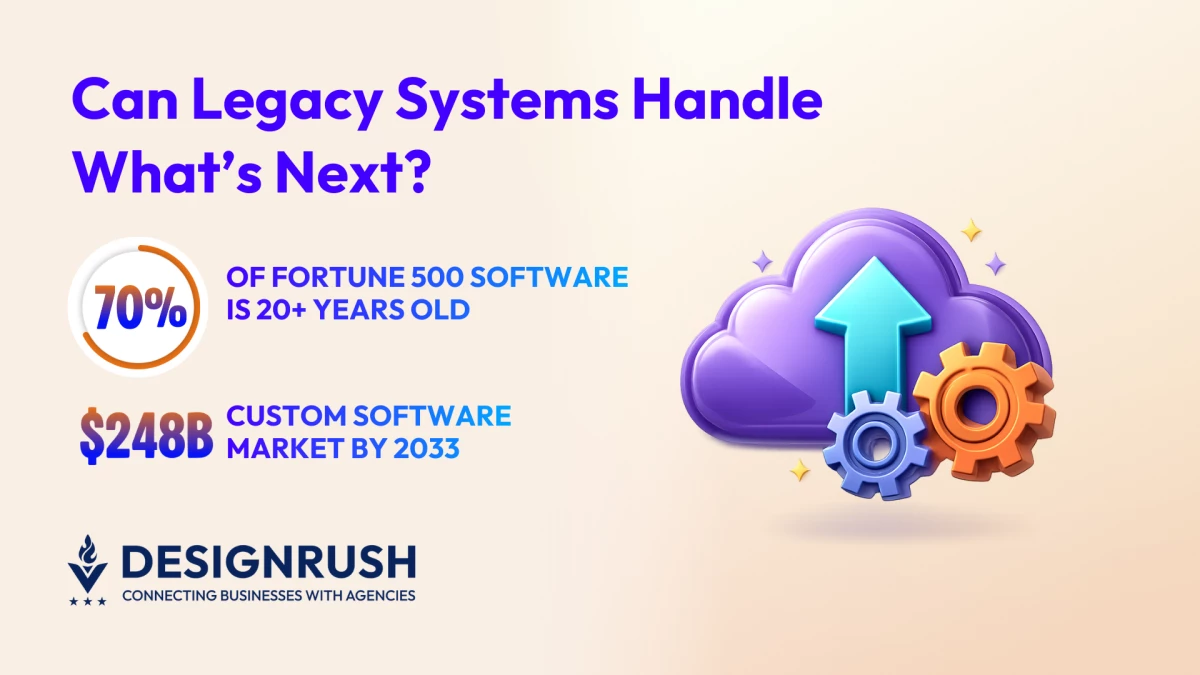

Custom Software Development Market: Key Findings
- The custom software market is expected to climb to 247.7 by 2033, as large organizations move away from legacy systems.
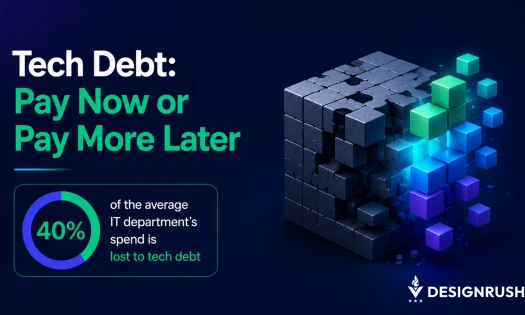
- Nearly 70% of software used by Fortune 500 companies was written more than 20 years ago, making them unfit to handle modern operations.
- Modernization decisions are increasingly tied to operational risk, as enterprises reassess reliability, compliance, and long-term usability.
Enterprise software budgets are changing course.
Instead of continuing to patch and extend legacy platforms, many large organizations are questioning whether these systems still belong at the center of their operations.
Global investment in custom software is projected to reach 247.7 billion by 2033, reflecting how widespread these rebuild decisions have become across large enterprises.
Up to 70% of the software still running inside Fortune 500 companies was built over two decades ago, according to a report by McKinsey.
These systems’ ages become apparent when they're slow to update, hard to connect, and resistant to change.
Full-service technology partner Kanda Software frequently sees this kind of outdated infrastructure when working with enterprise clients, particularly in regulated environments where reliability and security can’t be compromised.
"Many of these platforms still support critical parts of the business, but they weren’t built for how companies operate now," said Clynt Taylor, General Manager of Health Tech and Life Science at Kanda Software.
“Teams end up working around limitations instead of improving how the business functions.”
Over time, workarounds quietly harden into process debt, making even small changes slower and more expensive than leaders expect.
Healthcare as a Modernization Stress Test
Software upgrades were once treated as an IT maintenance issue, often delayed until systems failed outright.
But this mindset has faded, and businesses are now weighing whether their platforms can support growth, meet regulatory expectations, and remain usable as requirements evolve.
Enterprise software continues to account for the largest share of custom software demand, with cloud-based builds leading new projects.
Healthcare shows how quickly legacy software can fall behind real-world needs.
#Healthcare is shifting online fast. Nearly 65% of patients would switch providers for better digital features. Patient expectations are high, and #digitalplatforms are now a core part of how #care is delivered.
— Kanda Software (@KandaSoftware) December 11, 2025
Read more: https://t.co/3Ovtq7U28b#HealthcareTech#DigitalHealthpic.twitter.com/2cOMyFHork
According to Kanda Software, nearly half of adults ages 30 to 44 now use the internet to communicate with a doctor or medical office.
Yet, many providers still rely on systems built around paper workflows and disconnected records.
This gap then creates friction across care delivery, from delayed access to patient information to limited coordination between clinical and administrative teams.
The rapid rise of telehealth during the pandemic only made these shortcomings harder to work around.
#Healthcare organizations must move from manual, error-prone processes to #scalable tools like #robotic process automation (#RPA).
— Kanda Software (@KandaSoftware) December 4, 2025
RPA is streamlining operations at scale, #securely and effectively.
Read more here: https://t.co/88xP0Kzypqpic.twitter.com/hH0wV7gjpP
Kanda Software sees this most clearly in healthcare, where modernization often begins with rebuilding core systems:
- Consolidating patient-facing tools, so scheduling, records access, and communication live in one place.
- Updating backend systems to reduce manual processes and support real-time data flow across teams.
- Improving integration with existing EHR and EMR platforms, limiting duplicate entry and reducing error risk.
- Establishing stable deployment and security practices, allowing systems to evolve without disrupting care delivery.
Rising #cyber threats, mounting costs, and the need for interoperable systems make full #cloud#migration for #hospitals essential to both #patientcare and #financial health.
— Kanda Software (@KandaSoftware) September 18, 2025
Read here: https://t.co/gmt4kYf32M#CloudMigration#HealthTech#KandaSoftware#DigitalTransformationpic.twitter.com/HdJgrZ2HIY
“The questions executives are asking have changed,” Taylor explained.
“They want to know whether their systems will still hold up a few years from now, not just whether they still work today.”
Brands and agencies should treat strain on core systems as an early warning sign, since delays only increase the cost of fixing them later.
What IT Teams Are Running Into
As modernization efforts expand, several realities are becoming harder to avoid:
- Legacy platforms absorb engineering time, pulling teams away from improvement work.
- Distributed environments expose weak points, especially in older systems built for on-premise use.
- Advanced analytics require cleaner foundations, which many legacy platforms were never designed to support.
These pressures help explain why custom software investment continues to grow, even as technology spending faces closer scrutiny.
When Waiting Becomes the Costliest Option
The scale of investment moving into custom software points to a growing recognition that legacy systems carry hidden costs.
Delays, security exposure, and operational drag tend to surface gradually, then all at once, when systems are pushed beyond what they were designed to handle.
As organizations modernize in phases, the difference often comes down to timing.
Teams that address core platform modernization early retain flexibility as requirements change.
“Waiting usually feels cheaper in the moment.
But once core systems start limiting how teams work, the cost shows up everywhere, from missed opportunities to operational risk,” Taylor shared.
For large enterprises, modernization has become all about maintaining the ability to operate, adapt, and grow without friction as expectations rise.
In other news, Kanda Software recently earned its ISO/IEC certification, one of the highest information security benchmarks to combat cyberattacks.