
Figma Code-to-Canvas: Key Findings
- Design and development are still misaligned, resulting in teams losing intent as work moves from UX to code
- Late validation drives cost and inefficiency, which means issues surface too late when changes are harder and more expensive
- Code-to-canvas workflows close the gap, allowing real-time validation and shared systems to reduce ambiguity early
Figma’s new code-to-canvas workflow aims to close the gap between design intent and production code.
It enables real-time collaboration between designers and engineers.
Even in experienced product teams, designs often lose clarity once they reach development, as edge cases and real-world conditions introduce interpretation.
With its code-to-canvas update, the company is moving toward a model where design is no longer something you hand off.
Instead, it’s something you work through together, in real time, with the code itself.
Figma shows how coded designs from Claude Code are brought directly into the platform:
Editor's Note: This is a sponsored article created in partnership with Shakuro.
This shift, however, isn’t entirely new. Creative app design and development companies like Shakuro have been working in ways that naturally reduce this gap long before tools started catching up.
Shakuro’s CTO, Alex Chaly, explains that in environments where design and engineering sit close together, the idea of a clean handoff rarely holds up.
“It slows progress and leaves too much room for interpretation. So the process becomes more collaborative by necessity, particularly as designers and developers move in parallel and not in sequence.”
Figma’s code-to-canvas approach fits directly into that way of working.
Engineers can bring real interface states into Figma, while designers can immediately respond, adjust, and validate. And instead of waiting for builds or relying on static screens, both sides are working from the same evolving system. This reduces ambiguity early in the process.
“What changes isn’t just speed, but clarity. There is less back and forth, fewer assumptions, and a stronger shared understanding of how a product should behave,” Chaly said.
The video below delves into the Figma code-to-canvas update:
Why Design-Dev Gaps Persist
If you step back, most product issues do not come from a lack of tools, but from losing intent along the way.
Design systems are good at defining structure and visuals, but they often fall short when it comes to real-world behavior. Edge cases, data variability, and interaction states are left open.
Engineers then step in to fill those gaps. But over time, those decisions begin to drift.
That is where things start to feel inconsistent.
What Figma is doing is bringing those unknowns forward. Instead of designing in theory, teams are working with something much closer to reality from the start.
“The goal is to validate decisions in their most real form as early as possible, before assumptions turn into costly rework,” Chaly said.
“Of course, this only works when there is discipline behind it. Without strong systems and clear ownership, speed can just as easily amplify inconsistency.”
Take a look how Figma’s code-to-canvas is set to change the lives of designers forever:
The Cost of Design-Dev Gaps
This disconnect between design and development isn’t just a shared frustration. It shows up in how teams deliver.
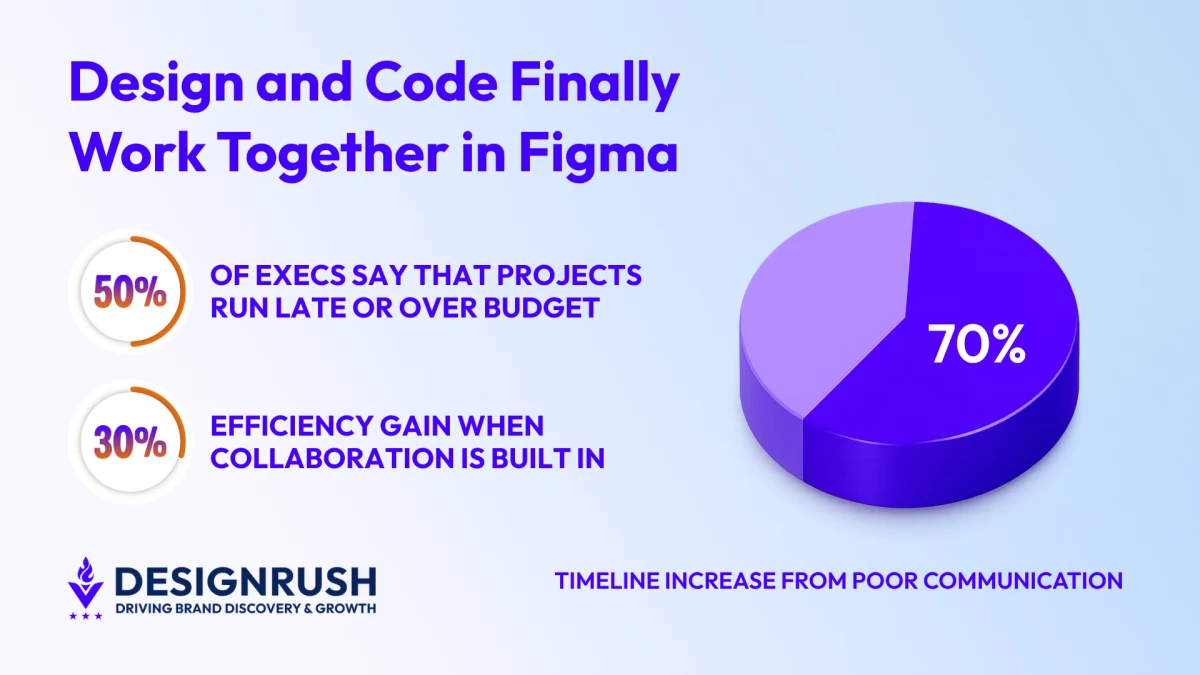
Some estimates suggest poor communication can extend timelines by up to 70%, while scope creep can add as much as 20% in additional costs, cutting directly into efficiency and revenue potential.
That kind of impact at the team level starts to explain a much bigger pattern across organizations.
Research from BCG highlights how common delivery issues still are. Nearly 50% of executives report that more than 30% of their technology development projects run late or go over budget, pointing to persistent gaps in how teams align and execute.
But there is an upside when that alignment improves. McKinsey finds that organizations adopting stronger, team-based ways of working can see efficiency gains of up to 30%, especially when collaboration is built into the process rather than layered on top of it.
That pattern is something product teams are already seeing in practice.
“What this really shows is that most problems are not happening at the end. They start much earlier, when decisions are still unclear,” Chaly said.
“Figma’s model speaks directly to that by shifting validation forward, where changes are easier to make and far less costly.”
From UX to Code, Faster
When you step back, what starts to take shape is a way of working that feels a lot closer to how teams actually think.
It usually begins with rough exploration in design. But instead of staying there too long, things move quickly into real components. From there, teams circle back, test what holds up, adjust what doesn’t, and move forward again.
“It’s not a straight line but a loop. And that loop changes how decisions get made,” Chaly said.
Instead of waiting until the end to find out if something works, teams are constantly checking their ideas against real conditions. This means that users can catch issues earlier, make fewer adjustments, and avoid that last-minute scramble where everything suddenly needs fixing.
The result isn’t just a faster process, but one that's more controlled and more intentional.
Learn how to set up Figma MCP inside Claude to unlock the new code-to-canvas feature in the video below:
Why Systems Drive Consistency
Even with better workflows, one thing does not change. Tools on their own do not create consistency.
The teams that make this work rely on structure behind the scenes. A shared source of truth that both design and engineering trust. The strongest teams also align design systems directly with component libraries, so what gets designed is exactly what gets built.
Here, changes are not reactive. They are deliberate.
This includes clear ownership and no uncontrolled overrides across components, ensuring consistency is maintained as systems scale.
“Without that kind of discipline, even the best workflows can break down,” Chaly said.
“But when it’s in place, alignment stops being something teams chase. It becomes something they can maintain as they grow.”
Take a look at how Figma’s code-to-canvas will change UI development forever:
What This Means for Product Teams
Figma’s update reflects a broader shift in how digital products are being built.
Design tools are becoming more aware of code, and the gap between design and development is narrowing.
Instead of working in stages and validating ideas late, teams are moving closer to real conditions earlier, testing decisions while they are still easy to change and reducing ambiguity before it spreads.
AI and its associated design tools will accelerate this shift, making it easier to explore more options. But speed alone is not what will separate strong teams from the rest.
“The real advantage will come from how well teams can make the right decisions as complexity increases,” Chaly said.
“When design and development move closer together, teams stop working on interpretations and start working on the same thing. Decisions become clearer, trade-offs become visible earlier, and the product takes shape with fewer surprises along the way.”
In that sense, the shift isn’t about speed. It’s about clarity.
And for teams like Shakuro, that clarity is what makes it possible to build products that not only move quickly, but hold together under real-world conditions.
Want to know more about UX and design?
Take a look at our list of the Top UI/UX Design Agencies of 2026.