
In July, Mark Zuckerberg told Meta employees that AI agent development hasn't really accelerated in the way that he had expected.
It was a rare public concession from a company that has bet its next act, and up to $145 billion in 2026 infrastructure spend, on agents being ready.
Most of the commentary since has focused on what it means for Meta, including pressure on the ROI story behind that capex and an opening for Google and Microsoft to claim ground with lower-ambition, faster-shipping agent products.
I'd argue the more useful read is what it means for everyone else, because Meta just supplied the cleanest evidence yet for something enterprise teams have been living with quietly for two years.
The bottleneck was never compute, and it was never really the model. It's execution.
Why AI Investment Alone Can't Solve Enterprise Execution
Meta is, by most measures, as close to a best-case scenario as exists for solving this by force.
Unlimited compute budget. Deep AI research talent. Full control over its own product roadmap, org chart, and timeline. No legacy vendor contracts or client politics to navigate. And it still slipped.
Alongside the delay, Zuckerberg acknowledged that Meta's AI-driven reorganization, including a 10% workforce reduction and roughly 7,000 employees reassigned into AI-related roles, had not gone as smoothly as initially planned.
At the same time, he said that the benefits from the new structure haven't come to fruition yet.
That is the part worth sitting with. This is not a story about a model that underperformed a benchmark.
It's a story about a company that controlled every variable, restructured its own workforce around AI on purpose, and is still finding that the organizational work is harder than the technical work.
Why Agentic AI Projects Stall Before Production
Meta is not unique here. It's just the most visible recent data point.
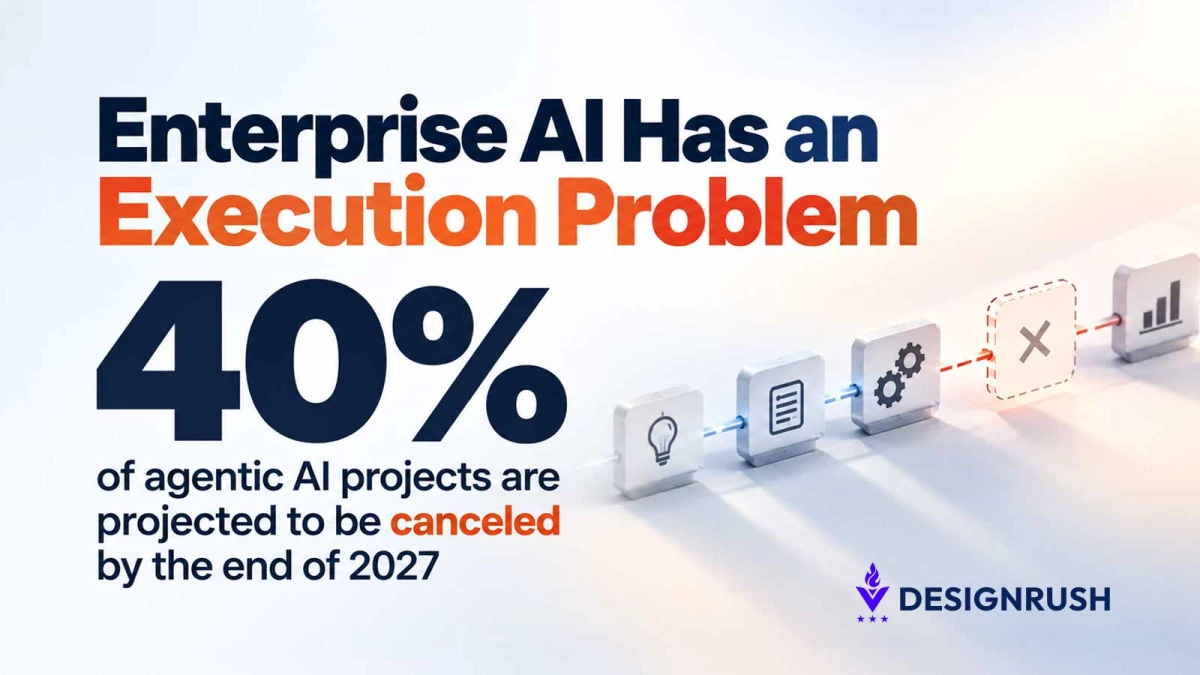
Gartner reported in August that only 10% of organizations had agentic AI in production. Separately, the firm projects that more than 40% of agentic AI projects will be canceled by the end of 2027.
Those figures point to a broader enterprise AI execution problem, even among organizations with access to strong models and significant technical resources.
If the common variable were the model, we'd expect the failure rate to track model quality.
Instead, it tracks how much structural work went into the workflow the agent was dropped into, and whether the organization actually changed how it operates rather than adding a tool on top of how it already did.
How Enterprise Leaders Should Plan AI Agent Deployment
Enterprise leaders shouldn't wait for the vendors to figure this out.
Meta just demonstrated that even a company with none of your constraints hasn't figured it out yet, and is still telling employees to expect benefits in three to six months rather than now.
The more defensible plan is to treat agent deployment as an organizational design problem from the start.
That means deciding which workflow you are redesigning, who owns the transition, what governance sits around the output and how you'll know when an AI pilot is ready to move into production.
And while that is slower to announce and harder to put in a keynote, it is also the only version that has been shown to actually land, with or without Meta's timeline.