
Mark Zuckerberg put a price list on his AI wearables push at Meta Connect on Wednesday, and the cheapest item still has to ship in December.
The Meta CEO used the annual developer conference to unveil the Meta VR Glasses, a slimmer and lighter successor to the company's Quest headsets.
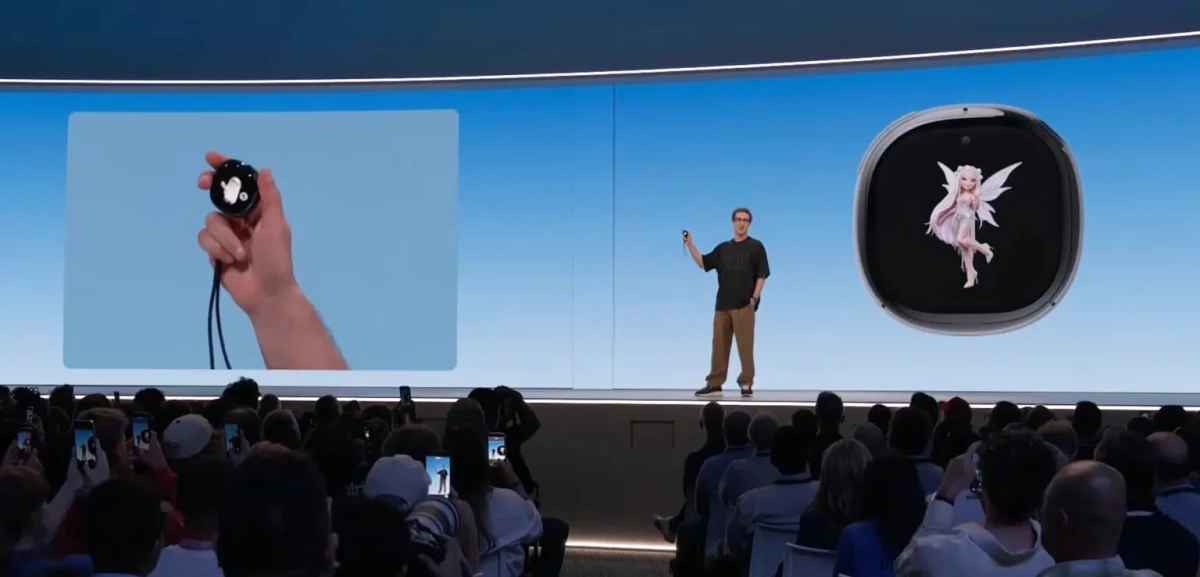
Meta announces Muse Charm, a handheld gadget allowing people to utilize an AI personal agent without their phone, computer or glasses.
— Pop Crave (@PopCrave) September 24, 2026
Available in time for the holidays. pic.twitter.com/pEW0XSzcpJ
In the same conference, he introduced the all-new "Muse Charm," a pendant-sized device that connects to Meta's recently launched Muse personal agent.
Zuckerberg said little about what the charm can do besides letting people talk to their agent "without having to unlock a phone or open an app."
While he also held off on naming a price, he confirmed a target window.
He told the Connect crowd that Meta still needs to "finalize laying out the components" before it ships for the holidays.
"We've packed a lot of technology with this little guy," Zuckerberg said of the charm.
Simply put, he's positioning the Muse Charm as the fastest way to reach Muse when someone doesn't already have a headset on.
Muse launched two weeks before Connect and quickly became the most downloaded app on both the Apple and Android stores in the US.
The app gives users a set of autonomous bots that handle everyday tasks like ordering groceries, booking travel, and organizing finances.
Zuckerberg has called Muse the centerpiece of his wider AI strategy, and Wednesday's hardware announcements give that assistant more ways to reach people throughout the day.
Updating the Eyewear
The VR Glasses arrive next spring at $1,299, Meta's first new headset since the $299 Quest 3S in 2024.
Weight and price moved in opposite directions this time.
An external puck houses the Qualcomm processor and battery, trimming the glasses down while eye- and hand-tracking sensors cut the need for controllers.
Muse Charm, meanwhile, is built around a fingerprint sensor and a small screen showing the Muse avatar, with real-time voice interaction as its main pitch.
Zuckerberg also pushed Muse to Meta's camera-free Ray-Bans and added hologram-based avatars for video calls.
This lets wearers appear on-screen even though the glasses can't film their own face.
The rollout follows a rough stretch for Meta's AI ambitions, but investors reacted well.
The stock has added roughly $300 billion in market capitalization since Muse launched on September 8, per the Financial Times.
This happened even as the company still has to patch security gaps in the agent and work around platforms like Amazon that have blocked it outright.
What the Smart Glasses Numbers Show
Meta's timing lines up with a shipment curve.
Display-less smart glasses shipped 2.25 million units in Q1 2026 alone.
This nearly matches the number the entire category sold across all of 2024, with Meta holding 69.2% of that market, according to IDC's Worldwide Wearable Device Tracker.
Standalone VR headsets are moving the opposite way, on pace to fall from around 200,000 units shipped in 2025 to fewer than 50,000 this year, per IDC figures reported by Computerworld.
Consumer trust hasn't kept pace with the shipment numbers.
Reviews.org's 2026 Consumer Trust Survey found 63 to 65% of Americans don't trust their AI assistants.
Concern levels were bunched within a couple of points of each other across Alexa, Gemini, ChatGPT, and Siri.
Three lessons apply beyond this launch:
- Read the shipment data before the roadmap: glasses are growing while headsets shrink, so hardware should follow where the category is already moving.
- Treat trust as a launch metric: rolling out an always-listening device into a market where two-thirds of people distrust AI assistants means the messaging has to address that gap directly.
- Give the agent a body people accept: While charms are on the rage, the Muse Charm will only work if a pendant feels more natural to talk to than a phone.
All in all, Meta is selling hardware into a category that's growing fast, while the agent riding inside it still has to earn the room.
Our Take: Can a Charm Win the Skeptist?
A device that sits against your skin is a different kind of purchase than an app on a home screen.
Muse Charm asks someone to wear a microphone on a keychain and trust that it only listens on cue.
That's gonna take a lot of convincing for the skeptical consumer who'd rather click install.
The market has already priced in the shipment curve, but the number that's harder to move is how someone feels wearing this next to a stranger at a coffee shop.
Meta just made a tiny AI device called Charm… but why would I carry this instead of my phone?
by u/Impossible_Truth_629 in artificial
Brands pursuing wearable AI should test the reaction to being seen with the device, because a product people are embarrassed to wear in public never clears the shelf.
We're less curious about how well Muse performs and more curious about whether the person wearing the charm can talk to it comfortably, trust it, and be okay being seen talking to it.
These leading AI companies help brands decide whether to open their storefronts to shopping agents.