
Every AI pilot I've seen succeed shares the same dangerous quality.
The pilot looks finished. The demo works. The stakeholders nod. Someone says "rollout" for the first time.
And at that exact moment, most organizations stop asking hard questions and start asking how fast they can scale this.
But that's the wrong question to ask as a pilot only answers one thing. Can this work?
It does not answer who owns it when it breaks, what happens when the data shifts, or who is still reviewing the outputs in month nine, when the novelty is gone and the person who built it has moved to another project.
The data backs up how often this goes wrong, with MIT's NANDA initiative finding that roughly 95% of generative AI pilots at companies fail to deliver measurable P&L impact.
Gartner has separately estimated that at least 30% of generative AI projects get abandoned after proof of concept by the end of 2025, citing poor data quality, weak risk controls, and unclear business value.
What is really behind this are operational failures, and they're predictable enough that they shouldn't be discovered, but planned for in advance.
Where AI Pilots Start to Break Down
Months one through three are calm.
Scope is narrow. The original team is still around. Everyone treats the system with healthy suspicion, which is exactly what keeps it reliable.
Months four through six are when things start to turn.
Someone asks to extend the pilot to a second use case, then a third. The person who built it is now supporting three systems instead of one, without three times the support. Quality then slowly drifts in ways nobody notices until a customer or a downstream team does.
By month nine, the system is load-bearing.
People have built workflows around it. It's still being run with pilot-era discipline, no formal ownership, no monitoring cadence, and no plan for what happens when the model or the underlying data changes.
By month twelve, one of two things has happened.
Either the organization has done the unglamorous work of turning the pilot into infrastructure, or the system is being quietly propped up by two or three people who've learned not to touch it too hard.
I'd rather see leaders choose the first path on purpose.
How to Scale an AI Pilot Into Production
1. Name an Owner Before You Scale, Not After
While a pilot can survive informal ownership, production cannot.
The single most reliable predictor I've seen of whether an AI system is still healthy at month twelve is whether someone's job description changed to include it.
2. Build the Monitoring You Skipped During the Pilot
Pilots get judged by demo performance. Production systems get judged by the worst day of the month, when a malformed input gets through, an edge case appears, or the source data suddenly changes shape.
If you don't know what "degraded" looks like for your system, a customer will tell you before your dashboard does.
3. Write Down What the Pilot Team Knew by Instinct
The team that built the pilot carries tacit knowledge, including which inputs break it, which outputs need a second look, which shortcuts were taken under deadline pressure.
That knowledge has to leave people's heads and land in documentation before those people move on. This is the item most often skipped, and the one that costs the most when it's missing.
4. Budget for the Second Version, Not Just the First
The version that impressed everyone in the pilot is rarely the version that survives real usage volume and real data variance.
Treat month twelve as a planned rebuild checkpoint, not a failure signal.
What Successful AI Deployment Looks Like in Practice
I'll give you the numbers instead of the theory.
A modernization project we ran for a healthcare client didn't stop at the pilot.
Twelve months in, it had produced 23% lead growth and doubled the number of active users on the prescription-management platform, because someone owned the system past launch day instead of treating launch day as the finish line.
An offline-first field application we built for an agtech operation hit 3x faster task completion in production, with more than 5,000 field downloads, because the team planned for the unreliable-connectivity edge case before it became a support ticket, not after.
And in fintech, a global wallet rollout went from kickoff to live in three months, which only happens when the ownership and monitoring questions get answered on day one instead of month nine.
These projects succeeded because ownership, monitoring, and support were planned into the months that followed launch.
In each case, the organization treated the twelve months after launch as the actual project, not the victory lap.
Why AI Pilots Stall After Proof of Concept
After thirteen years of shipping software into production, AI or otherwise, I've come to a simple conclusion.
Getting a model to produce a useful answer is only part of the challenge. Keeping that system reliable in production is where the harder operational work begins.
Over time, data changes, teams change, and priorities change with them. Managing those conditions requires ownership and oversight that a better model alone cannot provide.
Stack Overflow’s 2025 Developer Survey found that around 69% of AI agent users report a personal productivity increase, but only 17% say those tools improved how their team collaborates, the lowest-rated impact in the survey by a wide margin.
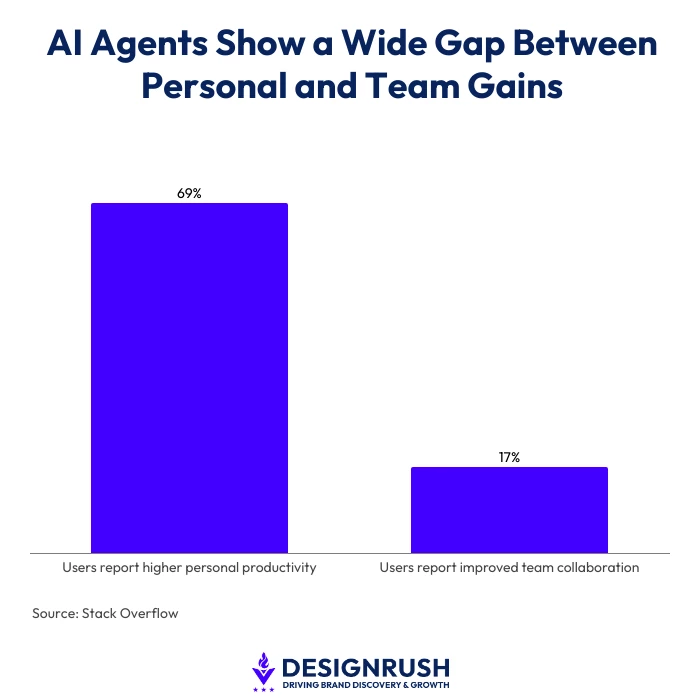
That gap becomes especially visible in the twelve months after a pilot succeeds.
If you're three months into a successful pilot right now, the question worth asking isn't "Should we scale this?" It's "Who is going to still be answering for this system in month nine, and do they know it yet?"
That's the conversation that decides whether you're looking at infrastructure, or a demo that's still running on borrowed time.