
Should brands shift their search strategy away from Google and toward platforms such as ChatGPT, Gemini, and Perplexity?
The latest data suggests that may be the wrong approach.
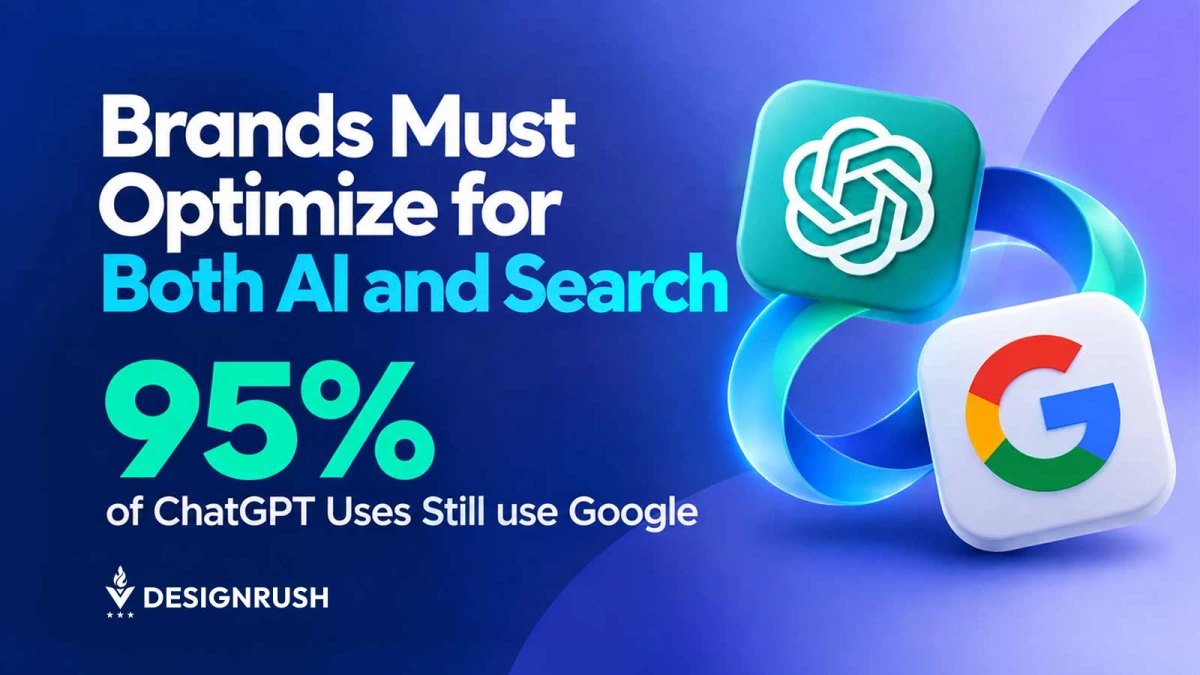
About 95% of ChatGPT users still used Google when searching, according to a Search Engine Journal study based on SimilarWeb data.
That figure has remained steady from September 2025 through May 2026, despite visits to genAI platforms growing 70% year over year.
The data suggests a significant overlap, and points to the fact that AI search is being added to people's search habits instead of replacing traditional search.
This may come as a surprise to many who have been following the AI search news cycle. After all, the Internet is filled with stories about how “AI search is killing Search and SEO.”
But for experts like Visuable, an award-winning Squarespace web design and SEO agency, this reflects a more complex search journey.
“The customer journey is becoming much less linear. People move between Google, AI platforms, websites, reviews and social media as they research and make decisions,” Visuable Founder Lidia Drzewiecka says.
“That makes optimizing for one environment at the expense of another a risky strategy. That’s why the real opportunity is to build a digital presence that can be discovered and trusted wherever that journey starts.”
Search Is A Connected Journey
People rarely have a single reason for conducting a search.
If someone is looking for a cafe to check opening hours or to find a particular product or service, traditional search often makes the most sense.
On the other hand, if someone is trying to find answers to a more complex question with the potential for multiple follow-up questions, using AI search would be more efficient.
But this doesn’t mean that both forms of search have a “one or the other” relationship. In fact, it’s quite common for people to use both.
For example, someone might ask ChatGPT, “What’s the best website platform for a service-based business that wants good SEO and an easy-to-manage website?”
They might then use that answer to create a shortlist, then move to Google to research the individual companies, read reviews, and visit their websites.
In some cases, the opposite is true. Someone might start on Google, realize there’s a lot of information to digest, and then turn to AI to help them make sense of it.
All this means is that visibility needs to survive the points where platforms hand off users to each other.
As such, the goal is less about choosing a winner between Google and AI search and more about making sure the brand can be understood in both environments.
Build The SEO Foundation Before Adding AI Search Tactics
The conversation around AEO and GEO has created plenty of new terminology, but the technical work underneath both is the same: good SEO.
In fact, even Google has said AEO/GEO is “still SEO.”
“It’s more helpful to think of AEO and GEO as an evolution of SEO, rather than a replacement,” Visuable SEO Specialist Stefania Grosso adds.
“AEO and GEO introduced new opportunities, yet many of the foundations that help a website perform well in Google also help AI platforms understand and trust it.”
So before worrying about how brands might appear in an AI-generated answer, their marketing teams should make sure search engines can find, understand, and evaluate the website in the first place.
That means getting several fundamentals right.
1. Make the website easy to crawl
Important pages need to be accessible to search engines and organized in a way that makes their purpose clear. That includes:
- Logical site architecture
- Crawlable pages
- Mobile optimization
- Appropriate metadata
- Clear heading structures
- Internal linking
- Optimized metadata
- and more
Visuable’s work for Los Mochis restaurant offers a great roadmap for brands to follow.
 When Los Mochis approached Visuable, they only had a single-page website with no SEO strategy in place. As such, the website did not have the chance to rank well on search engines.
Visuable delivered a comprehensive SEO strategy designed to drive qualified organic traffic.
The work included keyword research, a structured on-page SEO strategy, metadata optimization, mobile optimization, clearer navigation, technical SEO setup, and service-page content.
The result of this strategy was a 19.7% increase in visits, 68.9% increase in page views, a 44.8% increase in website clicks, and a 17.9% increase in search traffic.
The new Los Mochis website also won a Web Excellence Award.
Another great example of this is Visuable’s work for AlSawwaf Law, a law firm offering a full range of legal and advisory services.
Visuable reworked AlSawwaf Law’s entire international SEO strategy to scale brand presence in key target territories following a major rebrand.
By combining localized keyword research with targeted metadata optimization and geo-targeted site structures, Visuable was able to strengthen search relevance across diverse regional algorithms.
This drove measurable visibility gains in both domestic and international markets.
2. Give important pages a clear purpose
A page should tell both people and search systems what it’s about.
A generic page titled "Services" leaves a great deal unsaid.
But a dedicated page for "Brand Identity Design Services" can explain what the service involves, who needs it, what the process looks like, what outcomes clients can expect, and which questions commonly arise before purchase.
That additional context gives search systems more information to work with while giving potential customers a more useful resource.
3. Strengthen authority beyond the website
A company's website is only one source of information about the business. This is why brands should engage in “off-page SEO.”
Reviews, reputable directories, media coverage, backlinks, industry profiles, case studies, and other third-party references can all contribute to how a company is understood online.
This is also vital for AI search because a generated answer draws information from several sources rather than relying exclusively on a company's own website.
Give AI Systems More To Understand
Once the basic SEO infrastructure is working, brands can consider the additional signals that may help AI systems understand their content and business.
Structured data can provide useful context about entities, products, services, organizations, and other information on a website.
It should not, however, be treated as a shortcut to AI visibility.
Google's current guidance specifically says there is no special schema markup required for its generative AI search features, while still recommending structured data as part of an overall SEO strategy where it can support search features.
Visuable’s work for Raccoon London, a photography agency, offers a clear example of combining those elements.

Visuable led a comprehensive SEO and AI Optimization strategy for 75 core pages, successfully preserving and enhancing search visibility. The approach combined:
- Structured schema markup
- Content auditing
- Precise keyword mapping
- Metadata refinement
- Site structure updates
- Advanced GEO
This approach maximized discoverability across both traditional search engines and AI models, while building clear proofs of authority and credibility through an extensive portfolio of client case studies and photographers' bios.
As such, Raccoon London saw a 59.57% increase in site visits, a 54.55% increase in page views, and an 80% increase in unique visitors.
Avoid The Content Trap
The easiest mistake for brands trying to optimize for Google and AI search is creating more content simply for the sake of creating content.
After all, traditional SEO relied on a steady stream of fresh content to help improve rankings.
And now, AI tools have made it relatively easy to produce dozens of articles answering common industry questions.
But that mindset only creates the appearance of an active content strategy.
Furthermore, if your article simply repeats information that already exists across hundreds of websites, this gives search engines and AI platforms very little reason to prioritize your version.
Google's 2026 AI search guidance places particular emphasis on what it calls "non-commodity content."
Its example contrasts generic advice with content that provides specific, original insight based on actual experience.
So how should brands approach content creation?
“Create content that adds something genuinely useful to the conversation. That could be your own research, customer insights, original data, first-hand experience, case studies or a strong expert perspective,” Drzewiecka says.
Make Search Work Wherever Customers Look
Search will keep changing, but brands can’t afford to rebuild their strategy every time a new platform gains attention.
This is why the smarter strategy would be to invest in digital foundations that remain useful regardless of where the query begins.
In this case, that means treating search visibility as part of the customer journey rather than a competition between platforms.
After all, customers will always reward brands that make finding good answers easy.