
Ask most executives to describe their company's AI strategy, and they'll describe something you can see. A chatbot. A copilot. A feature with a sparkle icon next to it in the product.
Ask their operations teams what actually changed how the company works this year, and you'll often get a different answer entirely.
Some may say a search tool, a data pipeline, or an internal workflow that nobody outside the company will ever see.
After a decade of experience, I've watched this gap play out enough times to stop treating it as a coincidence.
The AI investments that move a company's actual economics tend to be the ones with the least PR value.
The ones built to be seen tend to get judged by a much softer standard than the ones built to be used.
Why Visible AI Use Cases Get Funded First
It's not hard to see why the visible use case gets funded first.
A customer-facing feature has a natural audience, a natural narrative, and a natural line item for the board deck.
An internal tool that helps a dozen people search across a hundred systems has none of that.
It doesn't get a demo day. It gets a support ticket that used to take four hours and now takes forty minutes, multiplied by however many people hit that same wall every week.
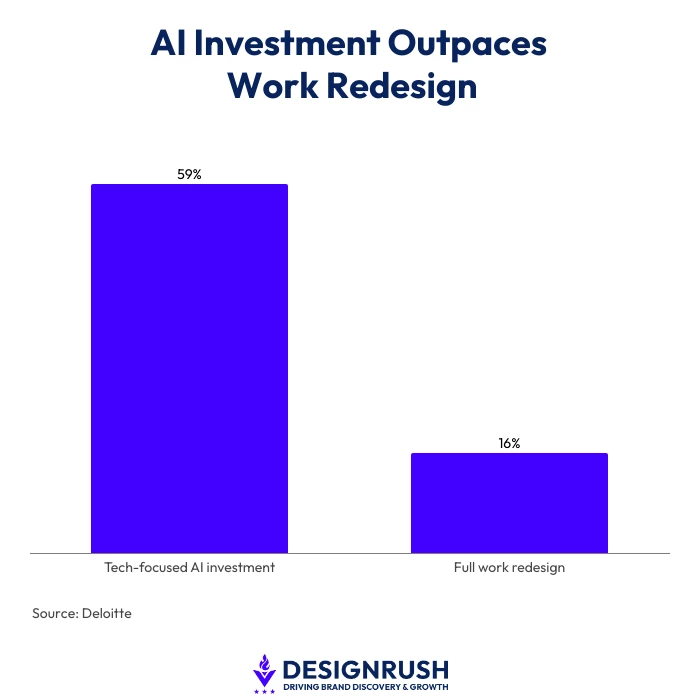
Deloitte found the same pattern at a larger scale, where 59% of organizations have taken a tech-focused approach to AI investment, while only 16% have fully redesigned the work around it.
The math on the second kind of use case is almost always better, and the market data backs that up directly.
MIT's NANDA initiative found that more than half of generative AI budgets are devoted to sales and marketing tools, while the biggest measurable ROI shows up in back-office automation.
The report's own case studies put a number on it, where organizations that got this right saw $2 million to $10 million in annual savings by replacing outsourced support and document review with AI, and cut external agency spending by roughly 30%.
The pattern holds regardless of industry, where budgets chase visibility, but returns concentrate in the parts of the business nobody puts in a slide deck.
The visible use case has to justify itself with a story. The invisible one justifies itself with a spreadsheet. Most organizations still fund the story first.
Where Less Visible AI Use Cases Deliver ROI
In our work at Cheesecake Labs, the projects that end up mattering most a year later rarely started as the headline initiative.
How Enterprise AI Search Cuts Time Lost Finding Information
A peer-reviewed workforce study found that a large share of employees spend anywhere from half a workday to a full extra day each week just searching for the information they need to do their jobs
That's a meaningful chunk of the work week spent finding things rather than using them.
We built a zero-ETL AI search layer across more than 100 enterprise systems for one client, and it now saves teams up to 80% of the time they used to spend hunting for information that already existed somewhere in the company.
Nobody had put a number on that cost before we measured it. Once it's measured, it's often one of the largest recoverable costs in the business, and the fix is unglamorous by design.
How Offline AI Tools Improve Field Operations
Field and offline tools that only get noticed when they fail. The best compliment a field application ever gets is silence.
We built an offline-first field app for an agtech operation that hit 3x faster task completion and more than 5,000 downloads among field teams working with unreliable connectivity.
It never made a keynote slide. It made the weekly job faster for every person using it, which is a different kind of win than the one that gets applause.
Embedded AI Agents in Regulated Products
For a healthcare-adjacent platform, embedding AI chat and agent capability inside the existing product, under SOC 2, HIPAA, and GDPR constraints, drove 23% lead growth and doubled active users, without the product ever being marketed as "an AI product."
Here, the AI was the infrastructure, not a headline.
Why Data and Legacy Modernization Matter for AI
This is the least visible category of all, and the most consequential.
But an AI feature is only as good as the data behind it, and in most established companies, that data sits in systems nobody wants to touch.
The unglamorous work of modernizing that foundation doesn't produce a demo. It produces every AI initiative that comes after it.
How Leaders Should Prioritize AI Use Cases
None of this argues against building visible AI products, especially since customer-facing AI has real value, and there are good reasons to invest in it.
What I'm arguing against is using visibility as a proxy for value, because I've watched that shortcut misallocate a lot of good engineering time and the data on where AI budgets actually go, versus where the returns actually show up.
The discipline I'd recommend instead is simple, and unglamorous.
Before greenlighting the next AI initiative, ask where the actual hours are going today.
Not where the interesting problems are, but where the boring, repeated, measurable hours are going.
That's usually where the real return is sitting, waiting for someone to notice it wasn't glamorous enough to get funded first.
The companies I've seen get the most out of AI over a multi-year horizon aren't the ones with the best demo.
They're the ones willing to fund the invisible thirteenth use case on the list, the one nobody would put in a press release, because they'd already learned the spreadsheet doesn't lie the way the story sometimes does.
That's where I'd tell any leader to look first.