
Key Takeaways:
- Only 3% of the internet is accessible to people with disabilities, showing how much work is left to do.
- Infinum’s focus on accessibility led to major improvements, like making their website one of the easiest for screen readers.
- Making digital accessibility a business priority leads to better user experience and long-term growth.
Despite all the talk, most websites still aren’t accessible. WebAIM found that 94.8% of home pages have barriers that block people with disabilities.
Meanwhile, Forrester reports that 62% of North American, 55% of European, and 63% of Asia Pacific organizations claim to have top-down commitment to accessibility.
Digital accessibility is still treated as a checkbox, not a business priority.
Ana Šekerija, product owner and leader of the accessibility initiative at Infinum, explains why it's often overlooked and how businesses can make it a priority.
Editor’s note: This is a sponsored article created in partnership with Infinum.

Who Is Ana Šekerija?
Ana Šekerija has been with Infinum for seven years, starting in QA before transitioning into a Product Owner role. Over that time, she has driven the company’s accessibility efforts, particularly over the past three and a half years, overseeing more than 40 projects, organizing workshops, and developing accessibility handbooks. In 2024, Ana earned the IAAP CPACC certification, becoming one of only three people in Croatia to hold it. Outside of work, she’s learning sign language to further support inclusivity.
Ana’s passion for accessibility didn’t start in a boardroom. It began in everyday life, watching people close to her struggle online. Then, as a QA tester, she watched a screen-reader user fumble through a mobile app and fail to complete a task.
“It was the first time I saw, first-hand, how easily people can be excluded even when we think a product ‘works’. That moment changed the way I see my role in tech,” she tells me.
A few small tweaks later, that same user called Infinum’s website “one of the easiest” they’d ever used, showing how minor changes can have a major impact on user experience and user retention.
But this exercise was encouraging and uncomfortable, because it reminded Ana just how low the bar still is for accessible digital experiences.
Infinum’s leadership approved company-wide workshops and process updates shortly after, and the European Accessibility Act proved that accessibility is a business requirement, validating Ana’s efforts.
Where Most Businesses Stumble
According to Ana, most businesses don’t know where to start when it comes to designing digitally inclusive products.
Myths and misinformation also complicate the issue.
“There’s often a lack of internal education, and a lot of myths around accessibility still persist — like the idea that it’s only for blind users, or that it’s too expensive or time-consuming,” she says.
“For mobile native apps, teams often aren’t familiar enough with platform-specific accessibility guidelines.”
Web Content Accessibility Guidelines (WCAG) can seem overwhelming at first, and she notes that companies are often targeted by vendors selling overlay tools as quick fixes that don’t really fix anything.
Have you ever considered the impact of software #accessibility? It's not just a niche concern. 1.3 billion people, or 16% of the world's population, encounter some form of disability, and our next Infinum Talks will tackle the topic of building inclusive products. pic.twitter.com/J1BKtBi0th
— Infinum (@infinum) November 28, 2023
When this happens, teams fall into the trap of either aiming for superficial compliance or giving up entirely.
For established products, Ana recommends agencies follow these steps with support from an accessibility expert:
- Audit the current experience: Identify what’s already accessible and pinpoint the biggest blockers.
- Remediate immediately: Tackle those barriers straight away, either hands-on or by coaching the team.
- Embed new processes: Update workflows so the same issues don’t recur.
- Train every role: Run focused workshops for design, dev, QA, and product teams to build shared ownership.
- Ensure long-term adoption: Integrate simple, repeatable accessibility checks into daily routines, not just one-off fixes.
For new products, she believes agencies should include accessibility from day one by defining clear requirements, conducting inclusive design reviews, and adopting an accessible-first workflow.
Chasing Perfection vs. Prioritizing People
“Perfect accessibility doesn’t exist,” Ana notes.
This pragmatic view is a stark contrast to many businesses that obsess over compliance scores or rigid WCAG checklists.
According to Ana, that pressure often leads to two things: turning to overlay tools that promise quick fixes, or giving up entirely because the goal feels too big or unclear.
Instead, Ana recommends starting with the biggest barriers and improving gradually. It’s not about rules; it’s about people.
“That’s why it’s important to treat the guidelines as just that — guidance, not a checklist for perfection. Instead of focusing exclusively on the guidelines, start with the biggest barriers, improve the issues step by step, and stay focused on real users, not just the rules,” she adds.
One of Ana’s proudest projects involved a mobile app for controlling home appliances. Many of the physical devices weren’t accessible, but the app changed that.
“Many of these appliances have non-accessible displays, but by making the mobile interface accessible, we gave users with disabilities a way to independently operate devices they otherwise couldn’t use on their own,” she explains.
The process started with a comprehensive audit and continued with embedding accessibility into every part of the workflow: product, design, development, and QA. Feedback was overwhelmingly positive, but more importantly, the changes stuck.
“The goal was to make the app better with every release — not just one big push,” Ana says.
Real Accessibility Goes Beyond Just Compliance
Ana is clear-eyed about the limits of traditional metrics, saying that it can be a slippery slope.
“It often leads to chasing compliance instead of focusing on real users. Automated tools can give you a score, but that number doesn’t mean much on its own,” she explains.
Instead, she urges executives to consider:
- User feedback from people with disabilities
- Testing with real assistive tech users
- Internal team maturity around accessibility practices
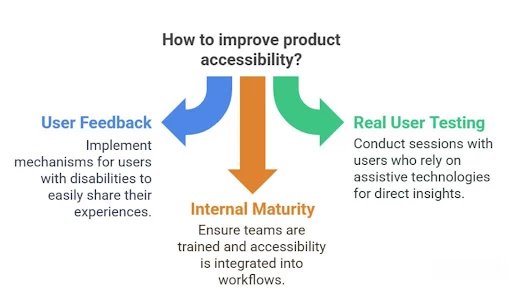
“These things can’t be summed up in a single number, but progress becomes very visible once the right foundations are in place,” she adds.
Infinum has embraced open knowledge sharing, led by Ana’s initiative. It has also hosted panels, workshops, and blog posts, one of which became the company’s most-read article of the year.
“Being a good partner in this space means more than offering audits or fixes. It’s about helping move the conversation forward,” Ana says.
“By sharing what you know, making space for learning, and encouraging others to do the same. Everyone has a role to play.”
Mobile has long been overlooked due to WCAG’s web focus. Because of this, Ana’s team has translated those guidelines into native-app workflows and now tests with real assistive technologies — screen readers, switch control, voice access, and more — where the true issues lie.
The Future of Accessibility Is Inevitable
As Ana notes, accessibility isn’t going anywhere. It’s here for the long run as an integrated approach to building digital products.
Now that accessibility is here to stay, industry leaders need to focus on how to push digital inclusion even further by asking:
- How will a blind person understand the information displayed?
- Will this flow feel overwhelming to a neurodivergent user?
- Can someone with limited dexterity complete the task?
“A client recently made a great comparison: he said accessibility today reminds him of the early days of responsive design. At first, teams were overwhelmed, didn’t know where to start, and saw it as extra work.
But over time, responsive design became standard — we now consider it in every step of product development without even thinking about it. Because people wanted to use the web on their phones, and as an industry, we adapted,” Ana says.
Her playbook — workshops, open-source guides, and baked-in workflows — turns accessibility into an ongoing commitment.
Listen to users. Educate teams. Build sustainably. And above all, understand that accessibility isn’t about perfection. It’s about people.