
There's no denying that AI has made building software dramatically easier, especially for non-technical founders.
However, that ease of entry has also made staying ahead of competitors much harder.
That reality sits at the heart of "The Moat Report: How SaaS Founders Are Building Defensibility in 2026," a new field report from Designli based on a survey of 100 SaaS founders and operators.
Rather than examining how companies are using AI, the report asks a more consequential question:
How are founders building businesses that remain difficult to displace when AI has lowered the barriers to creating software in the first place?
According to the report, many founders believe establishing a true competitive advantage now lies in building structural advantages that grow stronger with time, rather than releasing features at a faster pace.
Build a Moat That Goes Beyond Features
AI has changed the economics of software development by allowing founders to build products more efficiently, while also allowing competitors to imitate successful ideas with unprecedented speed.
"This is why getting a product to market is no longer the final hurdle to clear. Now, founders need to find ways to retain the value of their software after everyone else arrives," says Designli CEO Keith Shields.
And while Shields admits that technical innovation is still important, it is not the "be all, end all" it once was.
Designli's findings suggest that defensibility increasingly depends on multiple layers working together rather than a single technological breakthrough:
1. Technical moat
Technical differentiation remains the most visible form of competitive advantage, but it has also become the most difficult to sustain.
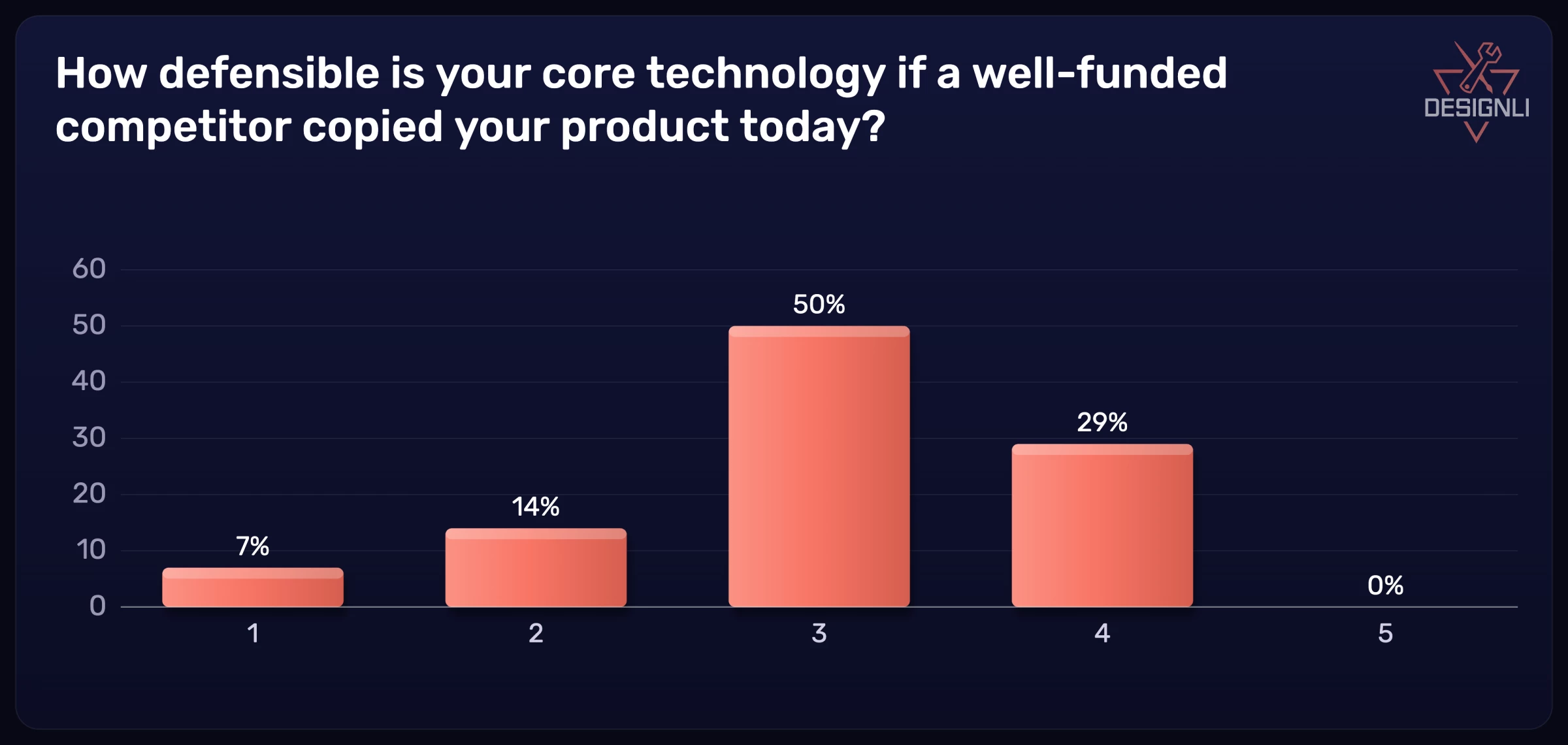
This is clearly seen in the report's survey responses. According to the report, 71.4% of founders said they are continuously shipping new products or features to widen their technical moat.
However, not a single respondent rated their technical defensibility a perfect five out of five, while only half rated themselves a three out of five.
Founders clearly recognize that continuous product development remains necessary.
At the same time, they also understand that releasing features alone does not create lasting protection.
"Technical investments begin creating real separation only when they compound over time by increasing switching costs, accumulating proprietary knowledge, or making the underlying architecture progressively harder to duplicate," Shields adds.
2. Data moat
If technical advantages can be replicated relatively quickly, proprietary data follows a different timeline.
Unlike software features, valuable datasets cannot simply be recreated through engineering effort.
They develop gradually through customer usage, historical context, and repeated interactions that competitors cannot manufacture overnight.
The survey found encouraging signs that founders understand this distinction.
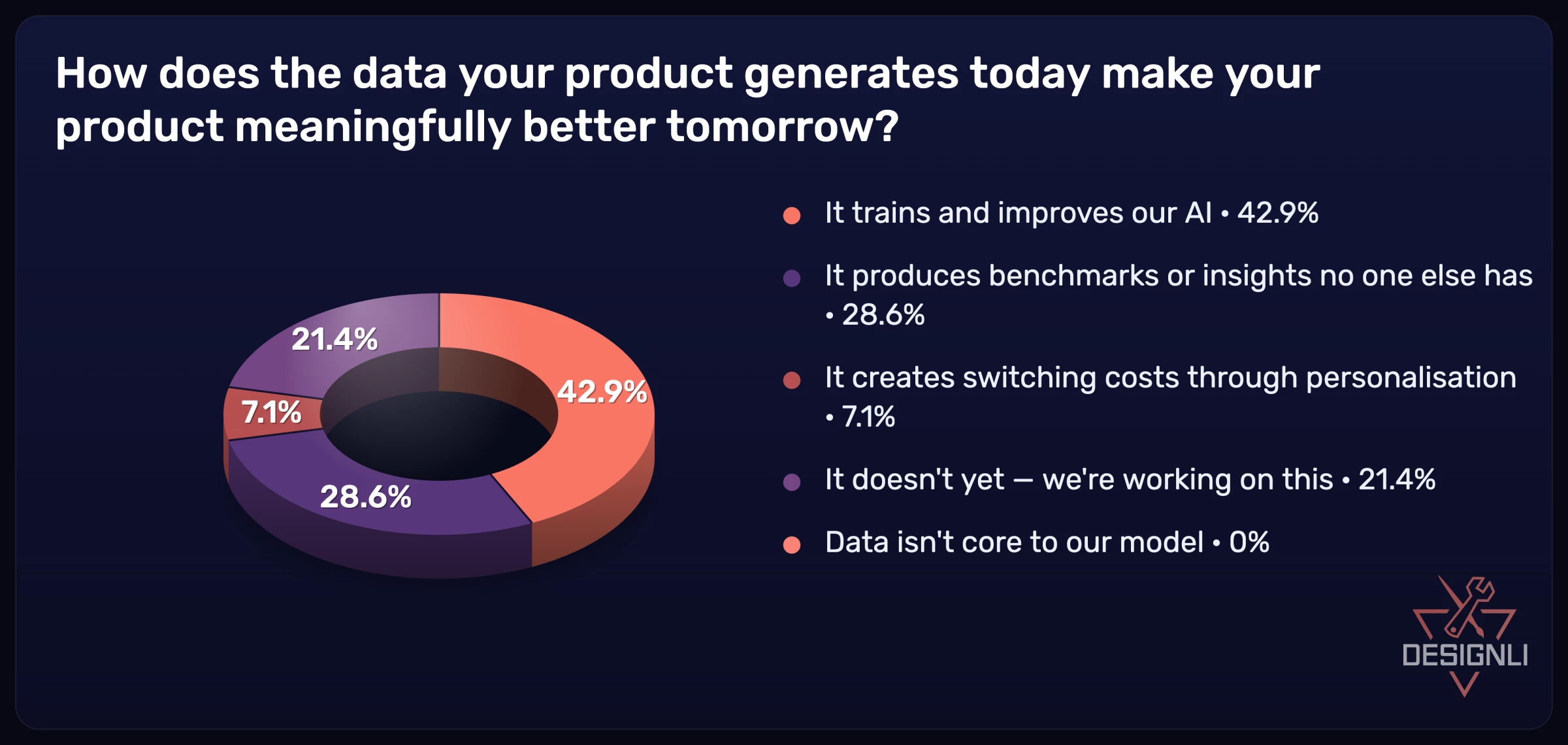
Nearly 42.9% of respondents said customer data is actively improving their AI systems, while 28.6% of respondents reported generating unique benchmarks and insights unavailable elsewhere.
But the report also found a gap, citing that 57.1% of respondentshave only accumulated less than 12 months of proprietary data.
Shields says this distinction matters. After all, collecting data isn't the same as building a data moat.
"The competitive advantage only emerges when information becomes increasingly specific to a company's customers, workflows, and operating history," he says.
That's why founders with the clearest data strategies could describe exactly what data they were collecting, who generated it, and why it would become more valuable over time.
Meanwhile, those with vague answers often revealed that data collection had become an accidental byproduct of operating the business instead of a deliberate strategic decision.
3. Service and retention moat
Not every competitive advantage lives inside the product.
The report argues that customer relationships have become increasingly important as feature parity accelerates.
For example, service quality, onboarding, workflow integration, and domain expertise all make a product harder to replace because they become embedded in how customers operate each day.
Respondents described several ways AI strengthens this type of moat.
Some focused on automating repetitive work. Others emphasized surfacing insights or reducing the time it takes customers to realize value.
But what's interesting is that no single approach dominated, reinforcing the idea that AI itself is not the differentiator.
Instead, the real advantage lies in solving a specific customer problem better than anyone else.
Additionally, the report also exposed that 21.4% of respondents said they don't conduct exit interviews at all and genuinely don't know why customers leave.
This is a problem since improving retention becomes a near-impossible task if founders don't understand why users churn.
"Long-term relationships rarely develop by accident. They require organizations to understand not only why customers buy, but also why they stay," Shields says.
4. Distribution moat
Distribution determines whether customers discover a business in the first place, and the report suggests this may become one of the most durable competitive advantages available to SaaS companies.
Traditional search, community building, strategic partnerships, owned audiences, and emerging AI search platforms all contribute to how companies reach potential customers.
And while products can often be reverse-engineered, trusted distribution channels usually take years to establish.
Simply put, the strongest distribution strategies reduce dependence on any single platform while steadily expanding channels that the business itself controls.
Design Defensibility Instead of Reacting to Competition
Perhaps the most revealing conclusion in The Moat Report has little to do with any individual statistic. It lies in the pattern that emerges when its findings are viewed together.
Many SaaS founders are investing in the right areas, particularly across technical architecture, proprietary data, customer retention, and distribution.
But they often lack a deliberate plan that connects those investments into a single competitive strategy.
In other words, founders are building moats, but the process is done more as a reaction to the market's movement and their competitors rather than intentionally designed.
"When product development responds primarily to competitors, market trends, or customer pressure, businesses risk creating isolated improvements instead of a system that becomes stronger with every release," Shields says.
As such, Designli encourages founders to reverse that process by defining what they want to protect before deciding what to build next.
This can easily be done by following these steps:
1. Define the structural advantage before building the roadmap
Every startup has limited engineering time, capital, and attention. Those constraints make prioritization just as important as execution.
Rather than asking which features should be released next, founders should first identify the structural advantage they intend to create.
That could mean building proprietary infrastructure, accumulating industry-specific data, embedding deeper into customer workflows, or developing distribution channels competitors cannot easily replicate.
Once that objective becomes clear, roadmap decisions become easier to evaluate because every release either strengthens that advantage or distracts from it.
2. Prioritize assets that compound over time
Features generate excitement. Compounding assets generate resilience.
The report repeatedly distinguishes between the two.
A new capability may attract customers today, but it offers little protection if competitors can reproduce it next quarter.
Proprietary datasets, trusted customer relationships, integrated workflows, and established communities behave differently.
That's why these become more valuable with continued use and more difficult and expensive for competitors to recreate from scratch.
3. Build moats that reinforce one another
A product that generates proprietary data can improve personalization at a faster and more efficient pace.
Better personalization strengthens customer retention. Higher retention creates richer historical data, which further improves the product.
At the same time, satisfied customers contribute testimonials, referrals, and stronger brand recognition that reinforce distribution.
Viewed independently, each advantage appears incremental. But together, these create a flywheel that compounds across the business.
That interconnected thinking is largely absent from reactive product development, where improvements are often made one feature at a time without strengthening the larger system.
4. Treat AI as an accelerator instead of the strategy
The report returns to this point repeatedly because it underpins every other finding.
AI can strengthen a moat when it amplifies assets a company already owns. When used without that foundation, AI becomes another feature competitors can quickly imitate.
That explains why founders should resist measuring success by the number of AI capabilities shipped.
A more useful question is whether those capabilities make the business harder to replace six months or two years from now.
5. Measure every decision against long-term defensibility
Product roadmaps often emphasize customer requests, quarterly objectives, or competitive pressure.
Those priorities matter, but Shields suggests asking one key question before major investments move forward, "Does this decision strengthen the company's moat?"
If the answer is unclear, the initiative may solve an immediate problem without improving the business's long-term position.
Build What Competitors Cannot Easily Replace
Although building software has become more accessible and efficient, building a business that customers remain loyal to is still as difficult as it used to be.
That difference helps explain why conversations about competitive advantage have expanded beyond engineering.
Technical excellence still matters, but so do customer relationships, proprietary knowledge, trusted brands, and distribution systems that continue attracting users regardless of how quickly competitors release similar features.
And as AI continues lowering the cost of software creation, the businesses that pull ahead will not necessarily write more code than everyone else.
Rather, the most successful ones will build advantages that become more valuable with every customer they serve, every workflow they improve, and every decision they make.
Download a complimentary copy of the full Moat Report at Designli.co.