
Tools like GitHub Copilot, Cursor, Claude Code, and Windsurf have changed what writing code means for some teams. Instead of typing every line, developers now describe what they want, and a model drafts it at different scales.
The scale of this shift is real.
At Alphabet's Q2 2026 earnings call, CEO Sundar Pichai described a Chrome engineering team that used AI-driven, model-assisted refactoring to compress a two-year roadmap into three months, a significant push on acceleration.
But here's the part that is often overlooked.
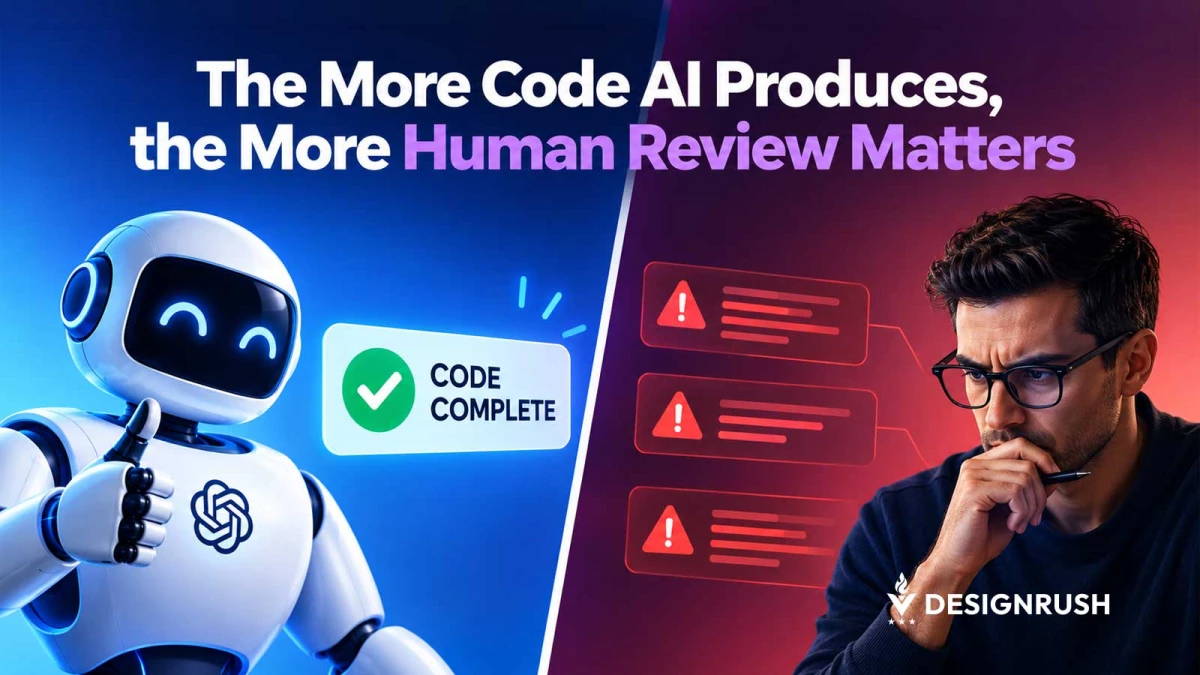
When the fastest code producer on your team is a model, review becomes the front line. It's the one place left where a human looks at what's about to ship and decides whether it's actually right.
There's a myth worth naming directly: the idea that AI-generated code is cleaner and needs less review than human-written code.
Honestly, it's often the opposite.
AI-generated code can look complete, well-formatted, and logical, but that has nothing to do with how your specific product actually works.
That's because the model has no memory of the decisions your team made last quarter, the edge case a customer hit in March, or the reason that one endpoint has to stay backward-compatible.
Why AI's Confidence Is a Problem
Models are built to produce fluent, confident answers. You won’t see an AI say "I'm not sure" when it should.
That's the core problem with treating AI output as trustworthy by default. In this context, confidence isn't a signal of correctness, and AI has plenty of the former with no guarantee of the latter.
Human-written code tends to fail in visible ways. A developer under deadline pressure leaves a TODO comment, half-finishes an edge case, or writes something that obviously needs a second look.
Those are signals a reviewer can spot immediately. AI-generated code doesn't come with those tells. It can look finished, pass a basic test, and still be built on an assumption that's wrong for your product.
A good example of how things can go sideways with AI code is the Replit case.
In 2025, an AI coding agent used inside the Replit platform deleted a production database during an active code freeze, despite explicit instructions not to modify data.
The incident was widely reported and is logged in the AI Incident Database as a documented case of an autonomous coding tool taking a destructive, unauthorized action with real consequences.
It's become a reference point for exactly the failure mode this article is about, and it alarmed the developer community about AI safety in product development.
This isn't unique to coding.
In an article on how regulated industries implement AI without losing accountability, Designli covered how healthcare and finance already build this discipline into their workflows, including:
- Physicians must sign off on AI-generated clinical notes before they enter the record.
- Financial analysts must review flagged transactions before an account gets frozen.
That piece also covers Mata v. Avianca, the case where a law firm submitted a brief full of case citations an AI tool had fabricated and got sanctioned by the court for it, a lesson the legal profession learned the hard way about verifying AI output against primary sources.
Software teams need the same discipline, for the same reason.
A human has to be the accountable checkpoint before AI output reaches production, precisely because the model's confidence tells you nothing about whether it's right.
The Quality Assurance Process AI Can't Replace
When it comes to repetitive testing and pattern detection, AI is a great asset. After all, it can run a test suite and catch a common bug pattern faster than a person can.
But like any AI so far, it lacks judgment about business context, user intent or simply can’t decode a requirement that was never written down correctly.
The real question a good QA process asks is, "Does this do what we actually meant, for real users, under real conditions?"
This type of question matters more now as AI creates more.
Even though a model can confirm that a checkout flow doesn't throw an error, it has no way to know that a discount code should never stack with a referral credit, because nobody told it that, and it has no way to ask.
That's the layer AI can't touch: the judgment call about what "being done" actually means for this specific feature, product, and users.
Careful review is where that judgment gets applied, regardless of whether it was created by a peer or by AI. The difference today is how often that code is coming from a model and whether it has enough context to create something valuable.
Reviewing code is nothing new. However, it has gotten more specific.
Now it is also about identifying how much you are catching at the review stage and whether that process can evolve.
What AI Catches vs. What Human Review Catches
| What AI-Assisted Review Catches | What Only Human Review Catches |
| Style, formatting, and lint issues | Architectural fit and long-term maintainability |
| Common vulnerability and security patterns | Business logic correctness against what the team actually meant |
| Duplicate code, dead code, and dependency conflicts | Edge cases specific to your product and your users |
| Boilerplate and repeated code patterns | Cross-team impact and API contract changes |
| Missing or shrinking test coverage | Accountability and sign-off on what actually gets shipped |
The left column is the real value.
It's just a different kind of value than the right column, and teams that treat a green checkmark from an AI review tool as equivalent to a human's approval are making the same mistake as trusting a fluent first draft.
Give AI Context So Review Can Focus on What Matters
Given how much code AI can generate in a day, adding more review hours to keep up isn't the lever that scales.
The better investment happens earlier. Give the model complete, correct context and clear guardrails before it writes anything, so less of what it produces needs correcting in the first place.
That points to a bigger shift already underway.
Code is becoming the source of truth for a lot of projects, which means architectural and business decisions can't just live in a founder's head, an old doc, or a Slack thread from four months ago.
They need to live in the repository itself, and they need to stay current as the product changes.
And when those decisions live in the code, the model has something to reference on the next task instead of starting from zero every time.
In practice, that means files like CLAUDE.md, rules files, or skills, which are structured instructions an AI coding tool reads before it starts a task.
They spell out the stack, the folder structure, and the architecture the project already committed to. A model working inside Cursor, Claude Code, or Windsurf shouldn't have to guess which patterns your team already chose.
It also means real test coverage, such as:
- Unit tests
- Integration tests
- Functional tests
- End-to-end tests
That coverage lets an agent check its own work against your actual requirements before a human ever opens the pull request. That's a filter that keeps obviously broken output from reaching a reviewer's queue at all.
This is what actually produces the right-hand column in the table above.
A team with real guardrails and real test coverage is reviewing at a higher level, architecture, business logic, and edge cases, because the model already has what it needs to get the basics right on its own.
None of this makes review optional. Actually, it changes what review is for.
Review Is Where Judgment Now Lives
When a model writes the first draft, the review is where a team's actual standards show up: what quality means here, what tradeoffs are acceptable, and what "good enough to ship" actually looks like for this product.
Done right, this maximizes time and resources. With a first draft already in hand, you spend less time writing and more time reviewing and enhancing what works.
It all comes from the person who understands why the product exists, who's talked to the users, and who remembers why a decision got made six months ago.
AI doesn't have that context, and it won't develop it by writing more code faster.
That's the whole argument, and it's the same one we opened with. The more code AI writes for us, the more we should trust the review that catches what it got wrong, and the less we should trust the first draft to be right on its own.
One More Step in the Process
AI is going to keep writing more of your codebase. It's already happening at the scale of teams like Chrome's, and it's happening on smaller teams too.
That’s completely understandable. AI tools have transformed the workflow, creating new opportunities along with real risks to manage.
Trusting these models completely will be a huge mistake, but using them as one step in the process is the right direction.
Confident, fluent, wrong code is the defining risk of this moment in software. Human review is where that risk gets caught, where product intent gets protected, and where someone stays accountable for what actually ships.