
Software investors are taking a harder look at the SaaS sector after a sharp market correction.
In fact, software indices have fallen roughly 15% in recent weeks and remain about 25% below their 12-month highs as investors weigh the impact of AI on the industry's future, according to Bain & Company.
And although customer retention remains strong, confidence in traditional software moats is weakening.
For leading evidence-based UX and UI design agency, UX Team, the selloff reflects concerns that software functionality is becoming easier to replicate as development accelerates and new products reach the market more quickly.
Chris Gieger, the agency's co-founder and director of user experience, says software companies are entering a more competitive market where customer experience matters more than feature volume.
"Despite AI accelerating software development at a rapid pace, the speed on its own doesn't create loyalty," he says.
"For brands, this means focusing on usability and how well a product fits into everyday workflows while also ensuring that these experiences feel intuitive and reduce friction."
How AI Is Lowering Barriers to Software Development
AI tools are changing the economics of software development as code generation, automation, and faster development cycles make it easier for companies to launch products and expand capabilities.
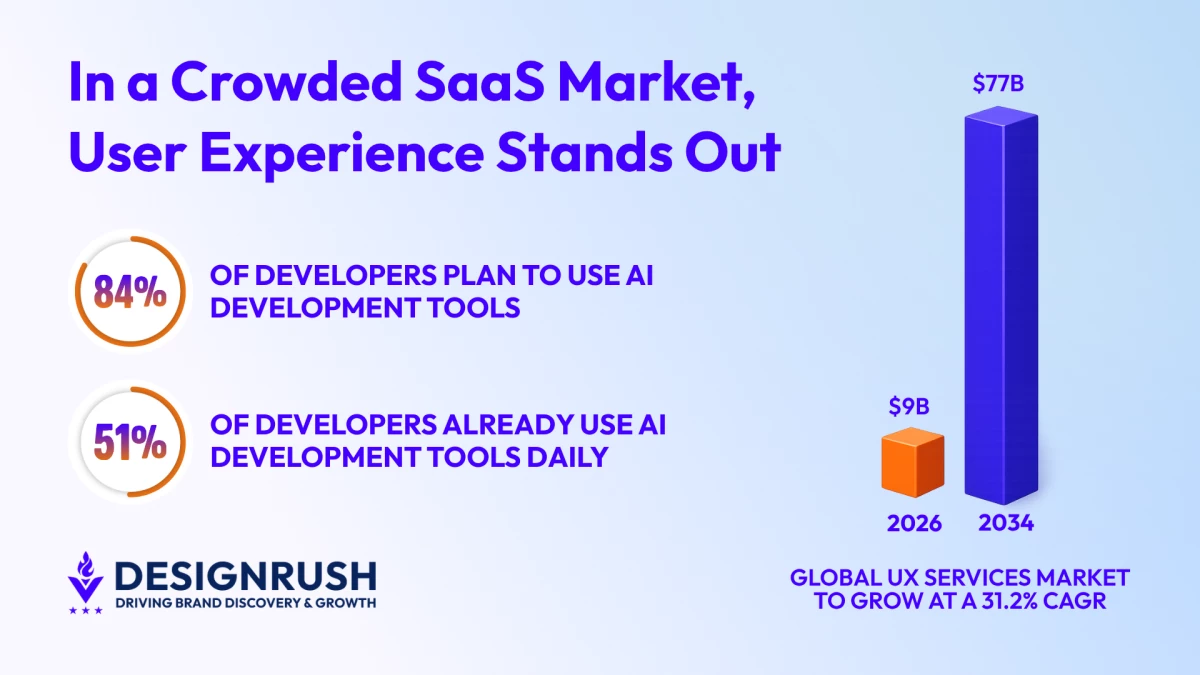
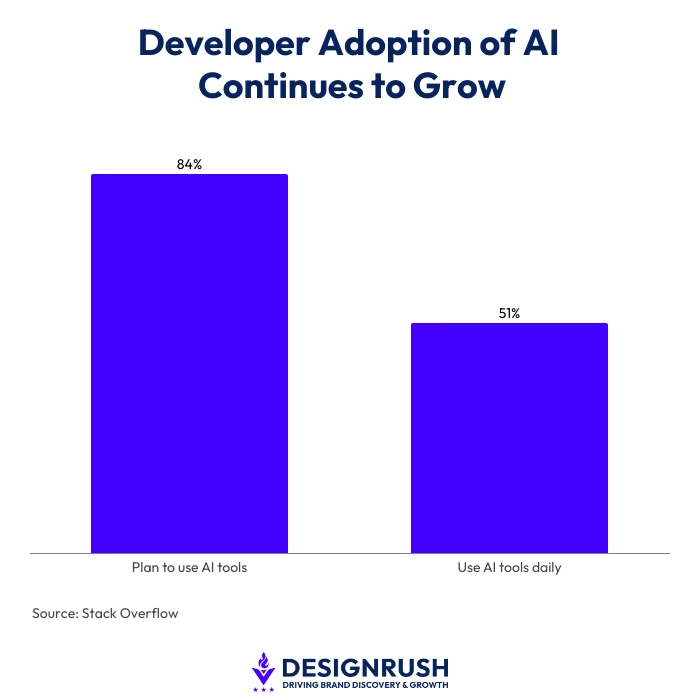
And it’s already showing up across the industry as 84% of developers are planning to use AI tools in their work, while 51% use them daily, according to Stack Overflow's 2025 Developer Survey.
 Widespread adoption, however, hasn't translated into widespread trust. The same survey found that 46% of developers don't trust the accuracy of AI-generated outputs.
Despite this, the result for startups is a lower barrier to building and launching new products.
"AI is shortening development cycles across the industry," Gieger adds.
"What used to require significant time and resources can now be brought to market much faster, which is changing how companies think about competition."
Why Investors Are Questioning Traditional SaaS Moats
For years, SaaS companies earned premium valuations because software was seen as difficult to replicate and highly scalable. But Bain’s insights argue that investors are now reassessing those assumptions.
Despite software stocks declining, average gross retention rates remain around 90%.
This means that the concern is less about today's customers and more about tomorrow's competition.
Investors are now trying to determine which advantages will remain durable as software becomes easier to create and distribute.
Why UX Is Becoming a Competitive Advantage in SaaS
A lot of products on the market offer similar capabilities. This means that to stand out, the user experience will be the deciding factor.
As a result, companies are putting more resources into UX.
In fact, the global UX services market will grow from $8.8 billion this year to $77.18 billion by 2034, per estimates from Fortune Business Insights.
Gieger adds that companies who better understand their users are at a significant advantage.
"Customers aren’t loyal because a platform has one more feature than a competitor. They choose to stick with them because the experience feels intuitive, reliable, and worth returning to."
Why SaaS Buyers Are Prioritizing Usability and Adoption
Software buyers have more choices than ever before.
As new products enter the market, businesses are looking beyond feature lists and paying closer attention to how software performs in day-to-day use.
Usability, onboarding, and workflow fit can play a major role in purchasing decisions.
A product may solve a problem, but that advantage can disappear quickly if teams struggle to adopt it.
"More often than not, the experience surrounding the product carries as much weight as its functionality," Gieger says.
What Will Define the Next Generation of SaaS Leaders
Technology will continue making software easier to build. And as development barriers fall, companies may find it harder to rely on functionality alone as a competitive advantage.
That leaves a different question for software leaders. What will separate them from the rest?
Gieger’s answer to that? A deep understanding of users and the ability to build products around the way people actually work.
"The companies that succeed won't necessarily be the ones building the most products or releasing the most updates," he says.
"They'll be the ones that understand their users best and remove the most friction from their everyday experience."