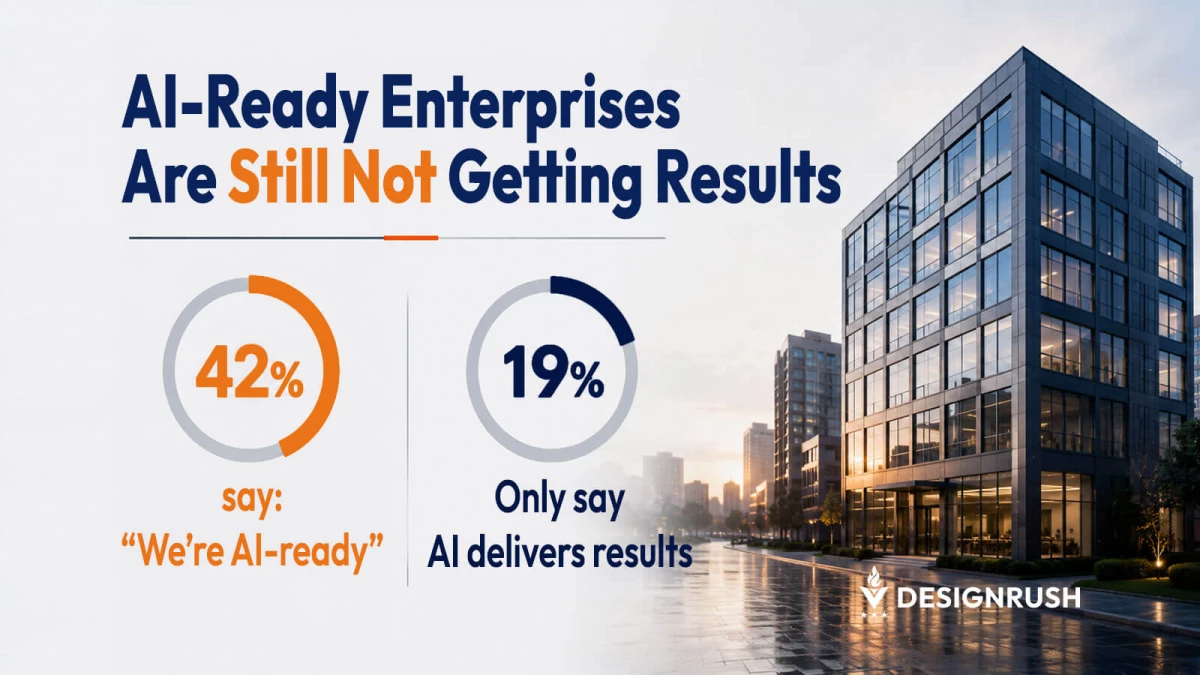

About 42% of enterprises say their strategy is highly prepared for AI adoption, according to Deloitte's State of AI in the Enterprise 2026 report.
And yet, only 19% say their efforts are driving meaningful outcomes, ServiceNow reported.
David Barlev, CEO of Goji Labs, a product strategy and software development firm, has seen this pattern repeatedly with enterprise clients.
“Companies invest in AI tooling and then wonder why nothing's changed," Barlev says. "The agent can see the data. It just can't do anything with it.”
The problem is execution.
AI agents are being deployed where they can surface insights but can’t act on them.
This leaves employees to manually carry out what the AI identifies.
Why AI Agents Surface Insights but Can’t Execute Them
The infrastructure underneath most enterprise AI deployments tells a different story than the confidence numbers that are the start of this article.
Despite 42% of companies reporting that their strategies are highly prepared for AI adoption, a huge 84% still haven’t redesigned jobs or the nature of work itself to accommodate AI capabilities, Deloitte reported in its 2026 survey of 3,235 leaders across 24 countries.
On top of that, worker skills are deemed the largest barriers to integrating AI into businesses.
The average organization manages 957 applications, but only 27% are connected, according to MuleSoft's 2026 Connectivity Benchmark Report.
Furthermore, 82% of IT leaders cite data integration as one of their biggest challenges when deploying AI.
So an AI agent sitting on hundreds of disconnected systems can retrieve a finding, but it can’t act across those systems without the integration layer to support it.
And that integration burden still falls on people.
IT teams spend an average of 36% of their time designing, building, and testing custom integrations between systems and data, according to MuleSoft.
The network layer compounds this further, as Cisco found in its 2025 AI Readiness Index:
- 54% of respondents say their networks can't scale for complexity or data volume
- Only 15% describe their networks as flexible or adaptable
- 64% of organizations struggle to centralize data, and fewer than one in three can detect or prevent AI-specific threats
Governance is another thin layer.
Only 20% of organizations have implemented AI testing, auditing, and risk assessment processes, according to ServiceNow's Enterprise AI Maturity Index 2026.
Only 29% strongly agree they have clear metrics to measure ROI.
And without those accountability structures, AI activity is difficult to measure and even harder to trust.
Barlev adds that the governance problem compounds the integration one.
“If you can't measure what the agent is doing, you won't give it more permissions. And if it doesn't have permissions, a human has to do the follow-through anyway.”
While 88% of McKinsey respondents say their organizations use AI in at least one business function, only 23% are actually scaling an agentic AI system across the enterprise.
Meanwhile, only 16% of organizations have streamlined and integrated AI workflows across business functions in 2026, down from 30% in 2025, according to ServiceNow.
This means more AI spend, but fewer integrated workflows.
Over the last few years, 25% of AI initiatives delivered expected returns, but only 16% scaled enterprise-wide, as per IBM.
Organizational factors account for 67% of reported AI impact versus 32% for individual effort alone, Microsoft's 2026 Work Trend Index found.
It all points to the bottleneck being the system design around the worker, not the other way around.
How Enterprises Should Build for AI Execution
The readiness-versus-results problem comes down to the systems, processes, and permissions surrounding AI deployment.
Barlev says the ones that move fastest share a common approach.
“They don't start with the AI. They start by mapping which workflows have the most manual handoffs, then they build integrations and permissions structures first. The agent is the last piece, not the first.”
That workflow-first approach is also becoming common practice among AI implementation firms.
Goji Labs outlined its pre-investment AI audit process, which starts with workflow mapping, data readiness, integration feasibility, and production conditions before any model deployment.
For executives and operators looking to move from AI visibility to AI action, the practical priorities are:
- Audit integration coverage before expanding AI tooling. If less than a third of applications are connected, agents will hit dead ends.
- Define what "action" means for each agent deployment. Know what the agent is authorized to do, and design workflows around that boundary.
- Include measurement from the start. Governance frameworks need to exist before scale, not after.
- Treat workflow redesign as a core deliverable. The process around the tool matters more than the tool itself.
- Expect integration work to take longer than the AI deployment. Underestimating integration complexity delays everything downstream.
Barlev adds one final point worth sitting with.
“Ask whether your systems are set up for an agent to take an action and have that action actually matter. Most organizations aren't there yet, and that's the work.”
Until the integration and permissions work is done, AI agents will keep identifying the next step, and humans will keep taking it.