
A Munich court issued a preliminary ruling in May 2026 that Google is directly liable for false claims generated by its AI Overviews, per the court filing.
The ruling is not yet final, and Google has said it will appeal, though preliminary rulings in Germany carry substantive legal weight.
The decision hinged on a single distinction. AI Overviews generate content in their own words, making them the company's own statements, not search results.
The scale of that liability becomes clear in the numbers.
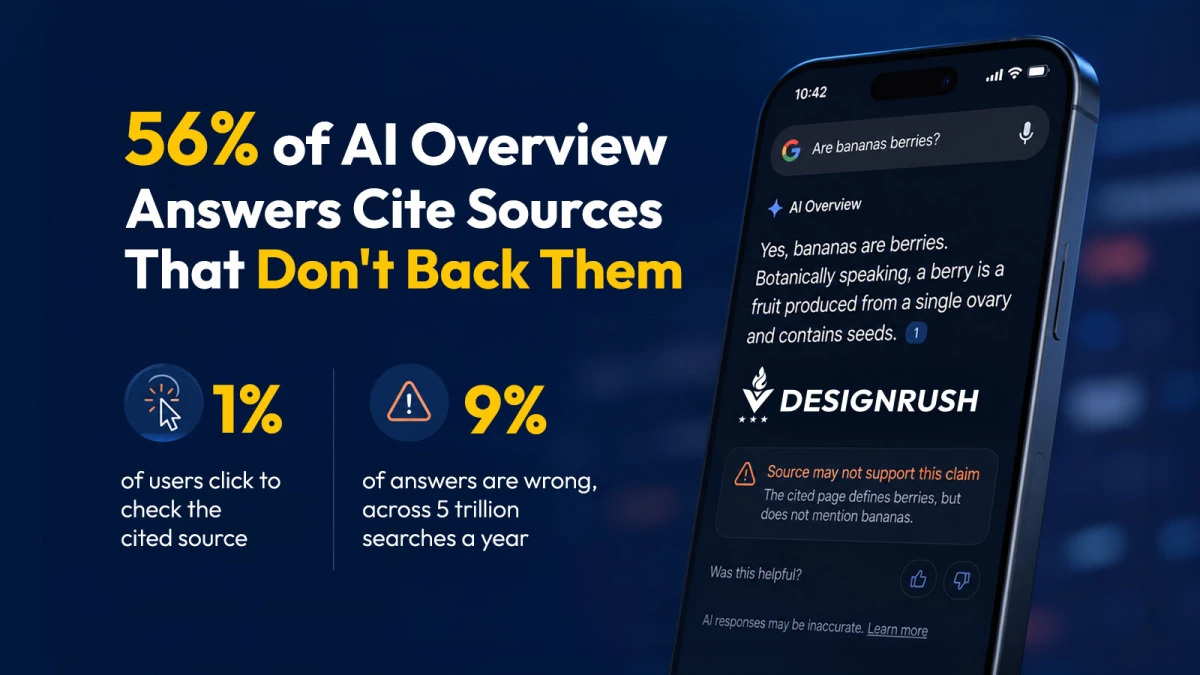
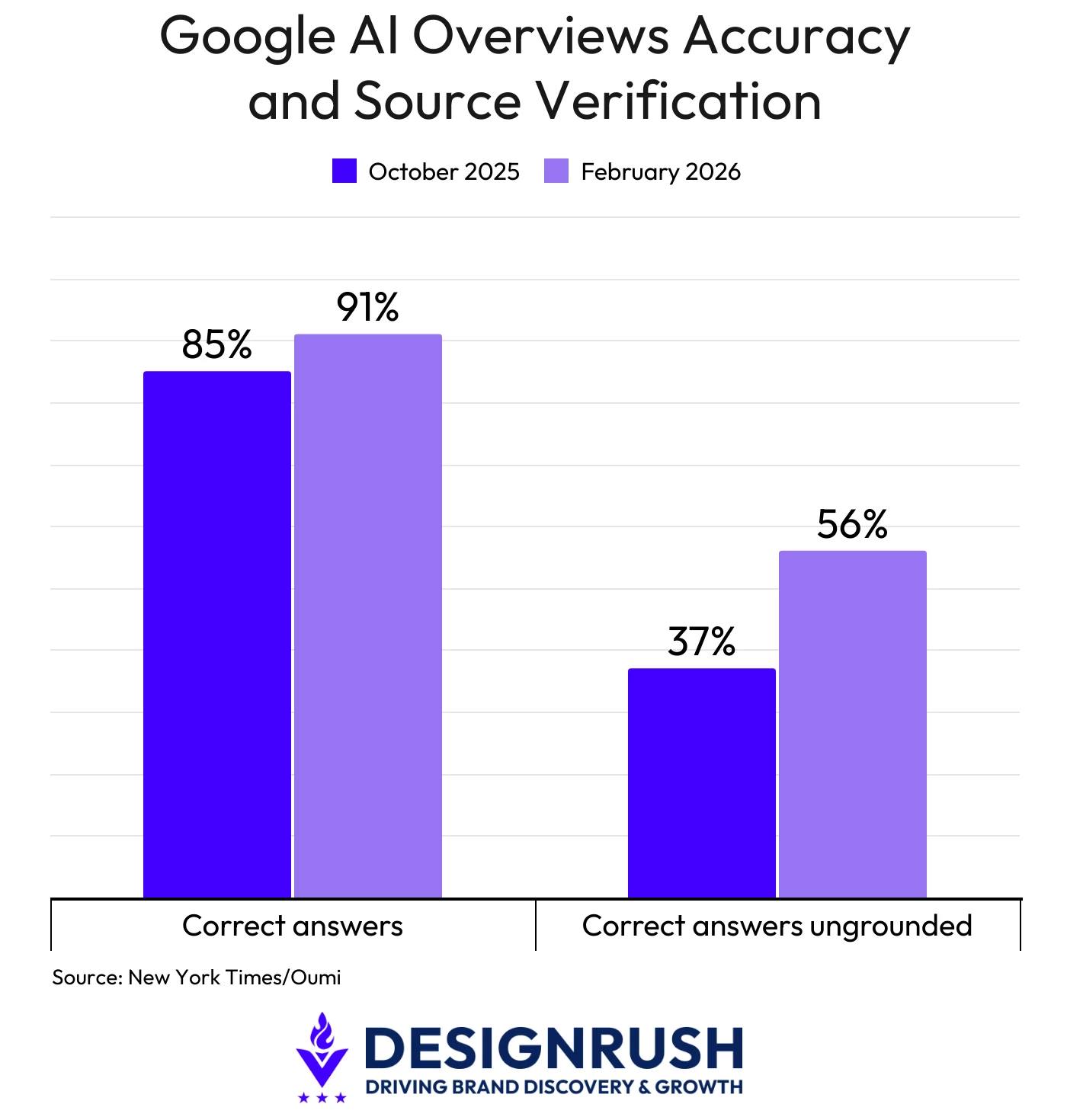
The feature answered factual queries correctly 91% of the time in February 2026, up from 85% in October 2025, according to a New York Times study with the AI startup Oumi.
At five trillion annual searches, that 9% still means tens of millions of wrong answers every hour. The verifiability problem grew faster than the accuracy improved.
In October 2025, 37% of correct answers linked to sources that did not fully support them. By February 2026, that figure had reached 56%.
 Users clicked on cited sources in only 1% of visits when an AI summary appeared, per Pew Research Center.
That makes source design a product decision with direct exposure, not a UX preference.
Confidence Without Verification Is a Design Choice
AI Overviews compress the research process into a single authoritative answer, removing the competing sources and comparison signals users relied on to evaluate credibility.
When an answer arrives fully formed and confidently stated, the interface itself implies the work of verification has already been done.
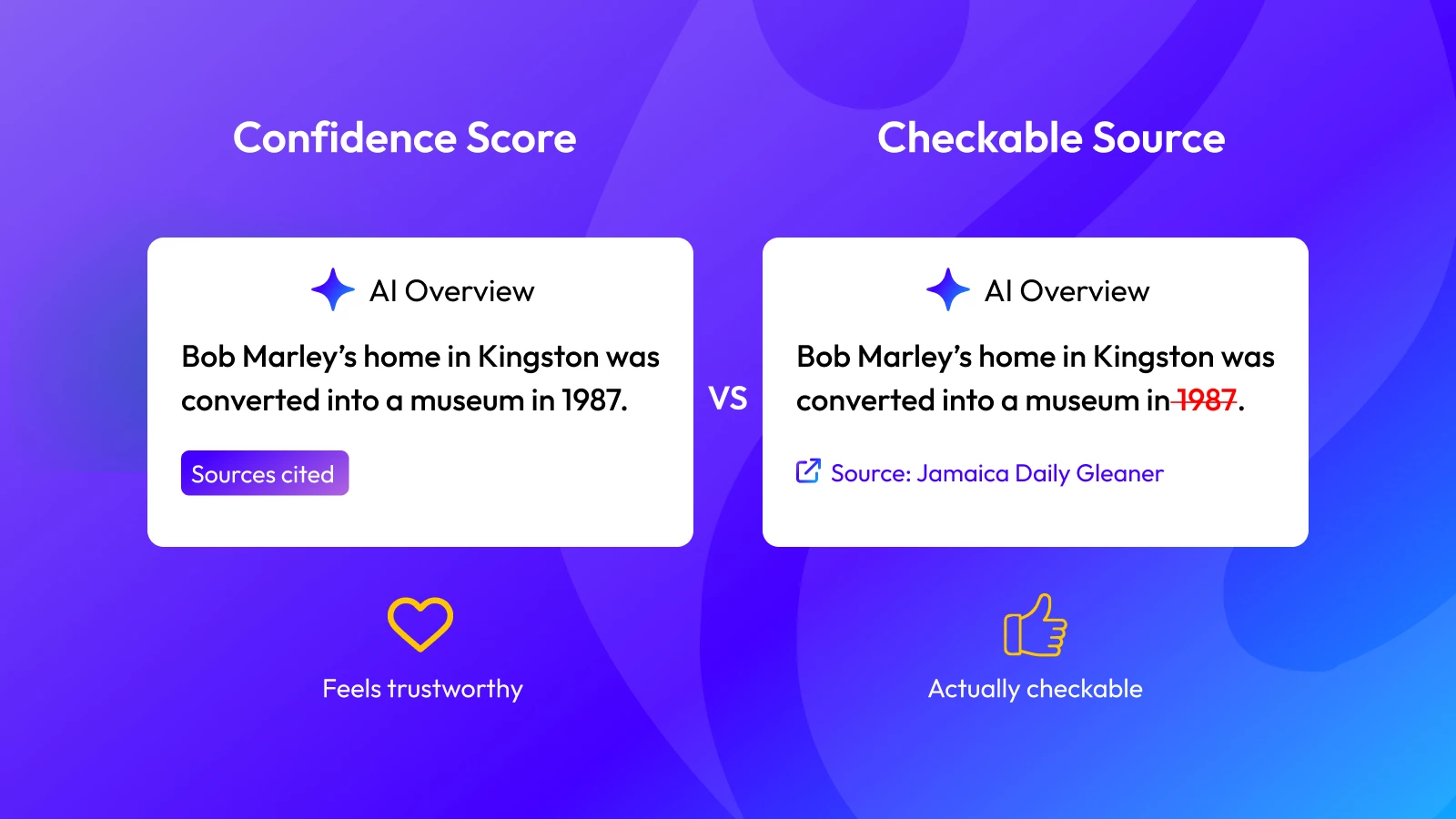
That is a design choice with measurable consequences.
Users who accept the answer, the 99% who do not click through, have no way to know whether the sources actually support what the AI stated.
Doug Hughmanick, Founder of ANML, a digital product design studio, sees the trust problem as a direct consequence of how AI presents information.
When an interface feels clear and complete, users naturally accept it. Search surfaced multiple sources and invited comparison.
AI removes that step entirely, and with it, the signals users relied on to evaluate what they were reading.
"That is a better experience in many ways, but it also removes many of the signals that help people evaluate credibility," he says.
"As AI becomes the interface, products need to make trust visible, not assumed."
AI Citations Are a Trust Signal
Citations in AI interfaces carry more weight than in traditional search precisely because users click through so rarely. A source badge or link tells users the answer is grounded.
When that source does not fully support the claim, the design has already done its damage before anyone reads it.
That damage compounds when the display format itself discourages verification.
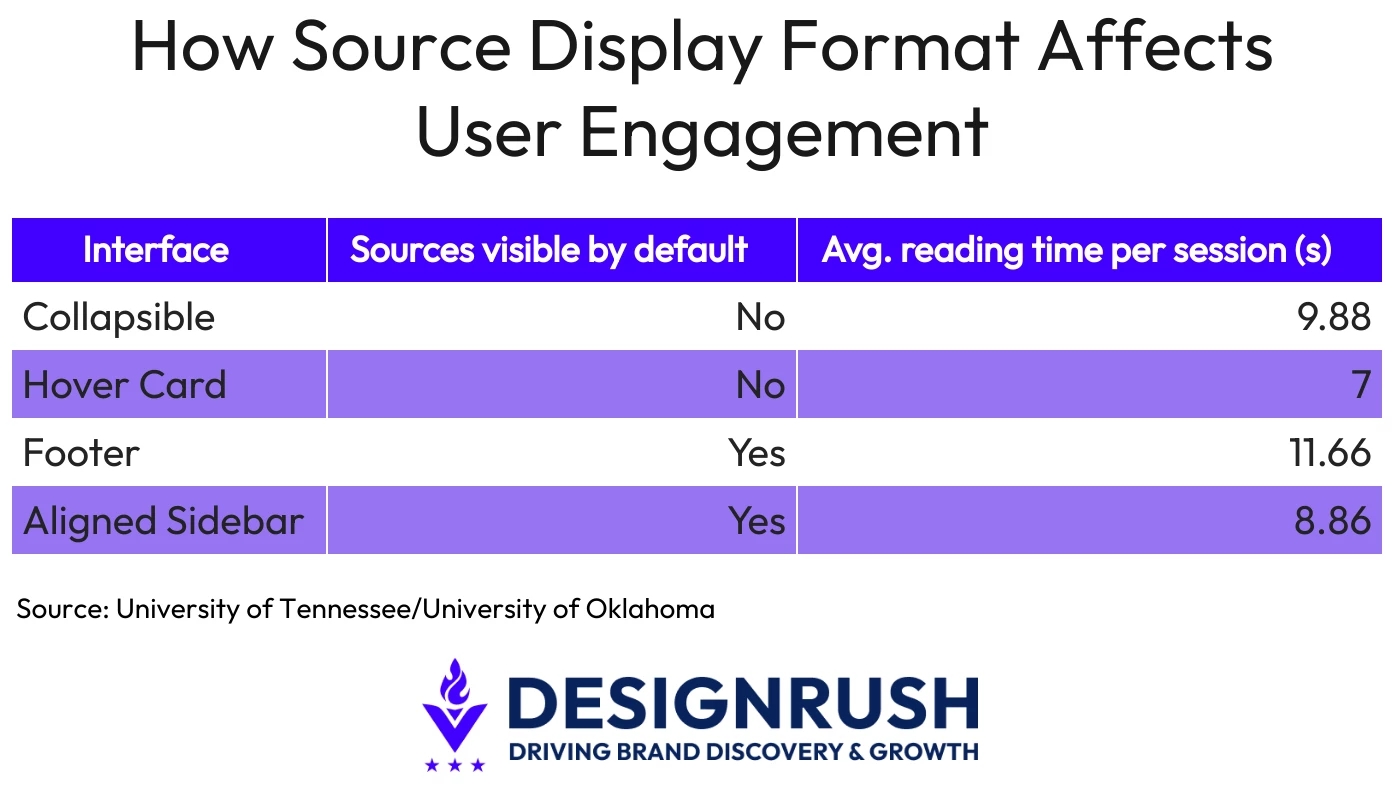 Persistently visible sources helped users maintain critical evaluation as information volume increased, per a University of Tennessee and University of Oklahoma study.
"One of the biggest mistakes is presenting every answer with the same level of confidence," Hughmanick adds.
"AI is probabilistic, but many interfaces make uncertainty look identical to certainty. If a source does not directly support the claim, trust disappears quickly."
The fix is a design decision about what gets shown, when, and how confidently.
Working with product teams on exactly that problem, ANML points to small design cues that carry significant weight:
- Source attribution visible at a glance,
- Confidence signals tied to how well an answer is supported,
- Clear paths back to original information when certainty is low.
"When uncertainty exists, make it useful," Hughmanick says.
"Show what is well supported, explain what is still evolving, and provide a clear path back to the original sources."
Designing for the moments when the system does not know something is as important as designing for speed.
When confidence is low, the experience should help users find a better answer rather than presenting an uncertain one as final.
Accountability Is Already a Design Requirement
The German ruling formalized something product teams already face. When an AI system speaks with authority, the company behind it owns what it says.
That is true in Munich and in every market where users form expectations based on how confidently a product presents information.
Hughmanick outlines four principles he argues will define trustworthy AI products:
- Every meaningful claim should connect back to its source.
- Confidence should reflect how reliable the information is, including knowing when to say the system does not know.
- Users should always be able to trace how an answer was formed and get back to the source.
- AI responses carry the same accountability as anything else a company ships under its name.
"Users don't distinguish between the model and the brand. They simply remember whether the product earned their trust," he says.
Products that retrofit source transparency and confidence design after something goes wrong are correcting what should have been the architecture.
The Design Decision Is Now a Liability Decision
The German ruling names Google, but the product architecture problem it exposed belongs to every team building AI experiences.
Designing for uncertainty, low confidence, and ungrounded answers has long been treated as an edge case in AI product development.
That changed when the consequences of ignoring it went on record.
In other words, source transparency and uncertainty handling are now decisions product teams will be asked to defend.
The teams that have not mapped those decisions yet have a product gap, regardless of what any court decides. The earlier those decisions get made, the less expensive they are to correct.