
For years, getting your business onto Google's first page was one of digital marketing's biggest wins. Now, it may not even get you noticed.
More people are getting their answers directly from AI, leaving businesses with fewer opportunities to turn search visibility into website visits.
This concern is backed by a 2025 Pew Research Center study, which found that users clicked traditional search results in only 8% of Google visits featuring an AI summary, compared with 15% when no summary appeared.
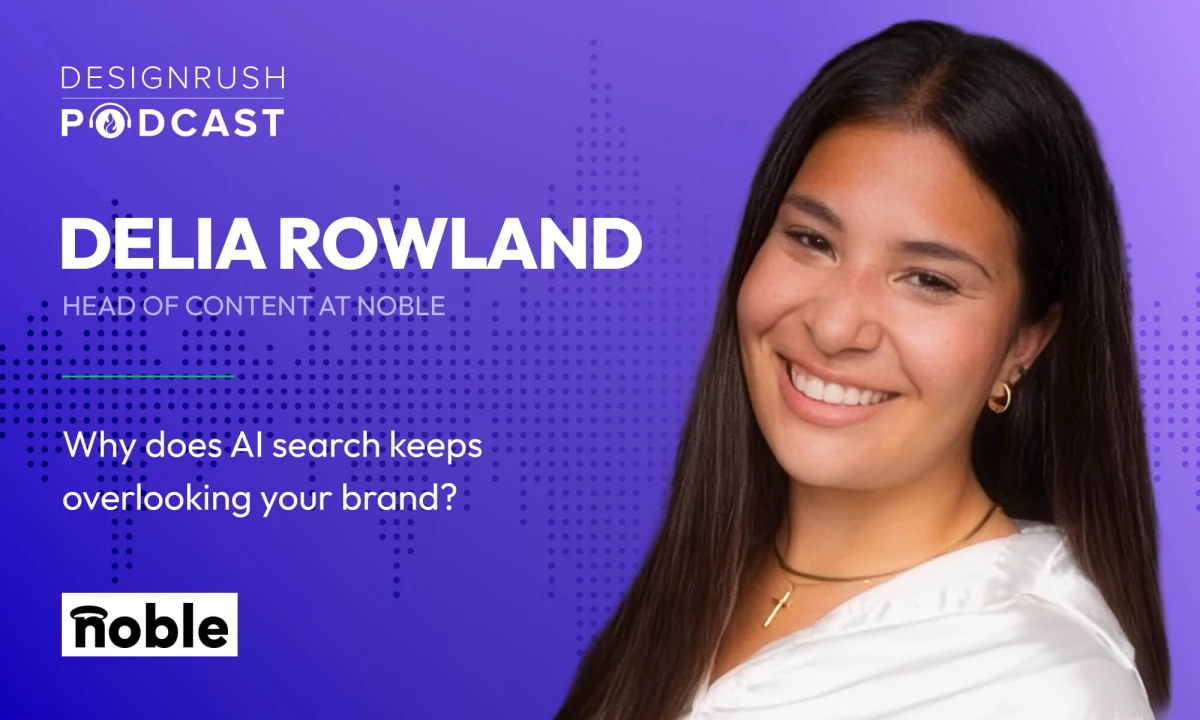
I spoke with Noble Head of Content Delia Rowland on the latest DesignRush Podcast episode about how brands can show up more often in AI-generated answers.
In her research covering 79 brands, 27 previously near-invisible brands that secured at least four third-party mentions went from under 1% visibility to about 19% within four weeks.
That's roughly one in five AI answers.
But getting mentioned is only part of the challenge. How can businesses make that visibility last?
“Four is when you start to see the stick happen,” Rowland tells DesignRush.
Rowland’s findings offer a starting point, although she cautions against treating four mentions as a guaranteed formula. In this episode, she covers:
- Why four mentions help AI visibility stick
- How to find the sources AI cites most
- Why third-party sources drive most AI citations
- How to keep AI visibility from fading

Who Is Delia Rowland?
Delia Rowland is Head of Content at Noble, an AI search visibility platform. Rowland specializes in research and content strategy, analyzing how third-party brand mentions influence AI-generated recommendations. She also helps businesses understand their visibility across AI search platforms.
Get Your Brand Mentioned Outside Your Website
Rowland says marketers often focus too heavily on their own websites, overlooking the external publications AI systems reference.
“85% of these sources that are being cited are third-party sources,” Rowland says.
She compares the process to word of mouth, where independent recommendations can carry greater weight than a company's own claims.
“If someone who works at a company says we're the best, you're not going to trust that answer,” Rowland adds.
DesignRush explored a related issue in a report on why 62% of brands remain invisible to AI search.
The article also drew attention on social media, including from M2C ip, a brand integration firm, which shared it with its own take on brand consistency:
Understand What Four Mentions Mean
While reviewing Noble's customer results, Rowland noticed an unusual pattern.
“I'd check back on brands and maybe they'd have a spike, and I'd be like, they're great for a case study, and then it would drop off the next week,” Rowland says.
Rowland’s research found that only around 22% to 23% of brands with one to three mentions maintained their visibility gains, compared with approximately 54% to 57% among those with four to 20 mentions.
She suggests that repeated mentions from credible sources may help AI systems identify consistent information about a brand.
So which publications deserve a CMO’s attention?
Identify the Sources AI Frequently Cites
Being featured on a popular website does not guarantee your business will appear in recommendations from ChatGPT or Perplexity.
Rowland recommends examining the publications these platforms repeatedly reference.
“We look for citation frequency, how often something continues to be cited across different LLMs,” Rowland says.
She suggests reviewing sales transcripts and customer conversations to identify the questions buyers actually ask, then testing those questions across AI platforms to find relevant publishers.
While platforms such as Reddit and LinkedIn attract attention, Rowland cautions against pursuing them without understanding their relevance to your customers.
“It's going to be a lot more work, you know, on the outset,” she says.
DesignRush examined another challenge in its report on AI citations that leave brands unnamed.
AI tools can cite a brand’s content without naming the brand in the answer. That makes it important to track both citations and brand mentions.
Add New Mentions as AI Sources Change
Rowland says brands should keep placing mentions after they reach four.
“The more mentions that you place from there, you can see in the data actually the more likelihood that it will stick,” Rowland says.
The sources AI tools trust also change over time. Rowland points to data showing LLMs tend to favor fresher content, and a new product launch calls for a new set of buyer prompts to track.
“It’s sort of a never-ending process, which sounds like a drag, but I think that’s how SEO was too,” she says.
She recommends waiting about a month after new placements go live, then rechecking AI visibility and the sources LLMs cite.
Outdated information creates a separate problem. Noble’s Mention Refresh product asks publishers to correct details such as old pricing in existing articles, and Rowland wants to track what happens next.
“I would love to answer the question of how long does it take for an LLM to reconsider the new information that’s been updated in an article,” Rowland says.
In the full episode, Rowland also covers the research and measurement questions AI search raises for marketers, including:
- Why ChatGPT and Perplexity shared only 11% of cited domains in a study of 680 million citations
- Why fake or spammy brand mentions can backfire in AI answers
- How to judge an AI search study before acting on it
- Why AI-driven purchases and demo bookings are making customer attribution harder to track
Don’t miss the full convo! Watch the episode on YouTube or listen on Spotify.