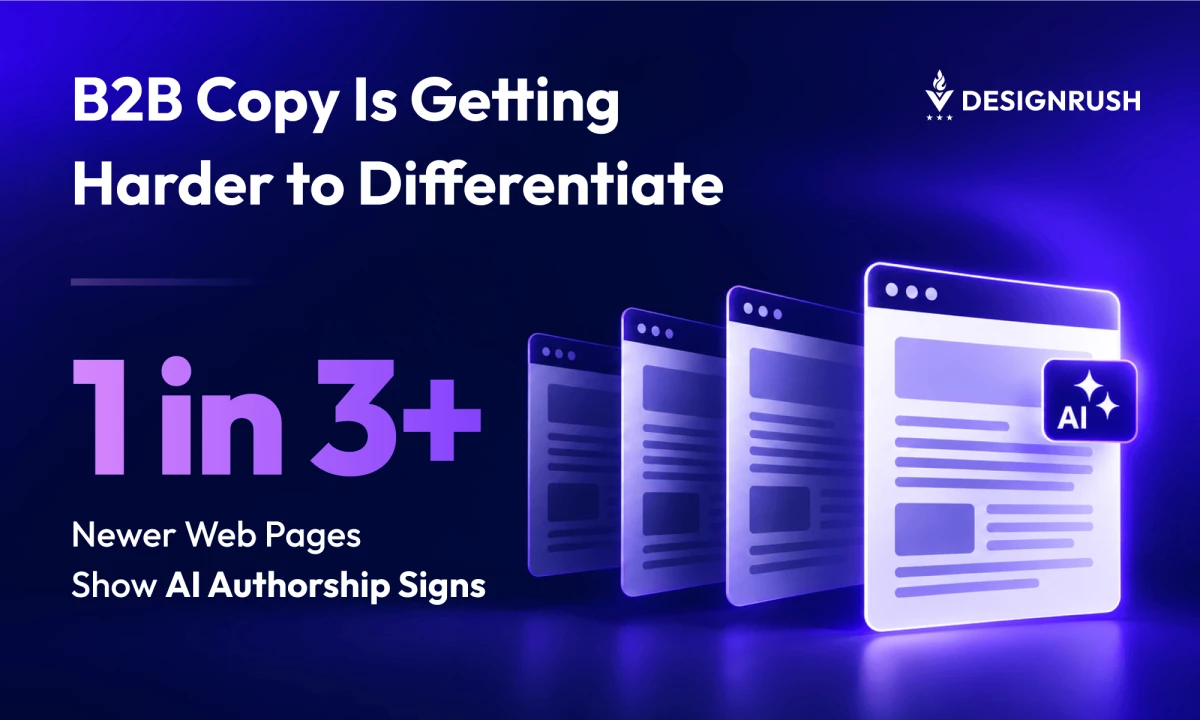

More than one-third of webpages published after ChatGPT’s release showed significant signs of AI authorship in Pew Research Center’s August 2026 snapshot.
Website copy increasingly has company after company sounding as if it was assembled from the same pile of prompts.
Pew Research Center’s broader sample found that 10% of all webpages showed ‘significant AI authorship signals’, but filtering out pages published before ChatGPT makes the concentration much higher.
A buyer moving through a website does not have much reason to remember polished language that could describe five competitors just as easily.
Original evidence, specific expertise, and a clear position give the copy something firmer to stand on.
Paul J. Scott, chief website strategist and founder of GoingClear, a B2B digital agency that works on website strategy, messaging, content, and UX, describes the work behind the words as a place where human judgment remains important.
B2B Website Copy Needs Evidence Buyers Can Check
The problem with generic AI-assisted copy is easy to spot once the subject matter gets specific.
Statements about "streamlined solutions," "industry-leading expertise," or "innovative approaches" can appear on almost any B2B homepage, yet they tell a buyer little about how a company actually works or why its claims deserve attention.
“The thoughtful UX process, interviews, and B2B website UX strategy are among the most important parts of a website project because they help establish the right strategy before the copy and design take over,” Scott says.
That process gives teams material AI-assisted writing cannot invent responsibly, such as the language customers actually use, the objections sales teams hear, the details that separate one service from another, and the proof that backs up a promise.
A strong website therefore needs source material from the business itself, not another round of generalized copy about results, expertise, and customer success.
GoingClear revamped its website with a focus on user experience, information architecture, navigation, and clearer presentation of its services and resources:
Fifty-one percent of B2B buyers surveyed by Gartner said they were more likely to encounter misleading information from GenAI than from sales representatives.
Meanwhile, 69% preferred to validate AI-generated insights with sales reps, while 45% had used GenAI during a recent purchase, mainly to research vendors and products, according to Gartner’s May 2026 survey.
Buyers may use AI to narrow a vendor list or collect background information, but the claims still need to survive scrutiny when a real purchase is on the line.
“That makes original proof valuable on the website itself. Thoughtful custom case studies or testimonials with video proof points always help,” Scott says.
A case study can show what happened, who the customer was, what problem the company addressed, and what changed afterward.
A testimonial adds a customer’s voice.
Video can let buyers see and hear the person making the claim.
None of these assets guarantees trust, but they give buyers something concrete to assess.
Website Messaging Has to Hold Across the Buyer Journey
There’s also a consistency problem. Buyers don’t read one page, decide, and then disappear.
They move between search results, AI tools, a company website, sales conversations, social channels, and other sources as they research a purchase.
McKinsey’s 2026 Global B2B Pulse Survey found that buyers use an average of 10 channels across the purchasing journey.
In the same survey, inconsistent information was the top reason buyers cited for switching suppliers, followed by difficulty accessing knowledgeable representatives.
The study covered nearly 4,000 B2B decision-makers across 13 countries.
That makes website messaging a coordination issue as much as a copywriting task.
A homepage can promise one thing while product pages, sales decks, and customer conversations describe something else. Buyers then have to do the reconciliation themselves.
Scott says teams should start by getting the website messaging framework right.
The framework needs to answer basic commercial questions with enough specificity to survive across channels, such as:
- Who the company serves
- The problem it solves
- Its approach
- Why customers can trust it
- The evidence behind its claims
GoingClear’s trademarked G³ Framework offers one example of this approach, organizing website and digital activity around three questions:
- Attracting the right visitors
- The information they need to convert
- Turning website activity into pipeline
That material can guide website copy, sales messaging, and the information buyers encounter through AI-assisted research.
Pew Research Center’s study shows why this work is becoming harder to ignore.
Researchers examined nearly 490,000 English-language webpages from 49 Common Crawl snapshots between January 2021 and July 2026.
In the August 2026 study, one in 10 webpages showed significant signs of AI authorship, while more than one-third of pages published after ChatGPT’s release showed those signals.
“Website copy needs to show what the company knows from its own experience,” Scott says.
“That means using company-specific facts, customer evidence, interviews, and details that reflect how the business sells and serves customers.”
A messaging framework can keep those details consistent across the website. Original evidence gives buyers something concrete to evaluate.
As AI-assisted copy becomes easier to produce, companies have more reason to ground their messaging in facts and experiences that belong to the business itself.