
Inconsistent brand data across owned, earned, and third-party sources is lowering citation rates in generative AI search engines.
And the businesses losing the most ground are the ones that assume their existing SEO investment already covers it.
AI systems select citations based on cross-source corroboration.
When a brand's name, category, product descriptions, or core facts conflict across platforms, including review sites, data aggregators, press archives, and directories, models register ambiguity and become less likely to include that brand in a generated answer.
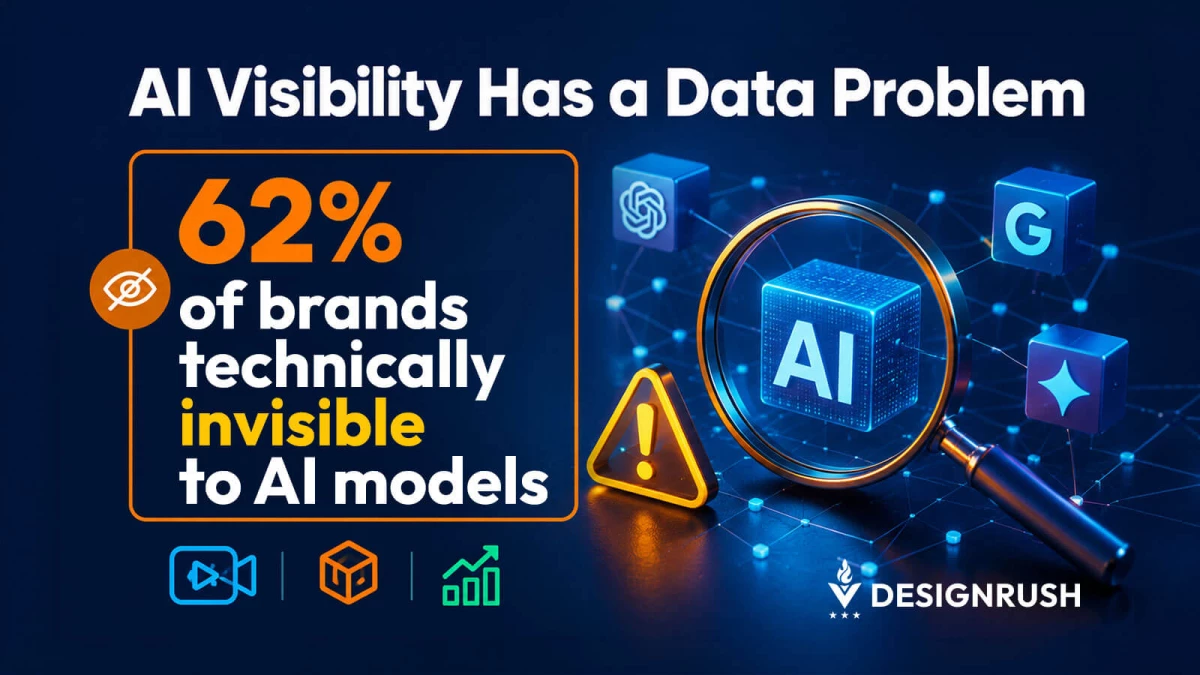
In fact, 62% of brands were "technically invisible" to generative AI models despite 94% actively investing in traditional SEO, according to Fuel Online's analysis.
That gap is the real story here.
Brands think they've solved for AI search because they've solved for Google.
Those are no longer the same project, but many companies haven't caught up to that yet.
The financial stakes make the issue harder to ignore.
AI-referred sessions grew 527% year over year in the first five months of 2025, and AI-referred visitors convert at 14.2%, on average, compared to 2.8% for standard organic Google search, according to the 2025 Previsible AI Traffic Report.
Meanwhile, a growing share of B2B websites have seen traffic losses as AI Overviews and other zero-click search features absorb query responses that previously drove clicks.
Why Fragmentation Happens, and Why It's Hard to Catch
The fragmentation problem spans three categories of brand data
Owned sources, including websites, social profiles, and press releases, frequently contain internal inconsistencies introduced through rebrands or product updates that were never applied retroactively.
Earned sources, such as press coverage and analyst reports, often reflect outdated positioning and remain uncorrected in archives.
Third-party sources, including business data aggregators and software review platforms, are frequently auto-populated and rarely audited.
Most of this is invisible from the inside.
A marketing team can be looking at a perfectly consistent website and have no idea that a data aggregator has the company under the wrong category or that a two-year-old press release lists a product name that's since changed.
The AI sees all of it, though.
Research from the University of Toronto found that AI search systems show a systematic bias toward earned and third-party sources over brand-owned content, which raises the stakes on exactly the data teams tend to overlook.
Citation weight is also unevenly distributed.
Wikipedia and Reddit alone account for more than a quarter of ChatGPT citations in the U.S. Domains with a strong presence on platforms such as G2, Capterra, and Trustpilot also tend to see higher citation rates, the 5W Citation Source Audit for Q1 2026 found.
A single inconsistency on any of these high-weight sources can be enough to drop a brand out of contention.
What Executives Need to Rethink About AI Visibility
One of the biggest mistakes I see leadership teams make is treating AI visibility as an extension of the SEO team's existing scope rather than a cross-functional data integrity problem.
On-site optimization used to be enough because Google was mostly reading your site. Generative engines are reading everything about you everywhere and cross-referencing it.
That means legal, PR, product, and customer success all now have a stake in whether your brand shows up in AI answers because any one of them can introduce the inconsistency that gets you excluded.
In practice, I recommend three shifts for leadership:
1. Audit before you optimize.
Most GEO strategies start with content production, but the higher-leverage first move is a cross-source consistency audit, checking that name, category, and core product facts match across the website, review platforms, directories, and recent press coverage.
You can write the best content in the world and still get excluded because a data aggregator has your address wrong.
2. Assign ownership, not just awareness.
Because fragmentation originates across departments, someone needs explicit accountability for monitoring and correcting external listings, not just internal content.
Right now, it's nobody's job, which means it's everybody's problem and nobody's priority.
3. Treat this as a revenue issue, not a visibility metric.
Given the conversion premium on AI-referred traffic, unresolved fragmentation is a direct, quantifiable cost.
If AI-referred visitors convert at five times the rate of organic search, every citation you lose to a fixable data inconsistency is lost revenue, not just a vanity metric.
The Cost of Waiting
Organic search traffic to websites will decrease by 50% or more by 2028 as generative AI search scales, according to Gartner.
Brands that wait to address fragmentation until that decline is fully realized will be competing from a structural disadvantage that takes longer to correct than it did to create.
Cleaning up years of inconsistent data across dozens of third-party sources isn't a sprint.
The brands treating this as urgent now are going to have a compounding advantage over the ones that wait until their AI visibility problem shows up as a revenue problem.