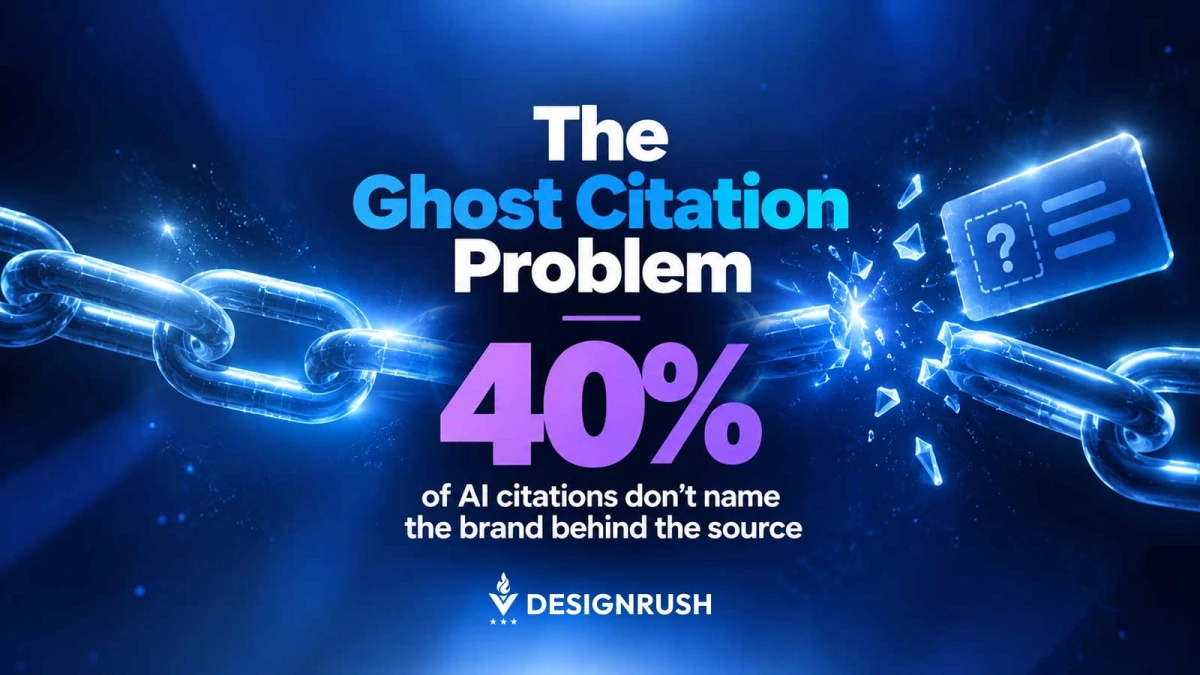

Around 40% of AI citations don't name the brand behind the source they use, according to Writesonic’s analysis of roughly 16 million brand appearances over a 30-day period, published by Search Engine Land.
In the study, a citation meant the AI answer linked to a brand's page, while a mention meant the brand name appeared in the answer itself.
But when a page was cited without the brand appearing in the answer, researchers called it a "ghost citation."
For marketers, that leaves an important gap.
A company's content can appear among an AI answer's sources while the brand itself never appears in the response a user reads. Citation growth alone can give an incomplete picture of AI search visibility.
ForeFront Web tracks how clients appear across major AI assistants as part of its SEO work, with senior SEO specialist Gabrielle Schneier focused on the search and content strategies behind that visibility.
"If I see a client's page in the sources but their name never makes it into the answer, I’d want to know two things," she says.
"Where was the brand actually visible, and where was its content being used without the same recognition?"
Ghost Citations Vary Across AI Search Engines
Ghost citations appeared in all seven AI engines included in the Writesonic analysis, though the rates differed considerably.
Perplexity left the source brand unnamed in 52% of cited appearances, while Google AI Mode followed at 49%, Google AI Overviews at 41%, and ChatGPT at 37%.
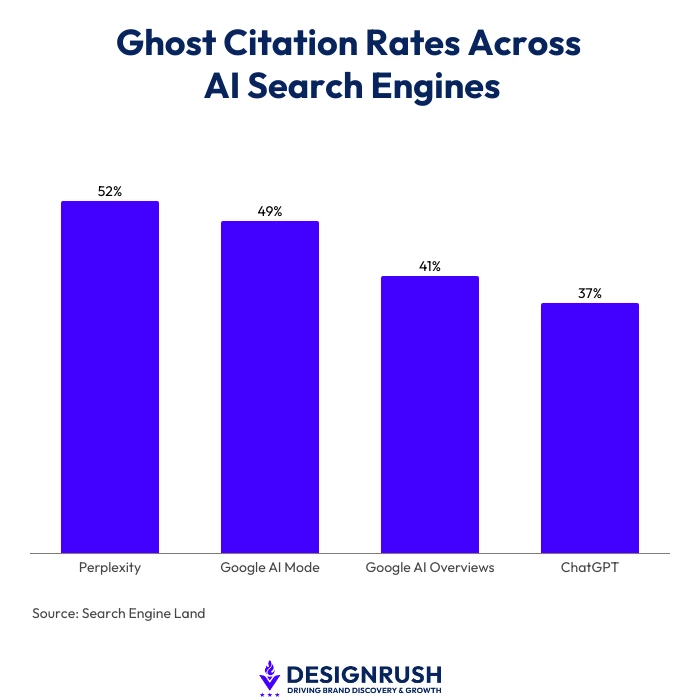
Likewise, the rate dropped to 25% for Gemini, 22% for Grok, and 19% for Microsoft Copilot.
Across the analysis, Perplexity and Google's answer engines linked to source pages more frequently while naming the brands behind them less consistently.
Gemini and Copilot, however, showed the opposite pattern, naming brands more often while linking less frequently.
Researchers don't yet know exactly what drives those differences.
According to experts at ForeFront Web, one possibility is that some engines treat the source link as sufficient attribution before rewriting the information in their own language.
Page structure may contribute too. The analysis suggests testing whether claims and statistics retain attribution more consistently when the company name appears directly alongside them.
The analysis doesn't establish what causes ghost citations or whether they affect clicks, brand recall, trust, or conversions.
"I'd test each platform separately," Schneier adds.
"If Perplexity keeps citing a page without the brand name and Gemini behaves differently, that gives us two different results to investigate instead of treating them as the same kind of visibility."
Google Search Central explains how AI features such as AI Overviews surface supporting links and determine which websites can appear in generative search results:
How Ghost Citations Distort AI Visibility Metrics
A single citation total can hide those engine-level differences.
The analysis recommends grouping tracked appearances by whether the brand was cited and mentioned, cited but not mentioned, mentioned but not cited, or neither cited nor mentioned.
Teams can then separate the results by engine and look for recurring patterns around the prompts that matter to the business.
When the same page repeatedly earns a citation without a brand mention, marketers can inspect:
- What information the engine extracted
- Where the company name appeared on the source page
- Whether other brands were named
- Whether the pattern carries across related prompts
"If the same prompts keep producing citations without mentions, I’d want to know which pages are being pulled, what text is being extracted, and where the brand appears on the page," Schneier says.
"Then we have a specific page and prompt set we can test again after making changes."
Google Search Central shows how site owners can track visibility inside AI Overviews and AI Mode through its Generative AI Performance reports:
How Brands Can Improve Attribution in AI Search
While there’s no proven way to make an AI engine name a company every time it cites one of its pages, there are four areas marketers can test:
1. Name Original Research Clearly
Named research gives marketers one place to start. Studies, indexes, datasets, and methodologies that carry a company's name keep the source more closely connected to the finding when that information is reused.
2. Keep Attribution Close to Key Findings
Attribution on individual pages can be tested the same way. A statistic sitting several paragraphs away from the company that produced it is easier to separate during synthesis than a finding that names its source in the same sentence.
3. Build Brand Associations Beyond Your Website
Independent coverage can strengthen that association elsewhere. Expert commentary, customer content, and industry articles give AI systems more places to encounter the company alongside the subjects and expertise connected to it.
4. Test AI Answers After Content Changes
Any changes still need to be judged against the answers themselves, including what each engine extracts, whether the brand appears, and which sources or competitors show up alongside it.
"If you've published original research, name it and keep the brand close to the finding," Schneier concludes.
"Then run the same prompts again and see whether that attribution survives when the engine rewrites the answer. That's the part I'd want to measure."