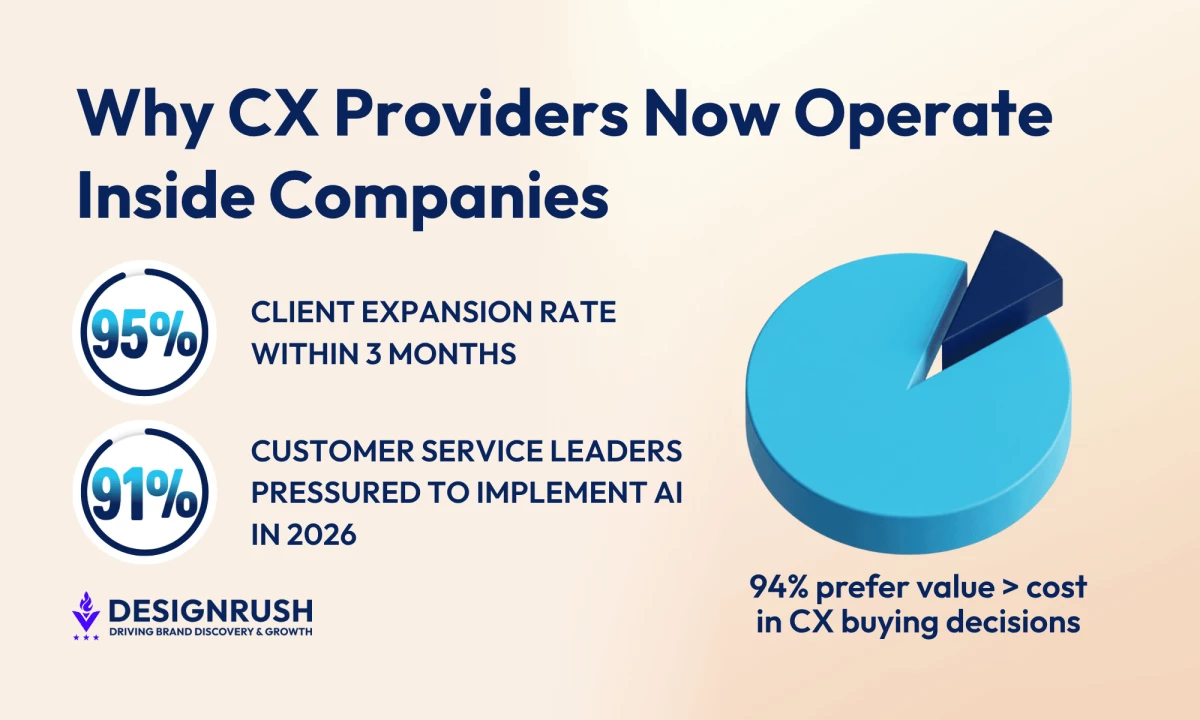

A reported 95% client expansion rate within three months in embedded CX models signals a change in how providers are evaluated.
The figure comes from Hugo Inc.’s embedded CX work and reflects how quickly clients scale scope once the model is fully integrated into daily operations.
In models such as Hugo, a global provider of customer support, technical support, and AI-powered operations solutions, this level of expansion reflects CX teams working inside client workflows as part of daily execution rather than operating as external support.
For Funmi Mide-Ajala, Director of Customer Support & Digital Operations at Hugo, the structure of embedded CX work starts with a simple check before automation.
"The question we ask before automating any part of a workflow is: what does the customer lose if a person isn’t involved here? Sometimes the answer is nothing. Sometimes it’s everything.
"That line moves depending on the customer and the situation, and only a human can read it in real time."
When that step is skipped, AI can easily remove context and weaken how the message is understood, while customers still need responses that show clear comprehension of their issue.
Deloitte reports that 48% of companies with mature service operations already deploy agentic AI, compared with 24% of less mature peers.
“Mature” here refers to organisations with defined service delivery models, strong personalisation capabilities, and low employee attrition, where AI is embedded into structured workflows rather than tested in isolated pilots. This structure determines how effectively AI contributes to service performance.
Ninety-one percent of customer service leaders say they’re under pressure to implement AI, according to Gartner’s 2026 survey results.
The survey, Service and Support Leaders’ Goals and Game Plans, shows how AI adoption is now embedded in service strategy planning across organisations and is directly influencing how service teams are structured, staffed, and measured.
This pressure to adopt AI is showing up in customer-facing environments such as review replies, public responses, and comment threads, where service decisions are now visible in real time.
“Consumers can already notice these changes in public-facing client interaction platforms, such as review or comment sections,” says Mide-Ajala.
AI Is Scaling Faster Than Customer Trust
"Customers can't always explain what's wrong with a response. But they feel the gap between something written for them and something generated for scale," she adds.
McKinsey found that 40% of customer care leaders reported significantly improved customer experience scores in the past 12 months, compared with 12% of lower-performing organisations.
The higher-performing teams were using AI to handle frontline issues while improving service quality.
A thoughtful reply builds repeat visits and shows that the business is present. A flat reply makes the interaction feel transactional.
That’s the risk with overly automated review replies.
They can look efficient and still miss the one thing that matters most in a public response: it should sound like the business actually noticed what the customer said.
Scaling Works When the Process Still Feels Human
SupportNinja's 2026 CX Outsourcing Report found that 94% of organisations prioritise value over cost when selecting CX partners.
The decision increasingly comes down to how reliably a provider works inside a company’s existing workflows and standards.
Hugo’s client expansion rate reflects that trend in practice.
"Expansion isn't a sales outcome for us. It's a trust signal.” Mide-Ajala says.
“Clients hand over more work when they stop finding errors, stop needing to check behind the team, and start treating the operation as their own."
How to Apply AI Without Losing Control of Customer Experience
Two things follow from this: one focused on how AI is used in customer-facing responses and the other on how CX partners are selected and managed.
On AI and customer-facing responses:
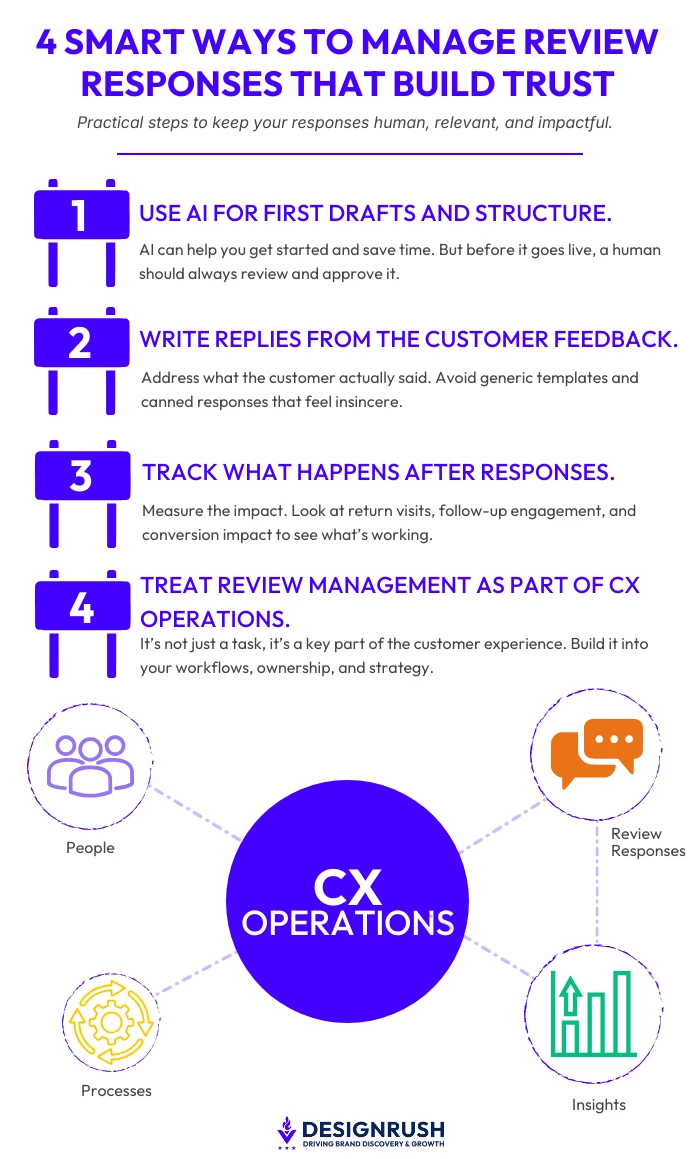
- Use AI for structure and first drafts. A human reviews before anything reaches a customer.
- Write from the actual feedback, not a pre-built response library. Generic replies signal that no one read the original message.
- Measure what happens after the interaction through return visits, follow-up engagement, and conversion impact. This reveals whether a response actually worked because ticket closure alone doesn't.
- Move review management into CX operations. It's a brand-facing function with real commercial consequences, not a side task to automate and forget.
On Selecting and Managing a CX Partner:
- Evaluate based on how they perform inside systems, and not on pitch decks or case studies from other clients. The test is whether the work holds under operating conditions.
- Tie contracts to outcomes, not activity. Hours logged and tickets closed measure effort. Customer retention, satisfaction scores, and expansion of scope measure results.
- Give partners enough access to operate with real accountability. A CX team that can't see the full picture can't make the judgment calls the work demands.
AI can help teams move faster, but speed does very little if the response feels hollow.
The pressure to adopt AI is not going away, and neither is the pressure to handle customer interactions properly.
The result is that automation gets used to handle structure and repetition, while human judgment stays in the parts of the process where tone and context matter.
Because when customers read a review reply, they’re usually asking one quiet question: did anyone here actually care, or was this just another layer of outsourced automation?