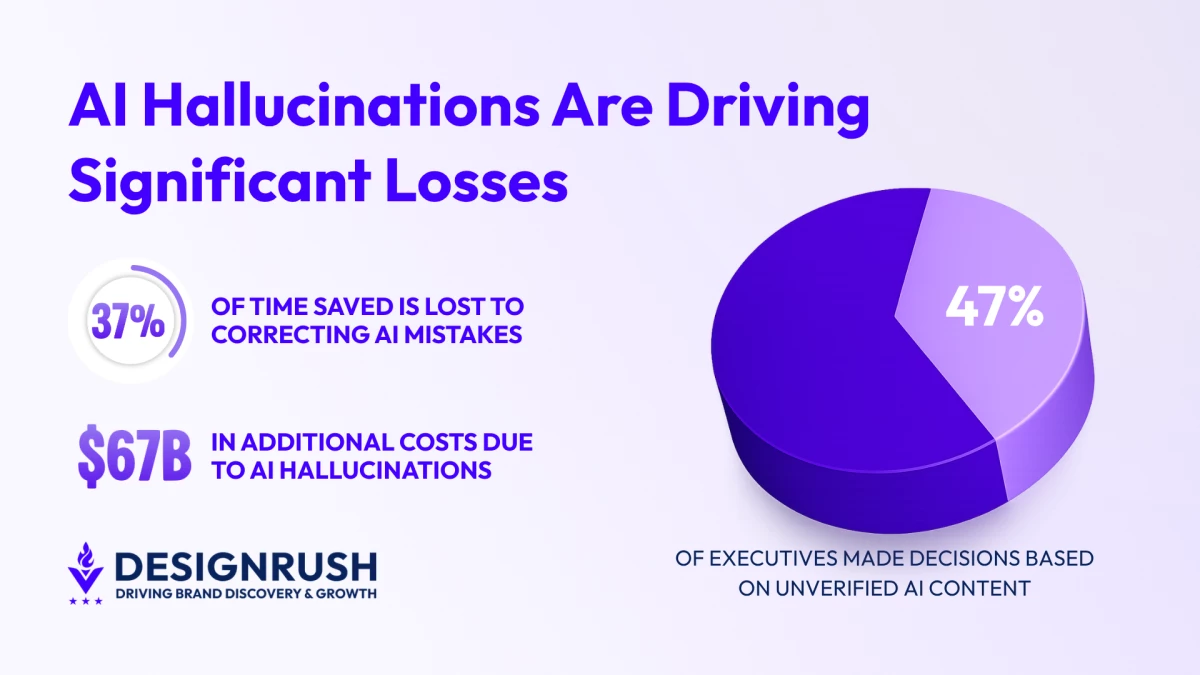

AI hallucinations cost global businesses roughly $67.4 billion, according to research compiled by FourDots
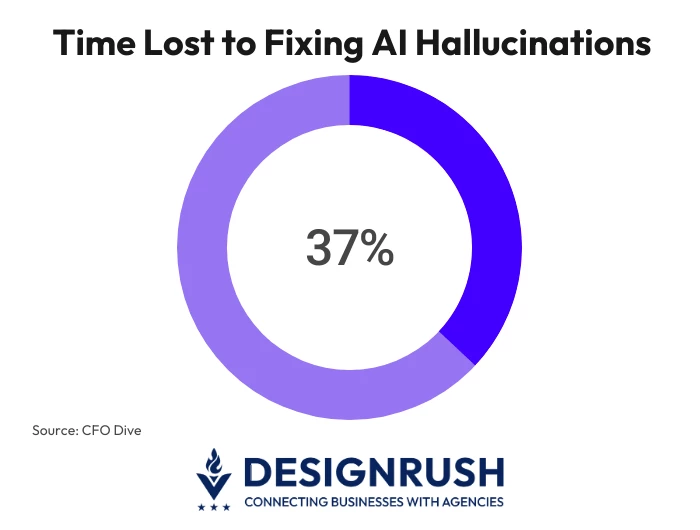
However, the losses go beyond direct financial impact, as 37% of the time employees saved using AI tools was lost to correcting, clarifying, or rewriting low-quality AI-generated content.
And as organizations scale their use of AI across operations, content, analysis, and decision-making, the cost of unverified outputs grows proportionally.
But don’t misunderstand.
The core issue here isn't that AI is unreliable. Rather, it’s that organizations are trusting AI without adequate oversight.
How Hallucinations Hurt Businesses
AI hallucinations are outputs that sound correct but are factually wrong.
A language model does not distinguish between accurate and fabricated information. It generates text based on statistical patterns in its training data.
When it encounters a gap, it fills that gap with something plausible rather than flagging uncertainty.
In practice, this means an AI tool can produce a financial analysis with invented figures, a compliance report with fabricated regulatory references, or a technical recommendation based on non-existent benchmarks.
Without a structured review process, these errors enter workflows, reach clients, and inform decisions.
And from my experience overseeing hundreds of projects at Unico Connect, the downstream effects compound quickly. For example:
- A flawed analysis leads to a misallocated budget.
- A fabricated data point in a client deliverable erodes trust.
- A hallucinated citation in a compliance document creates legal exposure.
It’s the aggregate costs that these problems introduce that lead to the $67.4 billion figure.
Why Scaling Makes It Worse
The risk increases as organizations move from experimental AI use to operational dependency.
When a single team member uses an AI assistant to draft an email, the blast radius of a hallucination is small.
When an organization routes document processing, customer communications, analytics, and decision support through AI systems, every output becomes a potential failure point.
Unfortunately, most organizations scale AI adoption faster than they scale AI oversight. They add AI tools across departments while their verification processes remain informal.
This asymmetry of fast adoption paired with slow governance is where the 37% correction figure originates and why the net productivity gain is far smaller than the initial promise suggested.
What Effective Oversight Looks Like
Oversight does not mean abandoning AI or reverting to manual processes.
It means building verification into the workflow so that AI-generated outputs are validated before they reach a decision-maker, a client, or a production system.
At Unico Connect, we approach this from both sides: building AI systems with built-in validation layers for our clients and advising organizations on governance structures for AI outputs they generate internally.
Three principles guide this work:
1. Define where human review is non-negotiable
Any AI output that informs a financial decision, reaches a client, or enters a compliance workflow needs human verification.
This is not optional overhead. It's quality control for a tool that is statistically guaranteed to produce errors at some rate.
2. Build validation into the system
Verification that depends on a human remembering to double-check is verification that will fail at scale.
That’s why when we deploy AI agents for clients, the agent includes structured checks such as:
- Cross-referencing extracted data against source documents
- Flagging low-confidence outputs for human review
- Logging decisions for audit trails
3. Measure the error rate and make it visible
Most organizations have no data on how often their AI tools produce incorrect outputs.
Yet, without measurement, there is no basis for improving the process.
We recommend tracking correction rates, time spent on verification, and the types of errors that recur.
This is no different from the same operational discipline organizations apply to any other production system.
Address The Governance Gap
The $67.4 billion figure will continue to grow if oversight practices do not catch up with adoption rates.
The fundamental issue is that many organizations treat AI outputs as drafts that need editing rather than claims that need verification.
That distinction matters.
Editing assumes the core content is correct and needs polish.
On the other hand, verification assumes the content may be fabricated and needs confirmation.
Organizations that make the shift from editing AI outputs to verifying them will see two immediate benefits:
- They catch errors before those errors reach clients or inform decisions.
- They build institutional knowledge about where their AI tools are reliable and where they are not, which allows them to deploy AI more effectively over time.
Ultimately, what organizations do next will determine whether AI becomes a genuine operational advantage or simply another source of hidden inefficiency.