
Some agencies lose clients even when the work is accurate, on time, and fully approved.
The problem rarely begins in delivery. It begins when production teams are expected to execute and coordinate simultaneously, managing output, handling client status inquiries, scope questions, and mid-project change requests without defined protocols.
That structural tension is more common than most agency principals care to admit.
One such pattern emerged inside a high-volume eCommerce image-editing workflow managed by an offshore production agency specializing in retouching and post-production services.
In early 2024, the agency introduced a dedicated client communication function, supported by an external operational partner, to address response delays and maintain continuity between clients and internal teams.
Within the first six weeks, average first-response time dropped from more than five hours to under 35 minutes, an 86% reduction.
The trigger was not a delivery failure. The work had been meeting spec. The problem was everything that happened around it.
Disclosure: The operational support partner referenced in this article operates within the same parent company group as the production studio described. All performance data cited are drawn from internal CRM and ticketing systems.
A Retention Problem That Quality Metrics Could Not Explain
The agency had built a reputable service offering for eCommerce clients, covering clipping paths, color correction, and high-volume retouching at scale. Project completion rates were strong.
But the return engagement was not.
Direct outreach to former clients surfaced a consistent pattern. Inbound questions during active projects were handled by designers without the context to address scope, pricing, or scheduling.
Likewise, mid-project change requests had no defined intake process. Meanwhile, response times were unpredictable enough that some clients had stopped expecting a timely reply.
The financial exposure embedded in that pattern is well-documented.
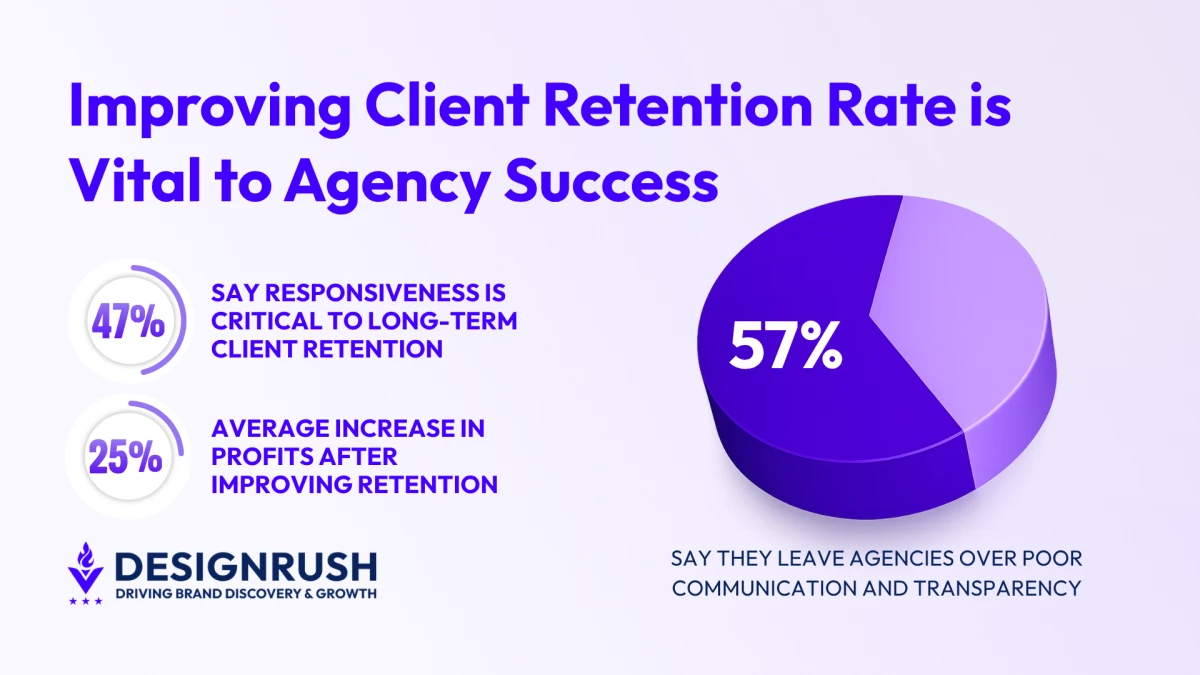
Roughly 57% of clients cited poor communication and transparency as reasons for leaving an agency, according to industry analysis of agency churn.
This matters because a 5% improvement in customer retention can increase profits by 25% to 95%, depending on the sector, per a separate research on retention economics.
When the cause of attrition is operational rather than quality-related, it is also among the most addressable.
Why Hiring an Account Manager Does Not Close the Gap
Production-focused agencies are organized for output.
For firms managing technically complex, high-volume workflows, that orientation tends to produce a predictable structural gap. This often comes in the form of strong delivery metrics alongside inconsistent client-state visibility.
The standard response to this is to hire an account manager.
But in practice, the approach often relocates the bottleneck rather than eliminating it.
The studio followed that path. After six weeks of scoping an internal account manager role, it was set aside.
Image editing communication requires familiarity with rendering behavior, file-format tolerances, retouching consistency at scale, and the handoff logic between rounds of feedback.
A generalist without that background would route most inquiries back to production staff, adding a coordination layer without reducing delays.
Project management research attributes project failure in nearly one-third of organizations to escalation failures and handoff gaps.
In this case, the projects themselves were completed to specification. The deterioration was happening between engagements, in the space where no single role owned client continuity.
How a Purpose-Built Support Layer Was Structured
The external support partner trained its agents across the studio’s full service catalog before any inbound contact was handled.
Onboarding covered the complete scope of work like background removal, basic retouching, multi-layered compositing, and high-volume eCommerce image processing.
It also paid particular attention to the vocabulary and tolerances that production staff used internally.
Tickets were categorized by request type (status inquiry, scope change, pricing clarification, new brief) and assigned SLA thresholds accordingly. Status inquiries carried a 30-minute first-response target.
Scope change requests triggered a structured intake flow before being escalated to production leads. New briefs moved through a defined qualification sequence before entering the queue.
Inbox prioritization was handled through a combination of rule-based triage and sentiment flagging, which surfaced unresolved or time-sensitive threads for agent review.
In one documented instance, a client with a pending batch of 1,200 SKU edits ahead of a seasonal deadline, who had sent three unanswered messages, received a proactive callback within an hour of the flag being raised.
Call documentation protocols ensured that all escalated briefs reached production with full context: client-stated requirements, revision history, deadline constraints, and format specifications.
This reduced the information gaps that had previously generated mid-project interruptions.
Production interruptions tied to client status inquiries were tracked as a separate metric.
Across the first six months, the volume of those interruptions declined substantially as the support layer absorbed the inquiry load that had previously landed directly on design staff.
What Six Months of Operational Data Showed
The first two months involved calibration.
Escalation protocols were refined, and handoff documentation was adjusted based on the types of information production staff needed most.
By month four, performance metrics had stabilized. By month six, the pattern had shifted materially.
According to internal CRM and ticketing data collected between February and July 2024:
- Average first-response time dropped from over five hours to under 35 minutes within the first six weeks
- Inbound lead-to-conversion rate increased from 18% to 34%, attributed to structured follow-up sequences maintaining contact with prospects who had not yet committed
- Repeat engagement from previously lapsed clients increased, with accounts that had historically completed one or two projects and disengaged returning for additional volume
- Production interruptions tied to client status inquiries declined substantially over the same period
What we observed was not a delivery problem.
The work was strong. What was missing was a consistent, knowledgeable point of contact for clients between projects. Once that layer was in place, the retention pattern shifted.
Agency benchmarking data indicates that 47% of leaders at high-retention firms identify consistent responsiveness as the most critical factor in sustaining long-term client relationships.
The increase in repeat business here corresponded directly with the period when clients no longer needed to follow up on unanswered inquiries.
The Operational Insight Worth Sitting With
This case points to a pattern relevant across the production services sector.
Delivery quality determined whether a client completed a project. Workflow coordination and escalation governance determined whether the client came back.
The two problems require different interventions.
Improving an already mature delivery system requires investment in tools, talent, and process at the production level. Building a coherent client continuity layer is a different kind of problem, and in most cases a more tractable one.
For production-focused agencies, the operational cost of that layer is, in most cases, lower than the cost of continued attrition.
The more useful question to ask is how to ensure that the experience of working with the agency, from deliverables to the relationship as a whole, meets the same standard as the output itself.