
Most companies think of outsourcing simply as hiring external teams to save on payroll.
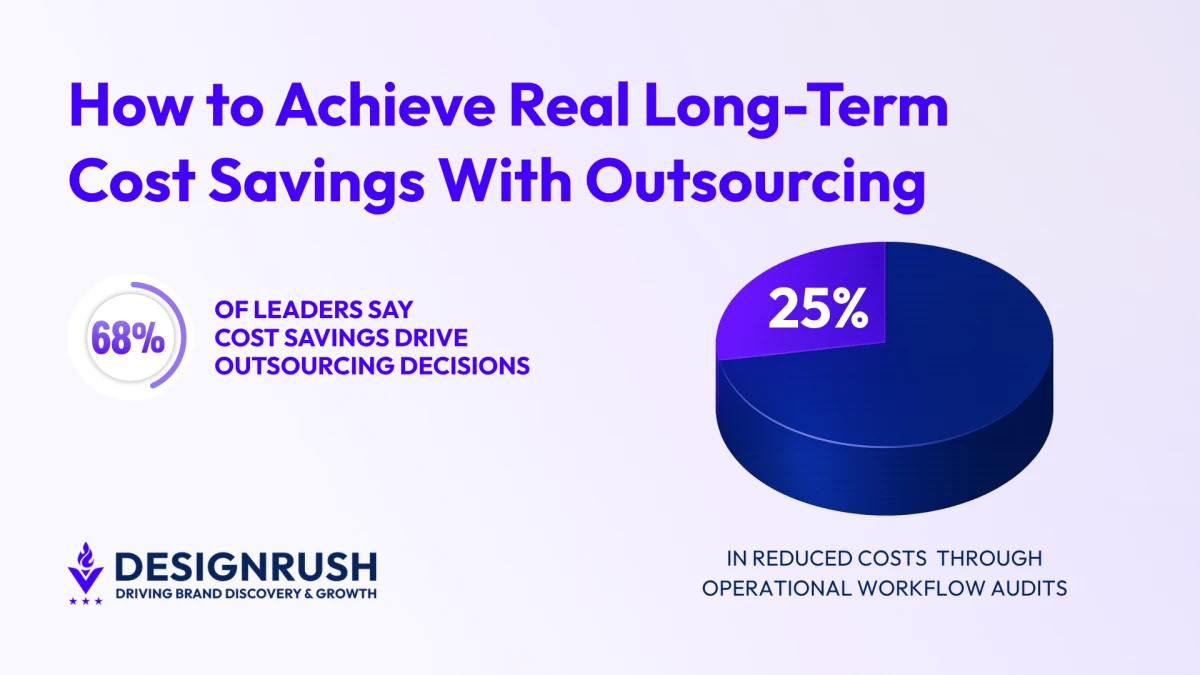
In fact, 68% of surveyed leaders list cost savings as a primary motivator for engaging in outsourcing, according to a report from ISG.
But if cost reduction is the only metric you track, you’re likely leaving thousands of dollars on the table through operational drags you haven’t thought of yet.
So, how do you actually reduce operational costs without dragging the quality down to the point where it’s no longer effective?
You have to move past basic labor arbitrage. True efficiency happens when you focus on three key shifts:
- Optimizing processes before you ever hand them off.
- Leveraging fractional sourcing for high-level, niche expertise.
- Transitioning to outcome-based pricing rather than hourly billing.
In my experience auditing operational workflows with Clark Outsourcing, I realized that companies can cut their administrative cost by over 25% simply by changing their approach.
It forced me to consider something other than the traditional hourly rates and started restructuring the actual engagement models.
The cost savings were almost immediate and actually sustainable.
Here’s how we can explore the unconventional, but effective, strategies that go beyond the traditional methods.
Moving Beyond the Lift & Shift Approach
The biggest trap in restructuring is the "lift and shift" method. This happens when companies take a highly inefficient, poorly documented internal process and simply hand it over to an external team.
While this might lower your initial hourly payroll, it rarely reduces long-term costs.
Instead, inefficiencies multiply across communication barriers, and you end up paying an external team to navigate your broken systems rather than actually executing tasks.
To prevent this financial drain, you must prioritize process optimization beforesigning an outsourcing contract.
A successful transition strategy requires you to:
- Organize current workflows to identify challenges.
- Simplify steps that waste a lot of time.
- Create Standard Operating Procedures (SOPs) so the external team has a detailed guide they can easily follow.
When I was actively managing the transition phase of a small eCommerce support team last year, we spent two weeks looking at errors/workarounds in their software and the escalation process.
By restructuring the workflow by improving the efficiency and writing clear SOPs before making the external team do the work, we reduced the required outsourced staff by 25% and cut their initial onboarding costs in half.
Outcome-Based Pricing Models
Traditional hourly billing can create a big conflict of interest. When you pay an external team by the hour, it’s a financial advantage for them to take longer to complete the work.
When this becomes apparent, it becomes a liability, and you need to transition to outcome-based pricing.
This model ties compensation directly to completed milestones or concrete performance metrics rather than time spent.
If you pay for results rather than hours, you shift the risk from your company to the vendor. If a task takes twice as long due to inefficiency, the vendor absorbs that financial hit.
This structure naturally enforces high efficiency because the external team must optimize its own workflows and adopt better technology to protect its profit margins.
With an outcome-based model, your operations have advantages, such as strategic budgeting, eliminating the need for micromanagement, and having aligned incentives.
Fractional Sourcing for Niche Expertise
Companies often inflate their budgets by hiring full-time specialists for roles that only need part-time, strategic oversight.
You don’t need a 40-hour-a-week Chief Financial Officer or Senior Compliance Director if their core responsibility is to set strategy and review monthly metrics.
Fractional sourcing solves this by allowing you to tap into top-tier executive talent on a part-time basis.
However, the key to fractional sourcing is seamless integration into your existing operational framework. You must avoid treating these experts like standard employees.
To maximize a fractional leader's impact:
- Separate strategy from execution: The fractional expert designs the operational playbook. They don’t run the daily plays.
- Empower your internal team: Assign your existing junior staff to execute the day-to-day tasks outlined by the fractional leader.
- Set high-leverage touchpoints: Limit communication to focused, weekly strategic reviews rather than pulling them into daily internal standups.
How to Identify Fractional Opportunities
Not every role is suitable for fractional sourcing. There are still limitations that businesses continue to address, such as knowing when to hire full-time versus part-time.
Use this quick checklist to determine if a position should be fractionalized:
- Is the workload primarily strategic? The role requires high-level planning, auditing, and decision-making rather than 40 hours of daily, repetitive execution.
- Are you scaling faster than your payroll? You need executive leadership to build department infrastructure, but you cannot yet commit to a long-term C-suite salary.
- Is the expertise highly specialized? The task demands deep knowledge (e.g., advanced cybersecurity, tax strategy, or legal compliance) that your generalist team lacks, but only for a few hours a week.
- Can current staff handle the implementation? You already have capable junior employees who simply need a senior mentor's roadmap to follow.
The Build-Operate-Transfer (BOT) Model
For companies seeking long-term scalability, the Build-Operate-Transfer (BOT) model is a strong solution.
Rather than building a new department from scratch or relying on permanent outsourcing, BOT offers the best of both worlds.
Under a BOT agreement, you hire a specialized third-party partner to build a dedicated team specifically for your company.
In simple terms, they handle the complex logistics of recruitment, infrastructure setup, and initial workflow design.
This provides a versatile and sustainable foundation for the future of your operations.
The standard life cycle of this strategy involves three phases:
- Build: The vendor completely sets up the new operation using their established resources and local expertise.
- Operate: They manage the department daily, optimizing processes and refining output until it reaches peak stability.
- Transfer: Once running flawlessly, the vendor legally transfers ownership of the entire operation, including the trained staff and systems, directly back to your company.
This strategy saves massive amounts of upfront capital. You entirely bypass the costly trial-and-error phase of launching a new department, allowing you to absorb a fully functional, high-performing team.
Furthermore, research into global infrastructure and business operational models by the World Bank demonstrates that BOT frameworks are uniquely structured to distribute risk efficiently, significantly reducing the initial financial barriers to expansion.
The 90-Day Outsourcing Audit Framework
Since the shift toward advanced operational models, new strategies have arisen to improve efficiency.
However, transitioning to these models needs to take time. Attempting to overhaul your entire infrastructure all at once will likely cause more disruptions than it solves.
To successfully implement process optimization, fractional sourcing, or outcome-based pricing, you need to plan.
Let us explore an actionable, 90-day framework to audit your operations and safely deploy cost-saving strategies.
1. The Internal Time Audit (Days 1-30)
Before looking outward, look inward. Have your in-house staff meticulously track their daily activities for two weeks.
Your goal is to identify exactly where your highest-paid employees are losing hours to repetitive, non-core tasks.
Document these bottlenecks thoroughly. In simple terms, you cannot optimize or outsource a process you do not fully understand.
2. The Vendor Structure Review (Days 31-60)
Next, audit your existing external partnerships.
Review every hourly outsourcing contract currently on your books. Identify which of these ongoing tasks have clear, measurable deliverables.
Approach those specific vendors to negotiate a transition to an outcome-based pricing model. This is designed to solve inefficiencies by focusing on results rather than time spent.
3. The Pilot Program (Days 61-90)
Never transition a core operation blindly. Instead, design a low-risk, 30-day pilot program to test a single new strategy.
For example, bring in a fractional specialist to overhaul just one struggling department, or transition a single administrative workflow to a new outcome-based vendor.
Measure the efficiency gains meticulously before committing to a wider rollout.
Rethink Cost Before You Cut It
Companies looking to reduce operational costs should focus less on minimizing expenditure and focus more on removing friction, eliminating inefficiencies, and making better use of expertise.
That often means questioning long-standing assumptions about how work should be structured, who should perform it, and how success should be measured.
This is why the organizations that see the best results are the ones that understand outsourcing works best when it‘s treated as an operational strategy rather than a staffing strategy.