
It’s no secret that the first year of operation is often the most difficult for small businesses.
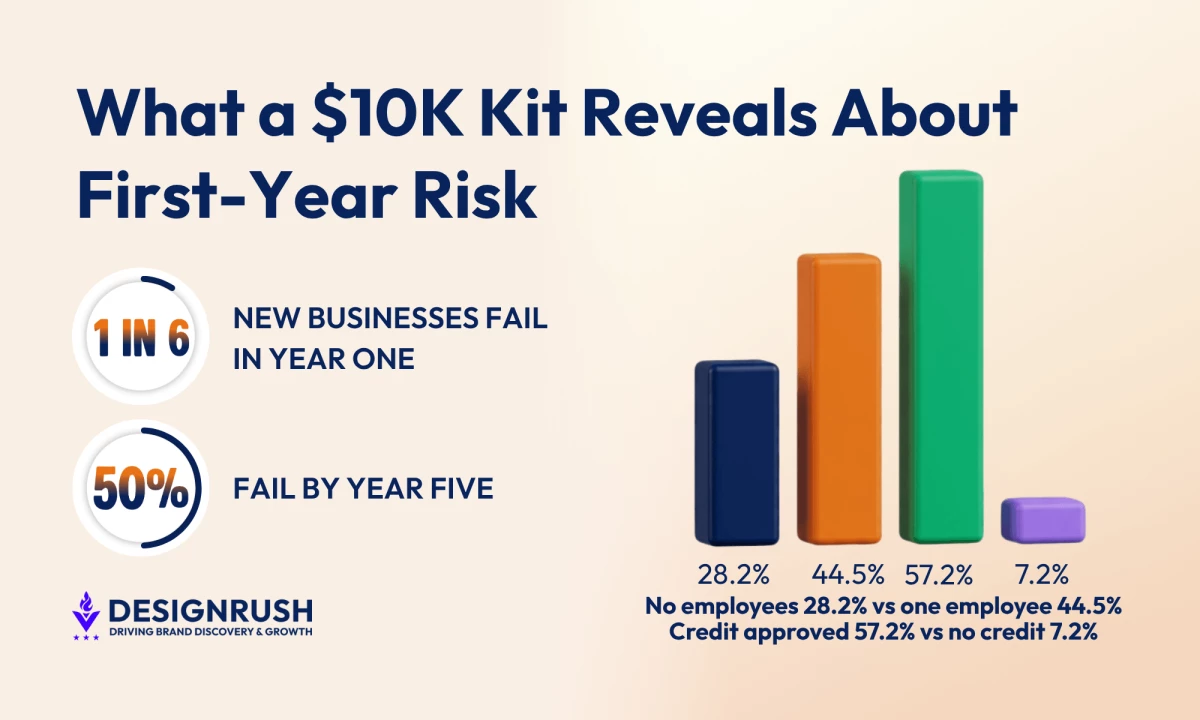
The Federal Reserve said about one in six new businesses fail in year one, and nearly half fail by year five.
National census data also found that startups with no employees had a 28.2% success rate, while those that began with one employee reached 44.5%, with stronger outcomes linked to higher initial capital.
Likewise, early-stage businesses often struggle with operational costs, core setup expenses, and cash flow during their first year.
That’s why Namecheap, a top provider for domain registration, hosting, and digital tools for building and managing websites, ran a $10K Starter Kit contest back in January 2026.
Now, the company has announced the four winning businesses selected from applicants across the U.S.:
- First Place: Habituel ($10,000)
- Second Place: Jolas Kitchen ($5,000)
- Third Place: The Good Hair Tribe and The Creative Yard Arizona ($1,000 each)
Applicants were required to already have a registered LLC before entering the contest, regardless of which provider they're registered with.
In addition, five runner-ups each received $100 in Namecheap account credits that can be used toward product purchases or renewals with the company.
“Early operational support, funding access, and lower setup costs all play an important role during a company’s first year,” says Eva Alexandropoulos, Namecheap Director of Business Development.
“That’s why we decided to run our $10K Starter Kit contest. We just wanted to give some amazing and innovative LLCs and DBAs a foundation for sustained success.”
The contest was open to U.S.-based founders with a registered LLC or DBA, and those without an LLC could register for free through Namecheap, paying only state filing fees.
A Spotlight on the Winners
Habituel
First prize went to Habituel, a functional mushroom beverage brand built around in-house manufacturing rather than white-label production.
The company makes drinks with chaga, lion’s mane, reishi, and turkey tail. It began as a personal project before early feedback from family and customers pushed it forward.
Habituel’s application said the prize would fund an automated pouch filler and an industrial grinder, which would increase production capacity, lower unit costs, and bring more of the process in-house.
The equipment would also help the company scale manufacturing while maintaining tighter control over production and quality.
Jolas Kitchen
Second prize went to Jolas Kitchen, which serves authentic Nigerian cuisine through a food truck in Edmond and ships meals across the U.S. and Canada.
It began by cooking for friends’ events at Dixie State University before developing into a formal business that now serves customers through a food truck in Edmond and ships meals across the U.S. and Canada.
In its grant application, Jolas Kitchen said the expansion would increase production capacity and support retail distribution efforts.
The Good Hair Tribe
One of the third prize winners was The Good Hair Tribe, a tech-driven hair care education and product company.
The company combines science-based hair education and coaching with a product line called Ethniik, which offers culturally relevant formulations designed for textured hair.
The founder’s application listed products not built for textured hair and limited access to usable hair-care education as common market problems.
The prize money would go toward marketing, business development, production, and eCommerce optimization to support growth and customer acquisition.
The Creative Yard Arizona
The second third prize went to The Creative Yard Arizona, a self-service creative studio in Tucson.
The business uses a staff-free model, with online booking, self-check-in, a cyclorama wall, studio lighting, and a connected software product called Kowbi.
Its application described the local market as underserved, with creators often relying on DMs, phone tag, and manual calendars to book space or find photographers.
The company’s pitch focused on a common operational problem for creative businesses, where outdated booking processes and fragmented communication can slow down bookings and reduce revenue.
The prize would support studio upgrades, marketing, and development work for the software side of the business.
Why Startup Support Still Matters in 2026
The first year remains expensive and unstable for many startups, with legal registration, setup expenses, operating costs, and limited cash flow early on.
“Many founders rely on loans, credit, or outside support just to get the business running,” says Alexandropoulos.
That dependence shows up in federal data from 2026.
The SBA’s Microloan Program provides loans from a few hundred dollars up to $50,000, averaging about $13,000, for costs such as inventory, equipment, supplies, and working capital.
The Census Bureau also reported that 57.2% of employer businesses received all the credit they applied for, while 7.2% received none, with banks still the main source of new credit for most applicants.
“Even with credit access in place, funding doesn’t cover everything in the first year,” Alexandropoulos adds.
“Many new businesses still need basic operational infrastructure while setup costs land before revenue becomes steady.”
That is where Namecheap’s Business Starter Kit comes in.
The company continues to offer it to founders registering an LLC, bundling a free domain, email, hosting, and marketing tools for one year.
The goal is to offset early setup costs that usually hit before a business starts generating consistent income.
For many founders, those basics decide how quickly a business gets moving.
They affect how soon it can launch, reach customers, and start bringing in revenue, rather than spending its first year stuck assembling the basics.