
AI in Customer Support: Key Findings
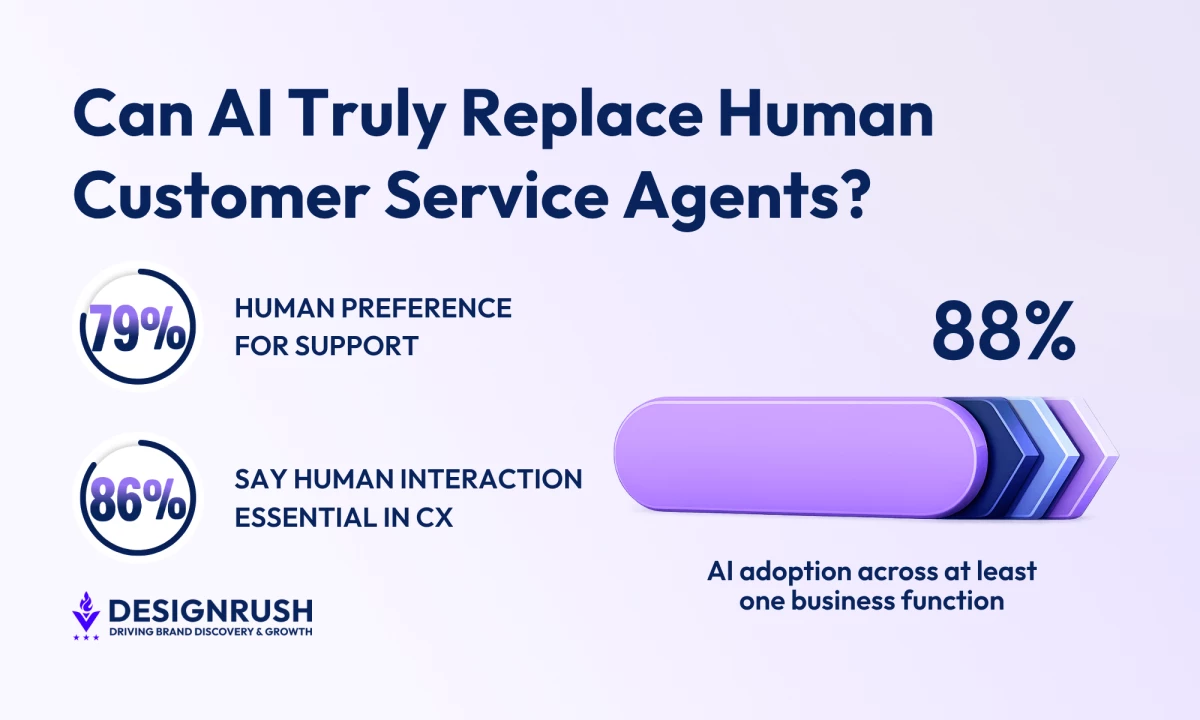
- 79% of Americans still prefer humans, shaping how AI in customer support is used in BPOs.
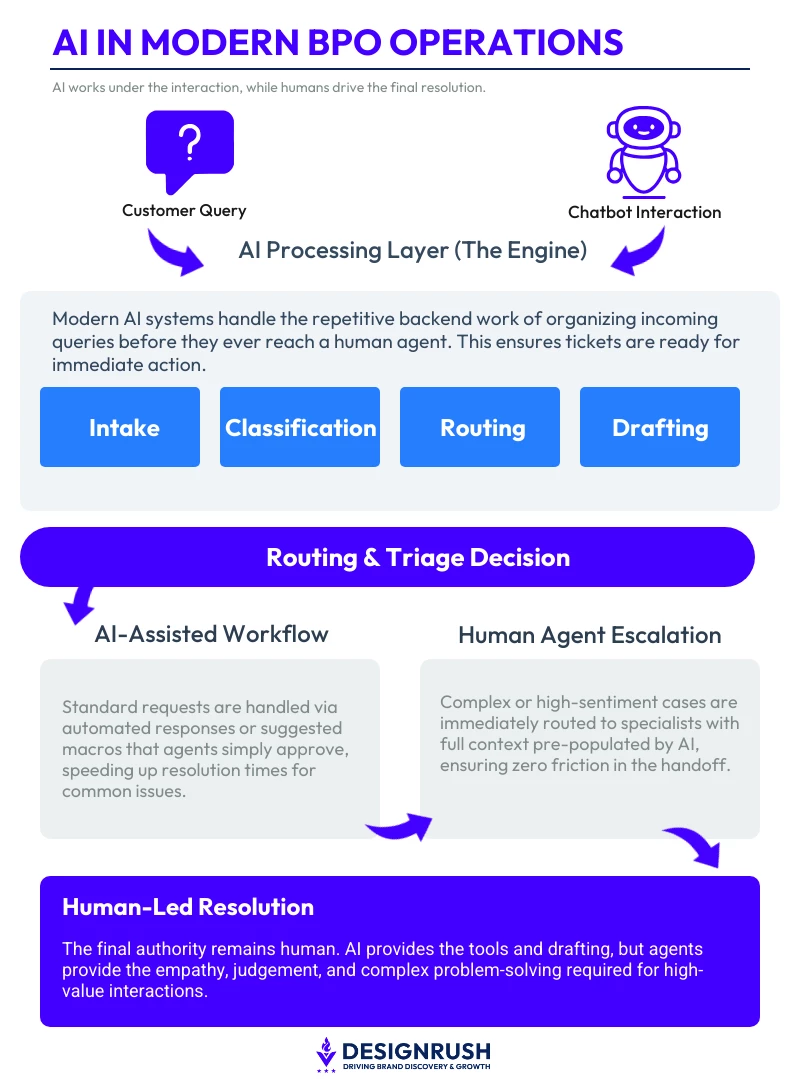
- BPOs apply AI in customer support for intake, routing, and drafting while humans handle resolution.
- Effective systems rely on clear routing rules, strong triage, and human-led handling of complex cases.
New data from SurveyMonkey found that a total of 79% of Americans prefer interacting with a human over an AI agent.
And 86% of consumers in a PwC survey said that human interaction was important to their brand experience.
The use of AI when deciding what to buy hasn’t changed customers’ expectations regarding their experience, and that preference sits at the center of a growing tension in customer support:
When something breaks, they still want a human to fix it.
As AI adoption increases across customer operations, leading Business Process Outsourcing (BPO) companies are focused on changing how support systems are built behind the scenes by using AI to support the human layer rather than replacing it.
Editor's Note: This is a sponsored article created in partnership with Hugo Inc.
Customers Still Prefer Humans Despite Rapid AI Advancement
In practice, global outsourcing companies like Hugo Inc. are defining what AI-assisted support looks like.
A Hugo interview described this model as “AI first, human backed,” where AI is positioned as a support layer that removes the repetitive grunt work and structures incoming requests before agents engage directly with customers.
As Funmi Mide-Ajala, Director of Customer Support & Digital Operations at Hugo Inc., explains:
“AI is most valuable in repetition-heavy tasks.
“Ticket classification, language detection, prioritizing by urgency and intent, drafting responses for common queries, and surfacing relevant knowledge base articles so agents aren't hunting for answers mid-conversation.”
This structure allows human agents to focus less on processing and more on interpretation and resolution.
“A customer who says ‘I want a refund' might actually be telling you they feel unheard,” Mide-Ajala says.
“AI will process the refund, but a skilled agent can read between the lines, pick up on emotional subtext, and get to the root of the matter.”
This is where the operational model diverges from full automation.
AI supports scale, but humans remain responsible for context, emotion, and decision-making.
The experience itself is designed to feel fully human to the customer, even when multiple AI systems are working in the background.
AI Is Already Embedded, but Mostly as a Support Layer for Human Agents
On the enterprise side, AI adoption is becoming more common.
About 88% of organizations are using AI in at least one business function, including customer service, McKinsey & Company found in its “AI at work but not at scale” report.
However, adoption alone doesn’t define proper execution.
In modern BPO operations, Support quality is no longer defined by responses.
It’s defined by routing and whether or not a ticket should be handled through AI-assisted flows or escalated directly to a human agent.
Mide-Ajala explains:
“The intake layer has a few things happening simultaneously: chatbots handling initial intake, confirming identity, pulling up order details, and collecting the basic ‘what happened’ before the ticket reaches an agent.”
Once that structure is in place, routing systems evaluate intent, sentiment, and complexity to determine what should happen next.
But escalation is built into the design, so if the system detects anything that suggests frustration, the ticket will be routed to a human.
It is this triage model that allows AI to improve speed and efficiency without removing that sought-after human layer during the process.
What This Means for Brands and Agencies Building Customer Experience Systems
Research from Deloitte shows that service teams see the biggest gains when AI is built into workflows instead of added as standalone automation.
For example, Hugo worked with a 107-person support team dealing with high ticket volume and rising costs.
Instead of adding AI on top, the team redesigned workflows to embed AI into intake, classification, routing, and response drafting.
The result?
- 60% of tickets resolved without human intervention,
- A 42% reduction in support costs, and
- A 12-point increase in CSAT.
This translates into three operational priorities to note when introducing AI workflow automation:
- Define routing logic before scaling AI.
- Build triage as the core system to ensure intent, urgency, and sentiment are accurately defined and filtered before a human steps in.
- Design for “protected moments” that carry a disproportionate weight in retention outcomes, like cancellations, refunds, and escalations.
For agencies building CX systems, routing logic between AI and humans is now the core design problem.
That’s where experience quality is ultimately decided.