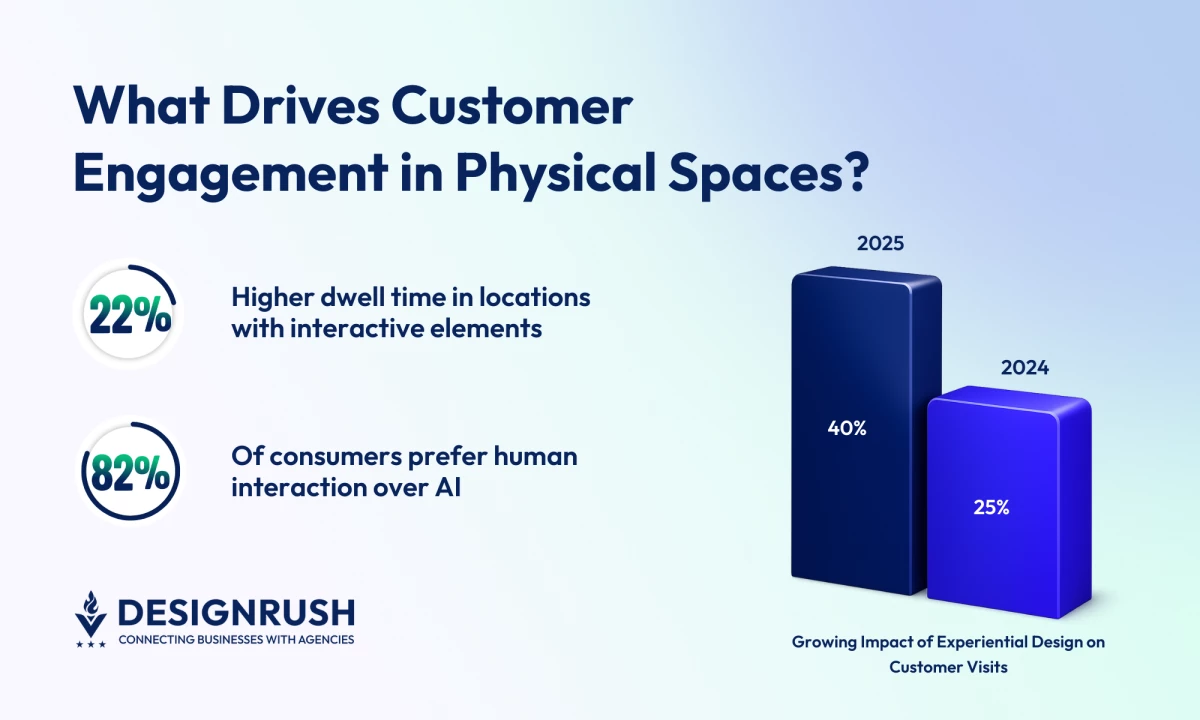

Customer Engagement: Key Findings
- Interactive elements can increase dwell time by 22% and visits by 25%. Add hands-on features to keep guests engaged and encourage repeat visits.
- Immersive spaces lead to 40% longer customer visits on average. Use layout, graphics, and signage to guide exploration and strengthen brand connection.
- 82% of consumers prefer human agents over AI, and 93% value human interaction. Maintain a personal touch in physical spaces to build loyalty and trust.
In retail and restaurants, making people feel welcome all comes down to the space, and whether it’s designed to trigger intuitive, automatic responses.
According to the International Council of Shopping Centers, locations that added interactive or entertainment features saw:
- 22% increase in average dwell time
- 25% rise in visit counts
Meanwhile, stores with immersive elements show around 40% longer customer visits, on average, according to UnivDatos, a global business intelligence firm.
Creating environments that encourage exploration, connection, and return visits is often easier said than done, and that’s where global branding agency Willoughby Design brings decades of retail experience.
Its team uses immersive design, interactive features, and visual cues to guide how guests move, engage, and connect.
A good example of how this can be done through the creation of a strong brand that clearly translates to signage is the work they did for Main Event, designed to make customer experiences engaging, valuable, and effortless.
Editor's Note: This is a sponsored article created in partnership with Willoughby Design.
Main Event is a national chain of family entertainment centers. Willoughby refreshed their brand identity system with a bigger attitude and more vibrant visual cues that are bursting with all the fun that happens inside.
Vibrant color brings the energy while bold black type makes it easy for guests to navigate the arcade, bowling lanes, and lounge areas. As a result, the highly activated space excites but doesn’t overwhelm.
The modern and sophisticated wayfinding system that Willoughby created for Loew’s Kansas City Hotel works in a completely different way.
The signage is so elegantly integrated into the built environment that guests see it and use it without even realizing it’s there.
It’s about prioritizing human behavior and a brand’s reason for being to inform aesthetics. This design philosophy comes through clearly when they talk about purposeful space:
“When every surface has a purpose, the space becomes an immersive element of the brand,” said Nicole Satterwhite, co-CEO of Willoughby Design.
“Graphics and signage are tools, not decoration. They support the experience and keep guests engaged.”
Beyond everyday design, themed experiences and interactive activations take engagement to the next level, giving guests moments they remember.
How Seasonal Immersions Boost Engagement and Recall
Mintel’s Holiday 2025 analysis found that seven in 10 U.S. adults say festive in-store experiences make shopping more enjoyable.
Hallmark is one of the masters when it comes to holiday branding. Their recently reinvigorated Christmas Experience shows how design shapes the way people engage through ice skating, holiday markets, photo spots, and hands-on workshops.
Guests notice small details as they move through the space and naturally engage with the activities.
Panera Bread, a past Willoughby client, is also well known for taking its customers along on a journey through the year with seasonal foods and associated in-café campaigns.
Willoughby layered in brand storytelling that tempts the reason for the season and the taste buds.
The design brings the food experience to the forefront, helping customers engage with the menu while feeling festive in the environment.
In Willoughby’s work, every touchpoint, which includes messaging and visual design decisions, contributes to the guest experience in a subtle manner.
Nicole Satterwhite points out how this plays out in physical spaces.
“Spaces that evolve throughout the year and gain a reputation as places that feel celebratory and on season give guests a reason to return to see what is new,” Satterwhite said.
“This can be more easily accomplished when graphics, messaging, and signage are layered over the everyday built environment vs changing out more expensive finishings.”
Design Cues That Drive Real-World Customer Engagement
Guests pick up on cues the moment they enter a space. What they remember or take away from that experience is an opportunity to create a memorable interaction with that brand.
They notice graphics that catch their attention and stop when something invites interaction.
The selfie wall that Willoughby created for KC Pet Project is a dynamic graphic experience that brings joy to the space, reinforces that brand story, and doubles as a background for the perfect first family photo when a new pet is adopted into their forever home.
And sometimes brand installations can double as art installations, such as the antique key wall behind the welcome desk at the Inn at Meadowbrook.
The key, representing the white glove service of times past, integrates into the very modern environment to tell the story of this unique destination.
Wayfinding, graphics, and interactive features help guide movement and focus attention.
When these elements are clear, guests move comfortably and engage at their own pace.
Thoughtful design shapes perception through clarity and consistency.
People feel settled when the space makes sense, and that feeling keeps them present.
“When a space feels intuitive, people engage more freely. They notice details, move confidently, and interact in ways that feel natural,” Satterwhite said.
That sense of comfort is what builds familiarity and encourages repeat visits.
Design as the Key to Driving Loyalty That Lasts
As our world continues to evolve, even in AI-driven environments, guests respond to empathy, attentiveness, and understanding.
A mid‑2025 HubSpot/SurveyMonkey survey found that 82% of consumers prefer human agents over AI systems, and additional research shows 93% of consumers favor human interaction.
That said, according to Kinsta’s 2026 research, 93% of consumers still prefer human interaction, and 84% believe people deliver more accurate service than AI.
That’s why the physical environment is becoming one of a brand’s most important differentiators.
Brand engagement is most successful when shoppers can experience something meaningful in person.
Digital shopping is convenient, but it cannot replace the sights, sounds, and human interaction that only come from being inspired by a space that offers tangible experiences.
But design alone isn’t enough; it has to be done right.
This is where Willoughby’s work stands out.
For brands, it shows that thoughtful design supports behavior and builds trust.
The main takeaway?
By treating every wall, sign, and visual as a behavioral cue, they create spaces that make guests feel welcome and want to return.