
Celebrity Ads Fail Without UX: Key Findings
- Many celebrity-led campaigns lose ROI after the click, highlighting a widespread failure to prioritize UX as a revenue-driving asset
- UX and engineering are brought in too late, creating friction-filled experiences that dilute even the most expensive creative efforts
- Performance hinges on campaign-to-landing-page continuity, demanding consistent messaging, fast mobile load speeds, and real-time optimization from the start
From Super Bowl ads to social feeds, celebrity campaigns are everywhere.
It’s nothing new, but if recent campaigns tell us anything, it’s that star power is still one of the most common approaches for brands with big marketing budgets.
Uber Eats, for example, is marking its sixth consecutive Super Bowl ad appearance with a 2026 campaign that reunites “Dazed and Confused” castmates Matthew McConaughey, Bradley Cooper, and Parker Posey.
Similarly, Hellmann’s Super Bowl LX ad features a celebrity-filled cast, including Andy Samberg, Elle Fanning, and a full deli of singing extras in a musical parody planned for the fourth quarter.
Albeit fun, fan-favorite lineups, they’re certainly not inexpensive.
When you factor in the $10 million cost for 30 seconds of airtime alone, not to mention talent fees, production, and extensions across platforms, the stakes behind these celebrity-led ads become clear.
But are these sky-high celebrity spends actually paying off?
On the surface, data seems to support the strategy. According to WifiTalents’ 2025 research:
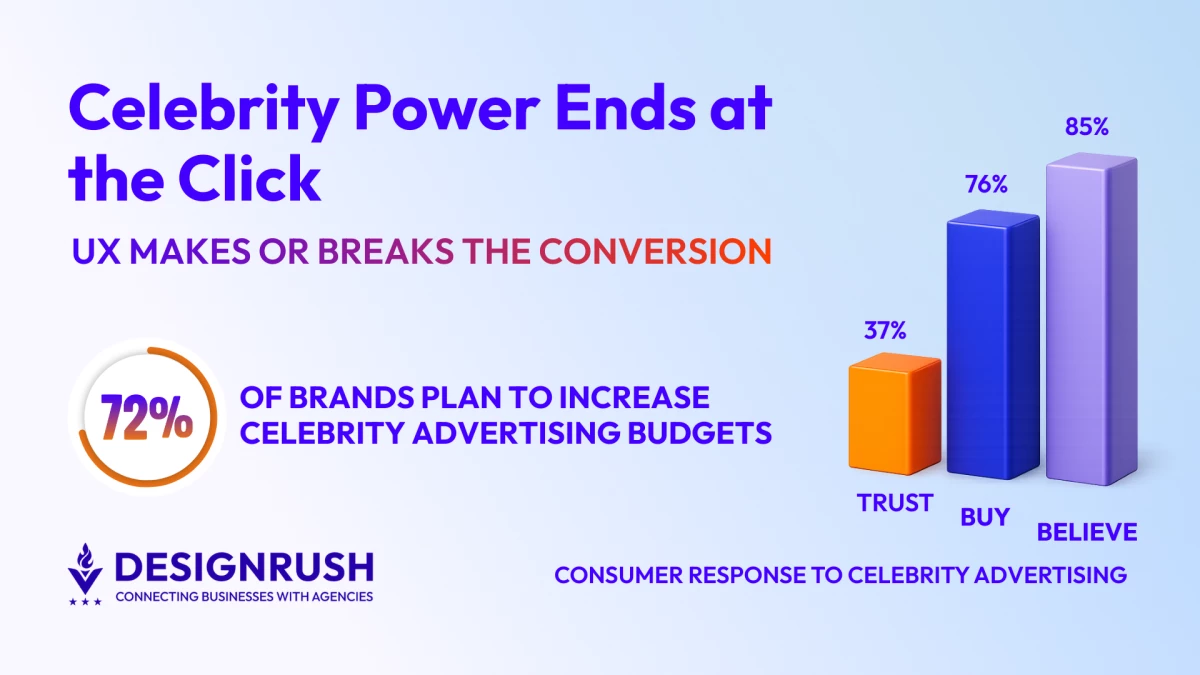
- 76% of consumers say they are more likely to purchase celebrity-endorsed products
- 37% place more trust in celebrity endorsements than other ad types
- 85% believe celebrity-backed brands are more honest than traditional advertising
- 72% of brands planned to increase celebrity endorsement spend in 2026
Editor's Note: This is a sponsored article created in partnership with Viacon.
Still, attention does not automatically equal ROI.
In a multi-year study, System1 Group found that Super Bowl ads featuring brand mascots outperformed celebrity-led spots in both emotional impact and short-term sales lift.
See here for the types of ads that proved famous faces, or at least human faces, aren’t everything:
What drives performance is what happens after that first click on an ad or CTA, which often determines whether a campaign delivers real results.
Sutanu Upadhyay, Head of Technology at leading digital marketing agency, Viacon, knows this all too well. An expert in digital performance and post-click optimization, Upadhyay warns that over-relying on celebrity power often leaves campaigns vulnerable at the point that matters most.
While celebrity-led creative can spark curiosity and drive traffic, performance still hinges on what happens next.
Brands often underestimate how much user experience (UX), landing page strategy, and technical execution influence real outcomes. The result is a familiar pattern, where big ideas attract attention, but underbuilt experiences struggle to convert it.
Why Most Celebrity-Backed Ads Fail After the Click
For many agencies in the field, high-profile campaigns traditionally always start with the same priorities: creative concept and media planning.
The idea then gets signed off, talent is secured, and timelines start moving fast.
Unfortunately, user experience and engineering teams often enter the process later, once most decisions are already locked in.
“From a technology and delivery standpoint, the biggest issue is sequencing,” Upadhyay says.
"High-profile campaigns usually start with creative and media planning, while experience design and engineering enter the picture later. By then, timelines are compressed and teams are focused on “making it live” rather than “making it optimal.”
There is also a lingering assumption that a strong concept or celebrity presence will smooth over any experience issues.
However, in practice, it rarely does.
In reality, both UX and technology should be brought into campaign discussions right from the start.
As such, web experience design must be treated as a strategic layer and not just a finishing touch.
“When brands align campaign strategy with experience strategy from day one, performance improves dramatically,” Upadhyay says.
How to Build Landing Pages That Turn Clicks Into Customers
A landing page built for performance does not try to do everything, but is engineered around intent.
“The page should immediately answer three questions: Where am I? What’s in it for me? What do I do next,” Upadhyay says.
Message continuity is equally as critical.
When an ad makes a promise, the landing page should pick up right where it left off. It should feel familiar, consistent, and part of the same story.
Mobile devices are the first point of contact for the majority of people.
This makes it critical to keep one clear goal in focus, guide the eye with clean visuals, ensure fast load times, and remove any unnecessary steps.
“Equally important, we embed analytics, heatmaps, and event tracking from day one so every landing page is built for optimization, not guesswork,” Upadhyay says.
“This allows us to continuously test and refine based on real user behavior.”
Why Big Creative Fails Without UX at the Table
Upadhyay has seen beautifully produced campaigns generate waves of traffic only to stall at the point of conversion.
Conversely, some of the most successful campaigns are those paired with intentionally simple creatives, leading to highly optimized experiences.
Fast load speeds, clear flows, and strong message continuity consistently outperformed expectations.
The pattern is hard to ignore. Creatives attract attention, but UX and technology are what turn that attention into results.
That’s why the most effective campaigns are not built in silos, but shaped collaboratively long before production begins.
Here, creatives define the emotional objective, UX maps the journey, and engineering ensures scalability, speed, and feasibility.
This not only prevents rework at a later stage, but ensures that the final experience matches the original vision.
Why the Post-Click Experience Is the Real ROI Engine
The biggest mistake brands investing heavily in celebrity endorsements or high-budget campaigns make is treating the post-click experience as a supporting asset instead of a core investment.
To mitigate this, brands must design dedicated campaign landing environments, define clear conversion paths, and set up continuous optimization from the start.
“This ensures the surge in attention is captured and converted into measurable business value,” Upadhyay says.
As celebrity-driven advertising continues to dominate ad spend, the brands that win will be the ones that look beyond the spotlight. Ultimately, while creative may open the door, it is the experience behind it that determines if anyone walks through.