
Google SEO Site Migrations: Key Findings
- Staggered site migrations create SEO confusion, with Google often treating split domains as competitors, weakening ranking signals.
- Full, coordinated migrations protect organic visibility, enabling cleaner authority transfer and faster indexing stability.
- Execution quality determines long-term SEO outcomes, where redirect errors and phased moves cause the biggest visibility loss and slow recovery.
For many B2B companies, a website migration represents a pivotal moment, where new branding, updated architecture, product expansion, or an acquisition might make moving to a new domain seem attractive.
Paul J. Scott, Chief B2B Website Strategist at leading B2B digital agency, GoingClear, explains that while a website migration may seem appealing, not all migrations are created equal.
“This is particularly relevant when site owners attempt staggered or partial moves that leave some pages on the old domain while others live on the new one.
“And instead of a smooth transition, Google’s systems often interpret this as two competing entities rather than a single, unified website,” adds Scott.
In this video, Scott explains why SEO migration and preservation are essential to optimize your brand’s online visibility:
Editor's Note: This is a sponsored article created in partnership with GoingClear.
Why Google Rejects Staggered Moves
It is essential to know that when only the homepage moves while large sections like product or category pages remain behind, search systems struggle to understand the site’s identity.
In a complete website migration, signals such as link authority and relevance cues transfer cleanly from old to new.
“In contrast, partial moves create signal fragmentation, unclear domain identity, and reporting noise in Search Console,” says Scott.
The SEO Risks for B2B Sites
For B2B brands with deep content hierarchies and thousands of product or solution pages, this matters more than ever.
These websites often depend heavily on organic visibility for high-value keywords tied to specific offerings.
When content is split across two domains, Google may crawl and index both separately, leading to:
- Confusing signals around domain authority
- Inaccurate performance metrics
- Unstable rankings
- Longer recovery periods after the move
“In other words, what starts as a phased rollout can end up resembling a technical SEO fragmentation, and precisely the state that B2B brands want to avoid,” notes Scott.
B2B websites update a pain point for your organization?
— GoingClear | Digital Agency (@goingclear) May 20, 2025
.
.
.
Our B2B website management, design, development, and optimization is our jam. And we do happen to be excellent at softball and ultimate frisbee for that! ✔️ https://t.co/3dcFfELD3Dpic.twitter.com/JvBsoSsCR8
What the Evidence Reveals
While Google’s guidance on staggered vs. full migrations is crucial, it helps to understand what independent data shows about real SEO outcomes after site migrations.
According to Search Engine Journal, domain migrations consistently trigger ranking turbulence, but the scale and duration of impact depend heavily on strategic rigor, technical accuracy, and whether brands migrate all at once or in fragmented phases.
The research shows:
1. Domain migrations can be long-term SEO events
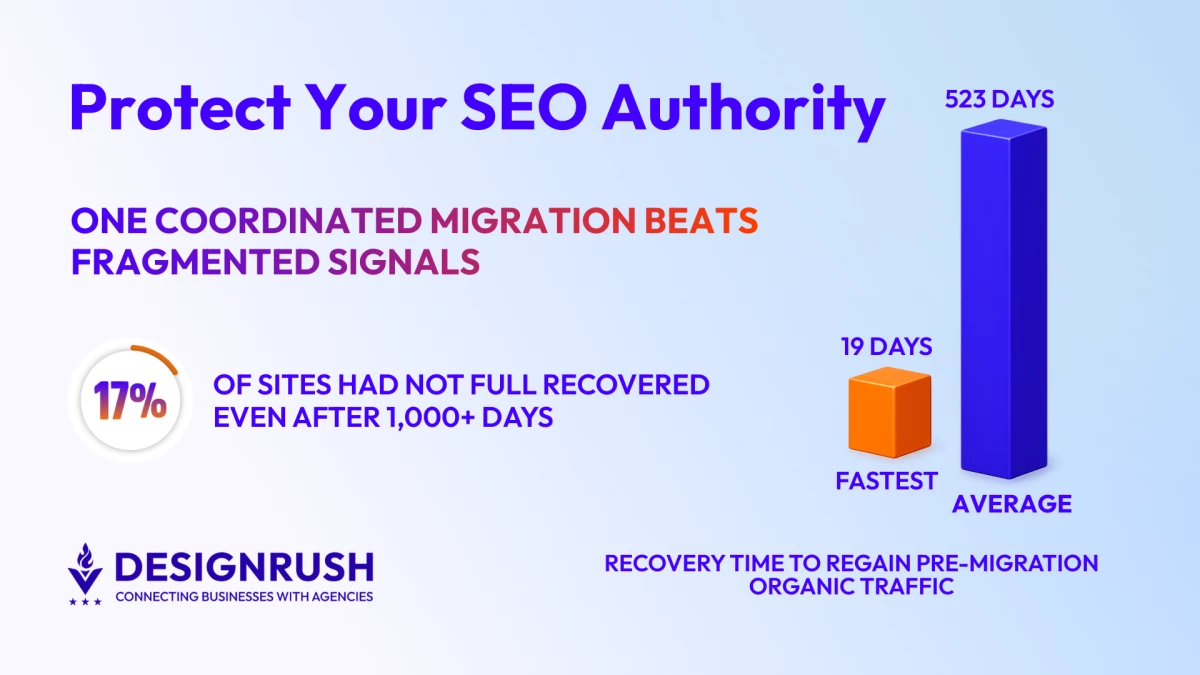
In a large dataset analysis of 892 domain moves, it took 523 days (1.4 years) on average for a new domain to reclaim previous organic traffic levels.
To this end, 17% of sites had not fully recovered even after 1,000+ days.
2. Outcomes vary significantly based on execution rigor
Exceptional migrations regained visibility in 19 to 33 days.
However, these were statistical outliers, reinforcing how site size, redirect strategy, and technical planning influence trajectory.
3. SEO-first migrations consistently outperform SEO-late moves
Sites that implement complete redirect mapping, internal link updates, and sitemap coordination from launch are far more likely to recover or improve organic performance.
Conversely, those that attempt partial or phased domain transfers see slower consolidation of authority.
The numbers reinforce the same takeaway.
Full migrations with exact redirects outperform phased domain moves, which dilute authority and prolong instability.
What This Means for B2B Brands
These statistics reinforce Google’s stance, where search systems need one clear, coordinated move to properly reassign authority.
“For B2B brands managing deep product taxonomies and content funnels, even a small period of prolonged ranking volatility can impact lead flow and sales cycles,” adds Scott.
Why a Complete and Coordinated Migration Wins
Full site moves eliminate these ambiguities.
When a site transition includes precise redirect mapping and a comprehensive timeline, Google can detect clear before-and-after signals.
The Change of Address tool in Google’s Search Console works more predictably when the majority of URLs, and not just the homepage, are redirected to their exact counterparts.
The result?
Search engines are able to quickly consolidate authority, keeping internal link equity intact, and ensuring that B2B SEO performance stays stable, even through inevitable short-term fluctuations.
A Practical Roadmap For B2B Migration
As an expert in B2B migration, Scott offers a practical roadmap that B2B brands should follow to protect rankings and ensure a coordinated migration:
1. Map All URLs with 1:1 Redirects
Build a comprehensive redirect map so every old page has a new destination. This minimizes loss of link equity and reduces crawl confusion.
2. Update Internal Links Post-Migration
Once redirects are live, update internal links across the site so they point directly to the new URLs rather than relying on redirects as a fallback.
3. Use Search Console Strategically
Verify both old and new properties in Google Search Console and submit sitemaps for efficient discovery.
4. Monitor Traffic and Rankings
Benchmark traffic before the move so you can track organic performance closely afterwards, with particular attention to high-value B2B content.
5. Coordinate Timing with Marketing and Product Launches
Avoid overlapping migrations with other major site changes that might complicate indexing and performance analysis.
6. Communicate with Stakeholders
Keep product, content, and analytics teams aligned on migration timing and expectations to ensure clear visibility across departments.
Final Tips to Master Your Move
For B2B brands, the lesson is evident: don’t stagger your site migration if you can avoid it.
“A complete, coordinated approach protects your SEO health, prevents unnecessary ranking volatility, and ensures that Google, and users, recognize your new site the moment it goes live,” concludes Scott.