
HubSpot CMS for B2B Website Growth: Key Findings
- 70% of active websites now run on a CMS, pushing B2B brands toward platforms like HubSpot that reduce plugin chaos and maintenance risk.
- 69% of decision-makers increased CMS spend in 2024, signaling a shift toward systems that unify marketing, sales, and website performance.
- B2B brands with long sales cycles now rely on connected data, making HubSpot CMS a natural fit for companies that need clearer attribution and personalization.
It’s no secret that having a beautiful website and good content is vital for B2B brands looking to improve their online visibility.
Sometimes, however, the value of having a great content management system (CMS) can get lost in the shuffle. Yet, this component powers a significant portion of the Internet.
According to a report from ThemeIsle, 70% of all active websites have a formal content management system powering their back end.
Additionally, a 2024 survey by Forrester showed that 69% of decision-makers increased their CMS investments in 2024. This is up from the 59% of survey respondents in 2023.
That number is only expected to go up in 2025 and beyond, as more companies look for ways to continue adapting to the rise of genAI and the need for AI-friendly content.
This doesn’t surprise Paul J. Scott, Chief B2B Website Strategist and Founder of award-winning web design agency GoingClear.
Scott has helped many B2B brands integrate content management systems, notably HubSpot CMS.
“More and more B2B decision-makers are starting to understand that a CMS isn’t just a backend tool. It serves as the foundation of a company’s entire digital growth engine.
In simple terms, having the right CMS can streamline marketing and sales alignment, boost SEO, and accelerate conversions,” Scott says.
In our interview, Scott shares his insights on why more B2B companies are making the switch to HubSpot CMS, how brands should navigate the transition, and what it means for their digital growth.

Who Is Paul J. Scott?
Paul is the Chief B2B Website Strategist and Founder at GoingClear. GoingClear is a B2B web Design agency located in Boston, MA, and established in 2001.
Paul spends his days at the agency working on website strategies for their clients, site optimization, and developing clear digital campaigns to support ongoing post-launch activities.
Why Companies are Switching CMS
For many businesses, the shortlist of CMS options often starts and ends with WordPress because it’s free and open source. However, it does have its downsides.
WordPress relies heavily on third-party plugins, which often leads to conflicts with both existing plugins and those added on later.
There’s also no guarantee existing plugins will continue to work after a WordPress update.
These integration and reliability issues can easily lead to increased maintenance costs or lost revenue due to downtimes, sinking a B2B brand faster than a floatie with a hole.
“This is a big problem since B2B organizations are trying to centralize their marketing and sales stacks,” Scott explains.
“When your website runs on a separate system that doesn’t fully connect with your CRM or automation tools, you lose valuable data visibility and efficiency.”
This is why his team often steers B2B clients towards HubSpot CMS.
As part of the larger HubSpot ecosystem, the CMS allows seamless integration and data sharing across all touchpoints.
And while HubSpot CMS wasn’t the most popular choice three to five years ago, it has quickly evolved into one of the web’s most marketing-friendly platforms by offering:
- Unified systems: Many B2B companies now run their marketing and sales operations entirely within HubSpot. Adding HubSpot CMS brings websites into the same environment, creating one connected system for data, reporting, and campaign management.
- Improved performance: Executives now expect proof that every campaign ties back to revenue. HubSpot CMS connects content performance directly to sales outcomes, offering clear attribution paths.
- Smarter decision-making: With everything under one roof, marketing teams gain clearer insights into how website activity connects to lead generation and sales outcomes. This integration turns the website into a measurable growth asset rather than a standalone channel.
Naturally, these features benefit any B2B company, but Scott says these are especially helpful for ones that have long sales cycles or multi-step buyer journeys:
“There’s just so much nurturing, automation, and personalization that ties back to contact records and deal records so neatly. That level of integration is invaluable,” Scott says.
“It allows marketing to deliver the right message at the right stage while giving sales full visibility into how prospects engage with content.
That feedback loop shortens the path from awareness to conversion and keeps every touchpoint aligned with real results.”
How GoingClear Helps B2Bs Transition
Switching to a new CMS can be intimidating for any organization.
GoingClear approaches this challenge with its G3 Framework, a trademarked three-part process focused on creating high-performance websites for B2B brands on HubSpot CMS.
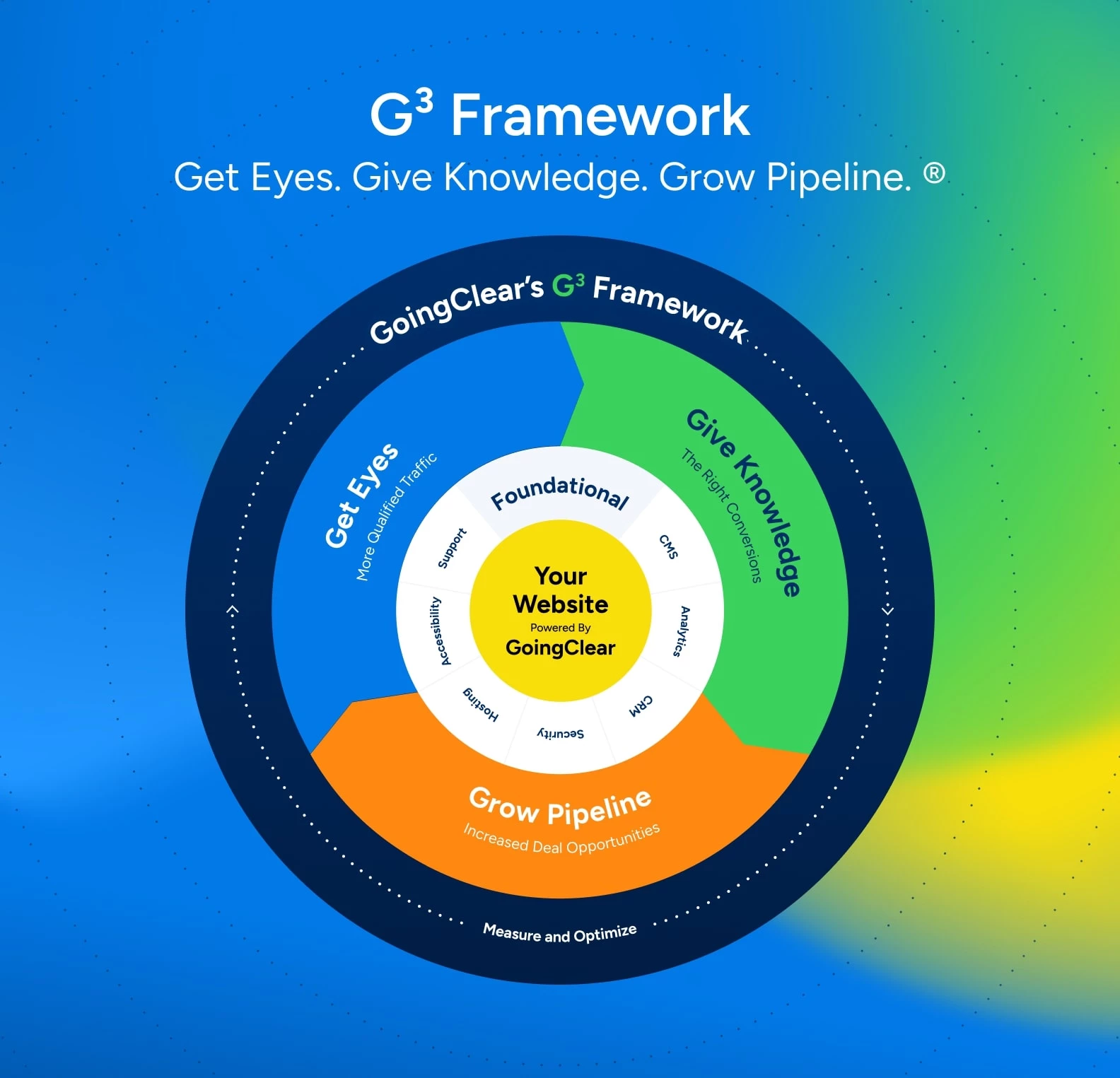
The framework has three core pillars that support creativity with strategy:
- Get Eyes: GoingClear works to bring qualified audiences into the funnel through SEO best practices and UX choices that support discoverability. It’s about putting the brand in front of the right eyes rather than simply increasing traffic for traffic’s sake.
- Give Knowledge: Instead of overwhelming visitors with features or jargon, the site guides them through a structured understanding of the product or service. This phase transforms the website into a knowledgeable, helpful extension of the sales team.
- Grow Pipeline: GoingClear helps B2B companies build conversion paths that integrate directly with CRM, automation, scoring, and sales workflows. The goal is to guide captured leads through a pipeline that reflects measurable intent and engagement.
“Our G3 Framework is very inbound-friendly, which makes it a perfect fit for HubSpot CMS. This is especially true when a client’s goal is to drive qualified inbound traffic to their website.
By using the right resources, such as ebooks, webinars, CTAs, and resource hubs, they can increase conversions.
Ultimately, sales enablement tools and deal-specific elements help grow the pipeline, especially when the site is built on HubSpot CMS,” Scott says.
Should You Make the Switch?
The advantages of switching to HubSpot CMS are undeniable, but that doesn’t necessarily mean it’s a one-size-fits-all solution.
A CMS migration can either accelerate growth or create months of clean-up work, depending on how thoughtfully a company prepares for the transition.
Unfortunately, many B2B teams either underestimate this or rush into migration without careful consideration.
“Some companies switch platforms simply because their competitors did, or because a plug-in broke one too many times.
Without a strategy anchored in business goals, the migration becomes a reaction rather than a roadmap,” Scott says.
To avoid making these mistakes, Scott advises decision-makers to assess whether migrating to HubSpot CMS is the right move by asking themselves the following questions:
1. Is your marketing and sales stack already rooted in HubSpot?
When a company’s CRM, automation, and reporting live inside HubSpot, moving the website there often creates immediate efficiencies.
If the organization still uses multiple disconnected systems, the gains may be less pronounced until consolidation happens.
2. Does your current CMS prevent you from tracking, nurturing, or personalizing effectively?
If teams cannot see which content influenced a deal, or if lead nurturing requires constant manual work, the CMS is likely part of the problem.
Poor visibility is an early sign that the platform can’t scale with the business.
3. Will this CMS support the next stage of your growth, not just today’s needs?
A migration should solve for tomorrow.
B2B brands with long sales cycles or expanding product lines need a CMS that can flex for personalization, reporting, security, and global scalability.
Otherwise, the company risks repeating the migration process in a few years.
Commit to Building a Smarter Digital Engine
B2B brands often underestimate how much their CMS shapes the rest of their operations.
If there’s one takeaway from my discussion with Scott, it’s that choosing the right system reflects how a company intends to operate.
It often comes down to working with clean data, aligned teams, and measurable results, or struggling with disconnected tools and inconsistent information.
And that’s why so many B2B brands are turning to HubSpot CMS. Not solely because it’s a great platform, but because it’s a great platform for their specific needs.