
SEO Roundup: Key Findings
- Google Search Console impression data was inaccurate for 50 consecutive weeks, with the fix applying only to data going forward.
- YouTube lost 567 visibility points in the March core update, the largest single-domain drop in Amsive's analysis of 2,000+ US domains.
- Google introduced five citation updates in AI Mode and AI Overviews, including inline hover previews and subscription-highlighted sources.
Each week, our analysts track the developments reshaping organic visibility and AI discovery. Brands building search programs can partner with vetted SEO agencies for strategic implementation.
Google's March core update data showed aggregators losing search visibility while brand and government sites gained ground, confirming a clear preference for first-party sources.
Google also resolved a year-long Search Console data error, introduced five citation changes to AI Mode and AI Overviews, and published guidance to help sites prepare for AI agents.
Here are the latest updates in search this week.
March Core Update Data Shows Aggregators Losing Ground
Amsive tracked US search visibility changes across 2,000+ domains using SISTRIX Visibility Index data, comparing scores at the start and completion of the March core update rollout.
YouTube lost 567 visibility points, the largest single-domain decline in the dataset and roughly 30% larger than Wikipedia's 435-point drop during December's core update.
The drop partly reverses a surge from early March, returning YouTube's visibility to pre-surge levels.
Reddit lost 64 points, Instagram lost 48, and X lost 46.
Brand and first-party sites gained across travel, jobs, and health verticals.
Direct sources gained at the expense of intermediaries:
- Hotels over OTAs,
- Employer pages over job boards,
- Government health domains over consumer health publishers.
Reddit and Indeed saw visibility bounce back shortly after the rollout window, suggesting the initial data reflects disruption rather than final settled positions.
Amsive framed the pattern as favoring "the company that owns the thing" over "the platform people use to talk about the thing."
Search Console Data Fix Doesn't Go Back
Google confirmed it resolved a logging error in Search Console that affected impression data from May 13, 2025, through April 27, 2026, approximately 50 weeks.
Historical data will not be corrected.
Clicks were not affected, but impressions, CTR, and average position from that window should be treated as unreliable for year-over-year comparisons.
Google Search Advocate John Mueller verified on Bluesky that the fix does not apply retroactively.
YouTube Citations in AI Mode Hit 40 Million
YouTube citations in Google AI Mode have skyrocketed since the beginning of 2026, according to data shared by SEO expert Lily Ray on X.
YouTube citations in AI Mode 🚀🤯
— Lily Ray 😏 (@lilyraynyc) May 4, 2026
via @ahrefspic.twitter.com/RfuoyAOBC4
Citations rose from near zero in early January to approximately 40 million by early May 2026.
The total volume of AI Mode queries remains undisclosed, which limits direct benchmarking.
Practitioners responding to the post cautioned that the surge reflects a very short window, with the chart showing flat performance for months before a near-vertical climb in the final two weeks.
Even with those caveats, the consensus across the thread points in one direction. YouTube is no longer a social platform for SEO purposes.
It is increasingly a source of citations in AI-generated responses, which changes how brands should approach video content in their visibility strategies.
Google Adds Five AI Mode Citation Updates
Google announced five updates to how links and citations appear inside AI Mode and AI Overviews, all aimed at increasing click-through to source pages.
The changes include suggested topic angles at the end of AI responses, and subscription-highlighted links from news outlets that users follow.
Creator names and handles now appear when social or community content is cited.
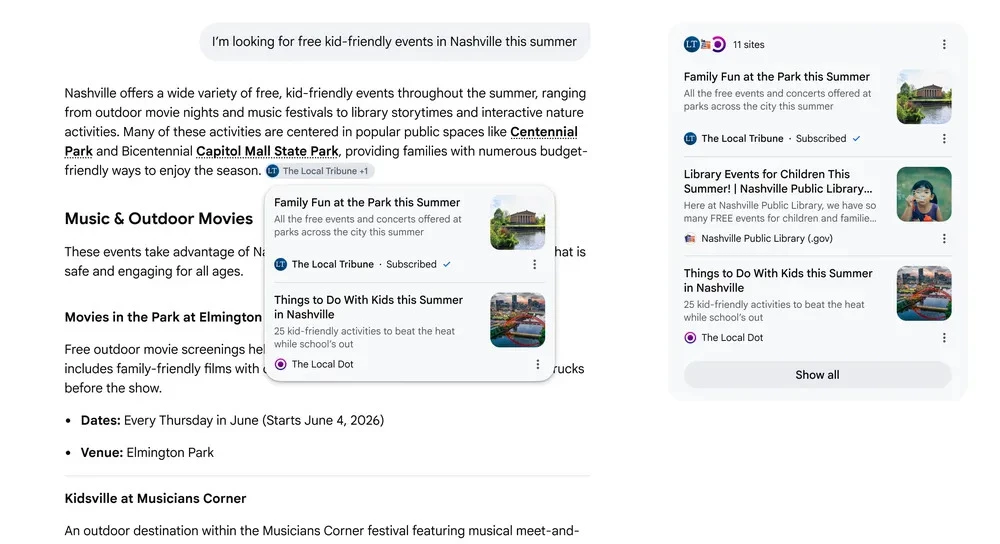
Google AI Mode inline citation previews and subscription-highlighted sources | Source: Google
Google also added more inline links positioned next to relevant text, along with desktop hover previews that display a page summary before users click through.
Google's VP of Product Management, Hema Budaraju, stated the goal is to make it "easy for you to connect with authentic voices and explore useful information across the web."
Google Releases Agent-Friendly Website Guide
Google published a new developer resource called “Build agent-friendly websites.”
The guide describes sites as having "a new type of visitor" as users increasingly delegate tasks to AI agents.
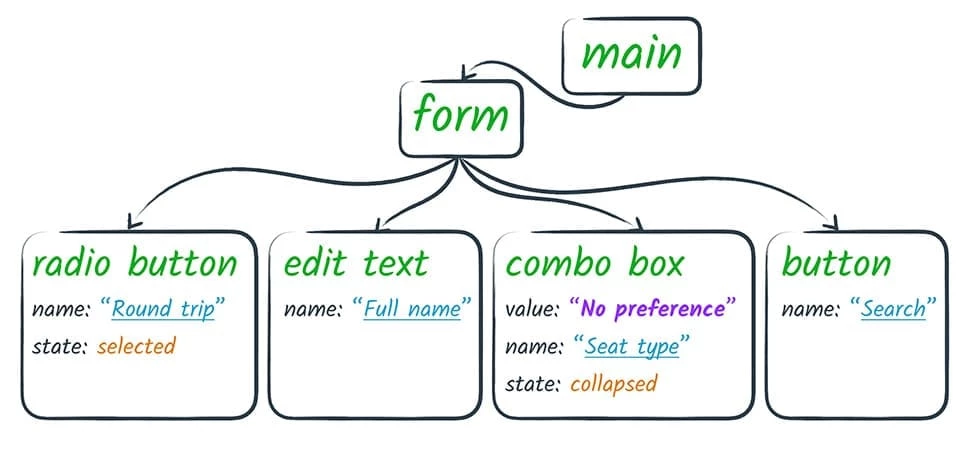
AI agent accessibility tree | Source: Google Web.dev
It recommends stable layouts that don't shift after page load, and semantic HTML tags over generic div and span elements.
The pointer cursor property in CSS is flagged as a direct actionability signal for agents.
Agents read accessibility tree data and DOM structure first, then fall back to screenshots when the layout is still unclear, making semantic structure the primary optimization factor.
The resource was published ahead of Google I/O and follows recent moves, including WebMCP and new action features in AI Mode.
Preferred Sources Expands Globally
Google expanded its Preferred Sources feature globally on April 30, making it available in all languages supported by Google Search.
The feature lets users select specific websites to appear more frequently in Top Stories when those sites publish relevant content.
Readers are twice as likely to click through to a site after marking it as a Preferred Source, according to Google.
Users have already selected over 200,000 unique sites, from niche local blogs to global news desks.
John Mueller addressed whether user selections can override quality signals.
We document it as 'When a user selects your site as a preferred source, your content is more likely to appear for them during relevant news queries in "Top Stories".' I don't think it makes sense to show spam to users just because of that, but it does help a user to see their preferred sources more.
— John Mueller (@johnmu.com) May 5, 2026 at 4:43 PM
He confirmed the feature won't surface spam, but it does help users see preferred publishers more often in relevant queries.
Preferred Sources functions as a user-level trust signal rather than a sitewide ranking boost, which limits its effect to audiences that actively select a publication.
SEO Industry Insights
SEO expert Chris Long called Google's agent-friendly website guide one of the more significant pre-I/O signals, noting that the resource confirms AI agents are now a design consideration alongside human users.
Several practitioners responding to Lily Ray's YouTube citation data noted corroboration from their own client testing.
YouTube mentions are emerging as one of the highest-impact GEO citation factors, independent of the platform's traditional role in organic search strategy.
This week's updates signal three immediate priorities:
- Audit Search Console data from May 2025 to April 2026. Impressions, CTR, and average position from that window are unreliable for year-over-year comparisons.
- Review content against the March core update pattern. Aggregator-style pages should demonstrate original value rather than redistribute what others published.
- Apply agent-friendly optimizations now. Stable layouts, semantic HTML, and accessibility-compatible structures are how AI agents read and navigate sites.
Our Take: Is Google Fixing What It Broke?
We think the five AI Mode citation changes reveal something Google hasn't said out loud.
Its AI features have been taking traffic from publishers without giving enough back, and the new citation features are a partial correction.
The March core update data confirms the same direction. Both moves favor content originating with the source, not with platforms that aggregate it.
The agent-friendly website guide is the piece most teams aren't treating with enough urgency.
Google said directly this week that AI agents are already visiting sites, and the optimization gap will widen quickly for sites that wait.
For analysis on organic CTR recovery and Google's Q1 revenue growth, check out last week's SEO roundup.
Which optimization on your current roadmap gets deprioritized when agents become a meaningful traffic source?
These leading SEO agencies develop strategies that adapt to algorithm changes and evolving AI-driven search environments.