
When business leaders hear that buyers want transparent pricing, they often jump to one of two conclusions.
Either they should copy a competitor's three-tier pricing table, or public pricing is impossible because their offering is too complex.
But I think both responses miss the point.
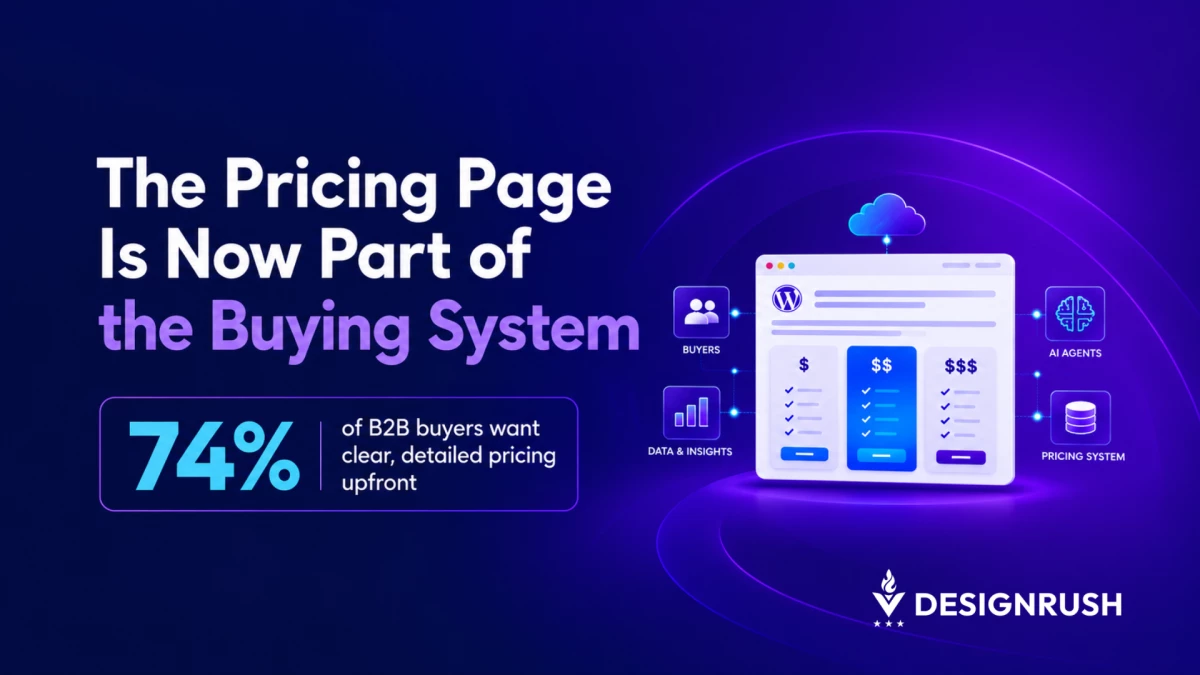
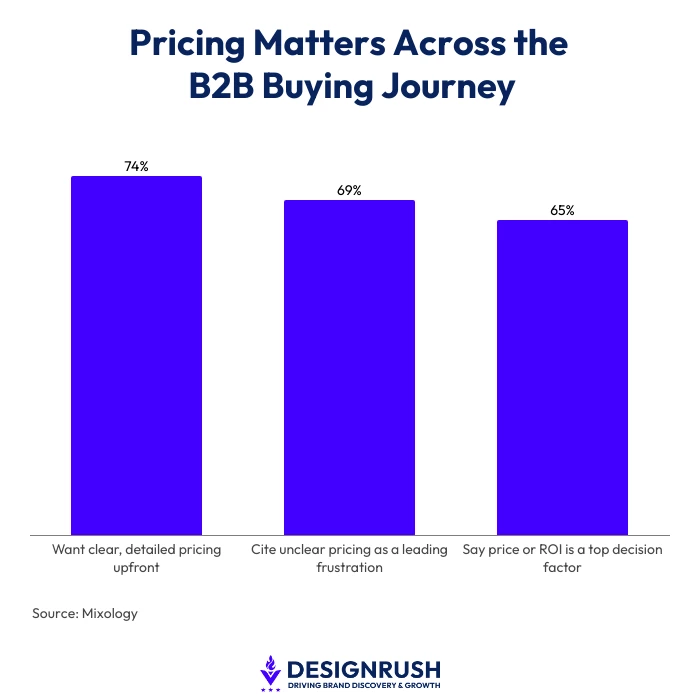
Mixology’s B2B Buyer Report found that 74% want clear and detailed pricing upfront.
The same study adds that 69% named a lack of clear pricing information among their leading frustrations with vendors, while 65% identified price or ROI as a top factor in the final decision.
It’s important to note that the survey doesn’t say that every buyer demands a fixed public price, nor that 74% will immediately reject a vendor without one.
I read the result as something more useful. Buyers want enough commercial information early enough to judge fit, value, and risk.
Having worked as a WordPress developer and architect before leading IT Monks, I see this less as a demand for a new page and more as a warning about the commercial system behind it.
Business owners should not only ask "should we show the price?" They should ask, "can our digital platform explain how our pricing works?"
How to Make Complex B2B Pricing Clear to Buyers
In a simple transaction, price clarity may mean showing an exact amount. In a complex B2B purchase, one number can create false precision.
Implementation scope, usage, number of locations, integrations, service levels, contract length, migration requirements, and regulatory obligations can all change the final cost.
Hiding every variable behind "contact sales," however, transfers all the work and uncertainty to the buyer.
Clear pricing for a complex offer can instead include:
- A credible starting price or range
- The variables that increase or reduce cost
- What each package includes and excludes
- Typical implementation and ongoing costs
- Representative scenarios or project examples
- Contract, renewal, and usage assumptions
- The information required to produce a final quote
- A clear process and timeframe for receiving that quote
This is not radical disclosure. It’s decision support.
That distinction matters because a B2B visitor is rarely deciding alone.
The Mixology study also found that 76% of respondents involve more than three people in a new vendor or product decision.
A pricing page therefore has a second audience. The colleagues who never visit it themselves but will see its information copied into a budget, procurement document, or internal business case.
If the first visitor cannot explain the cost model to the rest of the buying group, the website has not done its job.
The pressure is also visible from the seller's side.
Teneo's survey of 300 U.S. software vendors states that 80% reported greater buyer scrutiny of ROI quantification, and 31% said pricing and negotiation was the sales stage where performance had deteriorated most.
And while this is vendor-reported data, it reinforces the same commercial reality of how price now has to be connected to demonstrable value much earlier in the journey.
How B2B Pricing Should Adapt to Deal Complexity
A standardized subscription, a configurable software platform, and a six-month digital transformation project should not use the same pricing presentation.
For a standardized purchase, buyers may need an exact price, a feature comparison, renewal terms, and a direct path to checkout.
For a configurable purchase, however, they may need usage tiers, a calculator, package logic, and example configurations.
For an enterprise engagement, they may need a range, minimum commitment, cost drivers, assumptions, a sample commercial scenario, and access to a qualified human adviser.
McKinsey's 2026 B2B research makes a related distinction.
Buyers tend to prefer digital self-service when transactions are frequent, while human interaction remains important when large purchases happen less often.
The answer is not to choose between a pricing page and a salesperson. It’s to design the correct handoff between them.
A website should let buyers independently answer everything that does not require judgment.
Human expertise should then handle context, exceptions, and negotiation, not recite basic information that the website chose to hide.
Why WordPress Pricing Pages Need a Single Source of Truth
When I look at a pricing page, I see the interface to a larger commercial system. The more important architectural question is where the price, rules, and assumptions actually live.
In many organizations, they live in several places at once, such as WordPress text blocks, sales decks, spreadsheets, proposal templates, CRM notes, and an ERP or quoting tool. Each copy can be correct when created and contradictory three months later.
That’s not merely a content-maintenance problem. It’s a systems problem.
McKinsey reports that B2B buyers now use an average of ten channels during the purchasing journey. It also identifies inconsistent information across teams as the leading reason buyers switch suppliers.
A well-designed pricing page can therefore damage trust if the amount, scope, or terms presented by sales do not match it.
For straightforward commercial models, WordPress can store pricing in controlled, structured fields with clear ownership, validation, and publishing workflows.
When pricing depends on contracts, accounts, usage, inventory, or complex configuration, WordPress should usually obtain it from the appropriate system of record, such as a CPQ platform, ERP, CRM, commerce system, or dedicated pricing service.
The page components should render that commercial logic rather than force an editor to recreate it manually. The same structured foundation can support:
- Consistent package and feature comparisons
- Regional prices and currencies
- Volume, seat, or usage tiers
- Time-limited prices with effective dates
- Authenticated account-specific terms
- Calculators and guided configuration
- Approval and revision workflows
- Analytics showing where buyers hesitate or request assistance
- APIs and other authorized machine interfaces
Architecture should remain proportional to the business. A company selling five standardized services doesn’t need an enterprise CPQ implementation. It still needs one defined source of truth, structured fields, an owner, and a reliable update process.
My principle is simple. WordPress should communicate the commercial truth, not become an isolated second version of it.
Why AI Agents Need Machine-Readable B2B Pricing
This is also why I believe the shift from static copy to structured pricing logic matters even more as AI enters B2B procurement.
Deloitte's work on agentic commerce describes buyer agents evaluating products, configuring orders, reviewing contracts, benchmarking prices, and eventually negotiating with seller agents.
Deloitte argues that these systems will require machine-readable, timely, enriched, and verifiable information across products, pricing, inventory, vendors, and policies.
An AI agent doesn’t experience a polished pricing grid in the same way a person does.
It needs identifiable data and rules, including the unit being priced, currency, package, applicable volume, contract period, effective date, inclusions, constraints, and available next action. A persuasive headline cannot compensate for missing commercial data.
Machine-readable pricing does not mean exposing every confidential discount to the public.
A company can publish general ranges and drivers publicly, provide negotiated terms inside an authenticated portal, and permit transactional systems to access more detailed rules under appropriate authorization.
The objective here is not maximum disclosure. It’s controlled, consistent access to the right information.
If a buyer's AI agent cannot interpret the offer, it may be unable to compare it confidently or may have to escalate the evaluation back to a person.
Businesses should prepare for this without pretending that fully autonomous B2B purchasing is already universal.
As AI takes on a larger role in B2B purchasing, the architecture still has to work for today's human buying groups.
5 Questions to Audit Your B2B Pricing System
My message to business owners is that the 74% statistic should trigger more than a pricing-page redesign. It should trigger a short audit of the commercial system behind the page, including:
- Can a suitable buyer determine whether our offer is financially plausible before contacting sales?
- Do we explain the variables, assumptions, and value behind the price, not only the final number?
- Does the website use the same current pricing logic as sales, proposals, CRM, and commerce systems?
- Can that logic support different regions, packages, accounts, and buying paths without manual duplication?
- Can both people and authorized machines interpret the offer and understand the next step?
If the answer to several of these is no, the problem is unlikely to be fixed by copying a competitor's layout. Their pricing structure reflects their costs, positioning, sales process, and product architecture, not yours.
Pricing clarity is ultimately a form of operational clarity. It forces a business to define what it sells, how value is measured, which variables change cost, where exceptions begin, and how digital self-service connects with human expertise.
The companies that handle this well will not necessarily publish the lowest price or reveal every negotiated term.
They will make cost, value, and the next step easier to understand for a buyer, easier to defend inside a buying committee, and increasingly easier for an AI agent to evaluate.
That is why the modern pricing page should be treated as the user interface of a commercial system, not a static piece of website copy.