
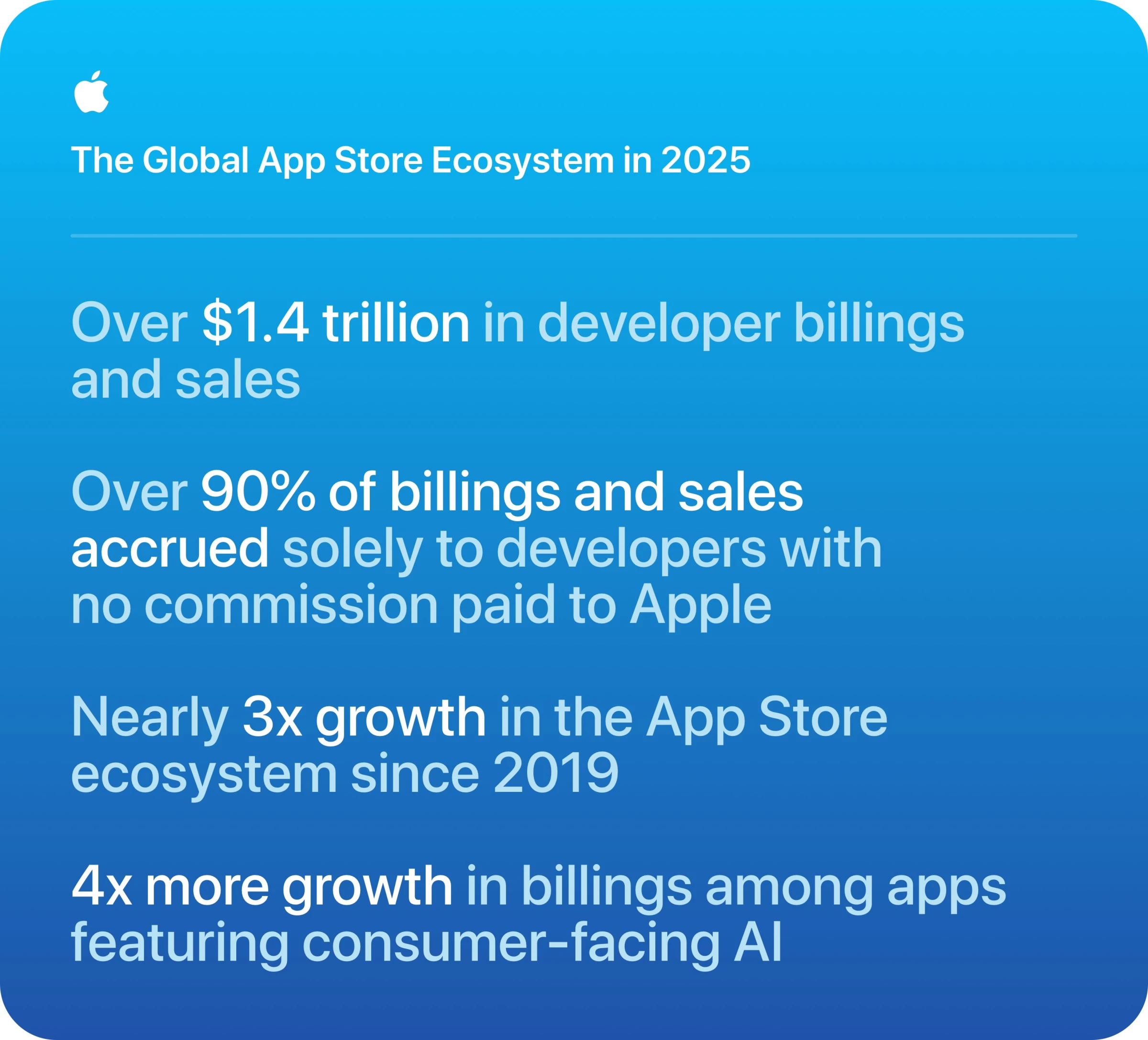
Apple’s App Store economy generated $1.4 trillion in developer billings and sales in 2025.
Apple’s latest App Store report showed that activity across the App Store economy came from three main categories:
- Physical goods and services: $1.1 trillion, accounting for the largest share of activity.
- Digital goods and services: $149 billion.
- In-app advertising: $151 billion.
For companies deciding whether an app belongs in their growth strategy, the question is which slice of that opportunity actually applies to them.
Joshua H. Davidson, founder and CEO of Chop Dawg, an app development company that has launched 500+ apps used by more than one billion people worldwide since 2009, says Apple’s $1.4 trillion App Store economy reflects how organizations now use apps to support sales, services, and daily operations.
“Back in 2009, half my job was convincing businesses they needed an app at all. In 2026, nobody asks why; they ask how fast,” Davidson says.
Case in point is Chop Dawg’s work for Suburban Shopper, a decades-old direct-mail advertiser that the agency rebuilt as an app:
View this post on Instagram
Apps Are Becoming the Front Door for Physical Businesses
While Apple’s $1.4 trillion figure may sound like a digital economy milestone, much of the growth comes from businesses selling physical products and services.
Davidson says Chop Dawg’s work with startups, enterprises, governments, and universities since launching in 2009 reflects how organizations are using apps to support real-world products, services, and operations.
View this post on Instagram
Examples include restaurant groups using apps to manage VIP experiences, retail brands connecting customers with physical locations, and service businesses creating digital channels around existing operations.
Mister Softee passed one million downloads within three months and drove 30% more repeat visits at a 35% higher average transaction value, and Zuma runs its VIP experience across 20+ cities with a 95% jump in reservation efficiency.
“The app economy isn’t just people buying digital products inside apps,” Davidson says.
“That's the entire economy running through apps.”
The distinction matters because companies don’t need to create the next social platform or subscription service to benefit from mobile adoption.
Apple also reported that apps with consumer AI features generated four times the billings growth of other apps in the top 100.
The demand for AI features in apps reflects a wider move by organizations to introduce AI into everyday workflows.
Across the board, 88% of organizations use AI in at least one business function, though most haven’t scaled it across the enterprise yet, according to McKinsey’s 2025 State of AI report.
“The strongest AI features are usually the ones that remove a step for the user,” Davidson says.
“The ones that get cut later are often the ones added because the release notes needed to say AI.”
Interest is also expanding toward AI agents, which can complete multi-step tasks rather than simply provide information.
Sixty-two percent of organizations are experimenting with AI agents, while 23% report scaling an agent-based system within their organization, according to McKinsey’s 2025 State of AI report.
For Davidson, the priority is identifying where AI can solve a specific problem.
View this post on Instagram
The First Step Is Strategy, Not Development
Despite the size of Apple’s app economy, Davidson warns that the $1.4 trillion figure should not be viewed as an automatic opportunity.
“The App Store does not hand out users because an app ships,” Davidson says. “Launch day is the starting line, not the finish line.”
Start by validating the product strategy before committing development resources.
One approach is creating a clickable, non-functional prototype that allows partners, investors, and stakeholders to test the product experience before development begins.
View this post on Instagram
This helps identify whether the app solves a specific customer problem.
Other common mistakes include:
- Building too many features too early
- Underestimating post-launch work
- Choosing an app development partner based only on initial cost
A Bigger Market Raises Expectations for App Quality
Companies still need a clear audience, realistic scope, and technology that can support future growth.
For larger organizations, that often means connecting apps with systems while accounting for integrations, compliance, and workflows.
For startups, it means launching the smallest version that proves customer demand.
“The market got bigger, but the fundamentals didn’t change,” Davidson says.
“A big market does not make weak products succeed. It makes strong products succeed bigger.”
More businesses are using apps to support sales, services, operations, and AI tools.
But long-term success depends on solving a clear problem for users.