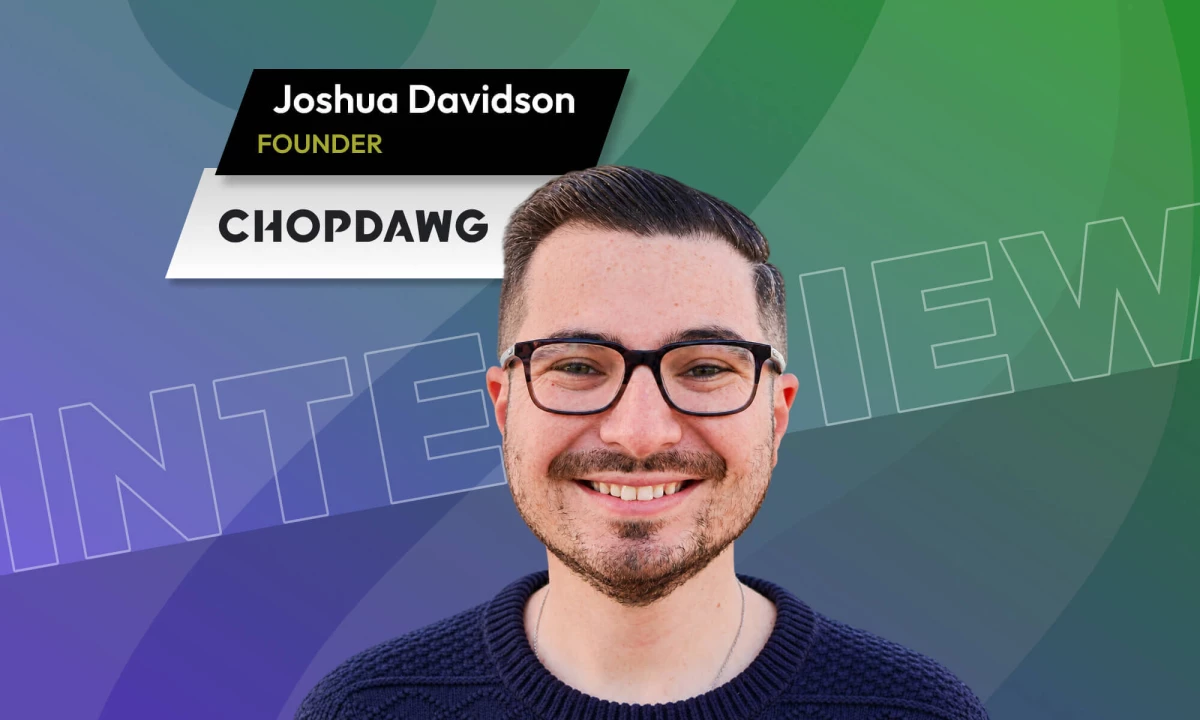

More than 500 apps and software products have shipped through Chop Dawg since Joshua H. Davidson founded the company in 2009 at the age of 16.
He started by selling websites to local businesses in South Jersey before he could drive himself to meetings.
The App Store was barely a year old. “There’s an app for that” was still a new phrase.
React Native didn’t exist, cloud infrastructure was in its infancy, and there were few established processes to follow.
“You invented the process while you built the product,” he tells DesignRush.
The work changed quickly as businesses began asking for apps, and today, the company works across web, mobile, and AI-powered products.
Around 40 artificial intelligence (AI) projects are currently in development.
For Davidson, the product decision still starts with the problem and the person experiencing it.
The first version needs to do that job well before any other features or visual polish are added.
In his interview with DesignRush, he discusses common product mistakes, first-version decisions, and what companies should expect from a development partner.

Who Is Joshua H. Davidson?
Joshua H. Davidson is the founder and CEO of Chop Dawg, an app development company that has launched 500+ apps since 2009 for startups, Fortune 500 companies, nonprofits, and government entities. Products built by Chop Dawg are used by more than one billion people worldwide. Under Joshua’s leadership, the agency has delivered software across iPhone, Android, tablet, web, wearable devices, AI, and other platforms. Joshua launched the agency at 16 and has since led its growth into a global app development company. The business has been named to the Inc. 5000 list of fastest-growing companies for three consecutive years and has received the Inc. Power Partner designation multiple times.
What Makes an App Successful in 2026?
More than 90% of software teams use AI for activities such as refactoring and testing, saving an average of six hours per week, McKinsey found in 2025.
Yet Davidson argues that easier development hasn't made successful products easier to create.
“Building an app got dramatically easier, and building an app that matters got dramatically harder.”
The productivity gains also vary widely.
The top 20% of software engineers surveyed reported average productivity growth of 55%, compared with about 3% across the broader group, based on McKinsey's 2026 research.
This is why Davidson keeps coming back to one principle:
“Solve a real problem, simply, for a specific person.”
“The successes share one trait, and it is not budget, industry, or timing. It is discipline,” Davidson adds.
Founders often arrive with extensive feature lists and ambitions for what the product could become years down the line.
Davidson doesn't dismiss that vision; he wants the founder to identify what the product can't function without.
At Chop Dawg, the team calls this “finding your oxygen.”
That means deciding what belongs in the first version and allowing everything else to wait until users provide evidence
He describes founders arriving with software that tried to do everything from day one, only to discover that they spent their runway learning what users actually wanted.
Davidson refers to what he calls “the three deadly Ms: Miscommunicated, misunderstood, misinterpreted.”
Products can go wrong long before a developer writes bad code.
A small ambiguity, repeated across hundreds of screens and dependencies, can turn into a large project problem.
What Makes Good App Design?
Judging design awards has changed Davidson's view of what deserves recognition.
The strongest work is the work that becomes invisible while someone is using it
“Polish is what you see in a screenshot. Design is what happens when a real human uses the thing,” he says.
He tests that by handing a product to someone who has never used it, with no tutorial, and watching where they hesitate or get lost.
That starts with defining the user through personas rather than treating “the user” as a vague idea.
For example, the nurse at the end of a double shift, the parent holding a phone with one free hand, or the retiree opening their first smartphone.
Wireframes are built in black and white before the visual layer is added, forcing the team to focus on logic and usability without visual polish masking weak decisions.
Then comes a clickable, non-functional prototype, the approach Chop Dawg uses on every build before development begins.
Davidson compares it to an IKEA showroom kitchen.
"You can open every drawer and run your hands along every countertop, even though the refrigerator is a prop," he says.
"Our partners put that prototype in the hands of their board, their investors, their spouse, their very first customer, and just watch.
"The room goes quiet, someone starts tapping, they find their way with no help at all, and then they smile. That smile is the whole job."
Fifty-two percent of consumers said they had stopped using or buying from a brand because of a bad experience with its products or services, PwC found in its 2025 Customer Experience Survey.
“If an experience works in black and white for the least tech-savvy person who will ever open it, it will sing in color for everyone else,” Davidson says.
What Should You Expect From an App Development Partner?
He adds that founders once had to choose between expensive domestic development and cheaper outsourcing, with uncertainty often coming with the lower price.
Chop Dawg was created as an alternative, offering a full-time team without the hourly billing model typically associated with development work.
AI has since made code faster and cheaper to produce, putting less value on the act of writing code and more on the relationship around it.
“Chop Dawg was built to be the third door. Back then, the scarce thing was the code itself. Today, code has never been cheaper or easier to produce, which means code is no longer what anyone is really buying from an app development partner,” he says.
“The scarce thing now is trust. Founders and enterprises need accountability: a team that protects their time and their money as fiercely as their vision.”
That trust is built into Chop Dawg's commercial model, which uses fixed monthly pricing instead of hourly billing.
Davidson says the structure gives both sides an incentive to finish the work instead of extending billable hours.
In all of 2025, not one Chop Dawg project ran over budget or over schedule because of Chop Dawg.
Partners also keep their code, designs, accounts, and intellectual property, while the agency takes no equity.
The team stays involved from start to finish instead of handing projects between freelancers.
For Davidson, those terms define the relationship he wants with partners.
“Founders stopped needing a vendor and started needing a partner sitting on the same side of the table.”
It is the reason 92% of Chop Dawg partners come back to build again.
Nearly two decades into the company, Davidson says he wouldn't radically rebuild it if he were starting today.
The principles would remain:
- Design before development
- Fixed monthly pricing
- Full ownership for partners
- A full-time salaried team rather than gig freelancers
One practice, however, would become a priority even sooner. He’d want to know whether both sides were actually a good fit.
“You can overcome a challenging project, but you cannot overcome a challenging relationship.”
Potential partners assess his agency while Davidson's team assesses the relationship.
“We do not partner with anyone we would not happily grab a bite with.”
Davidson also wants founders to document decisions from the start. Every screen, feature, and decision should exist somewhere outside someone's head.
Teams change, projects change hands, and priorities move. Documentation keeps those decisions with the product.
"Those standards are identical whether the partner is NASA, the NFL, the U.S. Navy, Siemens, Six Flags, Hilton, Jefferson Health, or a first-time founder chasing a big idea," he says.
"If you have checked out at a Wawa or chased down a Mister Softee truck, you have used a Chop Dawg product."
On August 1, Chop Dawg entered its 18th year, still carrying many of the principles Davidson developed since launching in 2009.
View this post on Instagram
The tools are different, the expectations higher, and AI has changed how quickly software can be produced.
But Davidson's view of good product development remains fixed.
“Outwork everyone, take care of people, help before you ever sell, and let the results do the talking.”
After 500+ apps shipped, Davidson is still working by those rules.