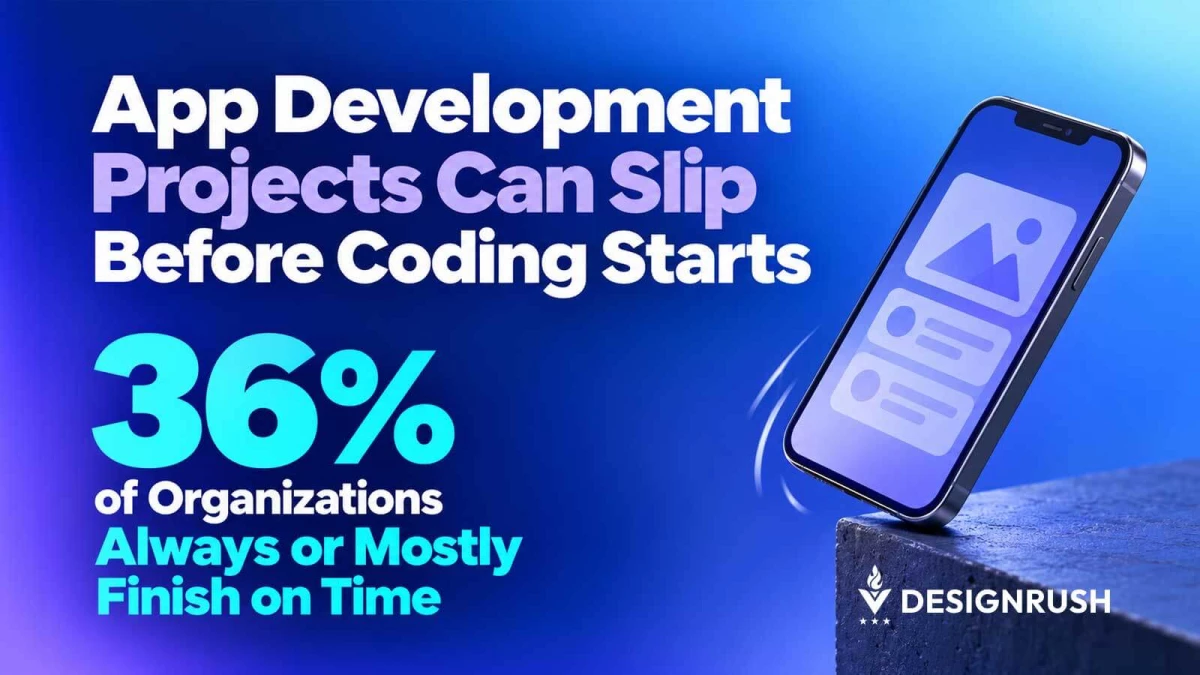

Thirty-six percent of organizations always or mostly complete projects on time, according to Wellingtone’s 2026 State of Project Management Report.
That means plenty of projects still run late, sometimes after months of work and a lot of money have already gone into them.
The usual suspects are familiar:
- Projects get complicated
- Requirements aren't clear enough
- New requests creep in
- Priorities move
There’s another part of the equation I think buyers should examine before signing with an app development partner: how the vendor itself is structured.
If the people who sell the project aren't the people who deliver it, or the commercial model rewards more hours instead of a finished product, the buyer may be starting with unnecessary friction.
At Chop Dawg, that starts with the first conversation.
How Can an App Development Company Keep Projects on Track?
Project management problems often begin before a project officially starts.
Thirty-five percent of executives identified a disconnect between planning and execution as the top barrier to business reinvention in PMI research published in 2025.
I've seen how quickly that disconnect can become expensive.
A promising idea gets discussed during a sales call, a high-level price is attached to it, and everyone feels good about moving ahead.
Then, when the work begins, assumptions surface, requirements get clarified, and the original timeline starts looking less realistic.
View this post on Instagram
At Chop Dawg, all of that planning happens before development starts.
Every relationship starts with a complimentary 45-minute consultation, where we work through the product, the audience, the business goals, and what the project needs.
We also talk through realistic timing and budget expectations before anyone starts engineering the product. The goal is a working estimate and timeline on the table before the call ends.
From there, the project moves into pre-production planning. Chop Dawg build-stage benchmarks put pre-production at 2 to 4 weeks on a typical build.
Design, engineering, and testing are estimated separately, then written into a proposal covering costs, deliverables, milestones, and the full schedule.
The buyer knows what is being delivered and when before a dollar of production work begins.
Once the proposal is in place, a new request has something to be measured against. We can see what it changes, what it doesn't, and where it belongs in the schedule.
PMI's 2026 research found that nearly one-third of complex projects fail to achieve the full range of their intended benefits.
Ninety-seven percent of project professionals had managed at least one complex project in the previous year.
The question is how much uncertainty can be dealt with before it starts eating into the delivery schedule.
View this post on Instagram
What Should You Ask Before Hiring an App Development Company?
Two questions should come up before the contract is signed:
- Who will deliver the project?
- How will the pricing work?
It sounds obvious, but it can get lost during a sales process. Buyers may spend time with senior people during the pitch and meet a different group once the contract is signed.
These two questions are only the starting point. We’ve gone through the nine questions to ask before hiring an app development company in depth in another article for DesignRush.
The handoff can happen at exactly the point when the project needs continuity.
At Chop Dawg, the partner knows the dedicated senior-level team from the beginning, and that same team carries the project from planning and design into engineering and ongoing support.
Communication stays tied to those stages, too. We meet weekly during design, every other week during engineering, and weekly again during testing, with Slack available between meetings.
That gives us regular points to address questions before they become late-stage problems.
The pricing model deserves a closer look, too.
More than half of enterprise services decision-makers use outcome-based pricing, while 46% rely on fixed-price contracts, Forrester found.
The survey covered 2,078 enterprise services decision-makers.
The research doesn't establish that hourly billing causes projects to run late, but it does show that buyers are using commercial structures beyond traditional time-and-materials arrangements.
For new app projects, we use fixed-monthly pricing. Each month has defined work, costs, and deliverables, so the financial picture doesn't depend on how many hours someone can put on a timesheet.
When something genuinely requires additional time, the partner can see the effect on timing and cost before deciding how to proceed.
I care about this because the commercial structure should support the delivery goal, not work against it.
In 2025, we had zero projects go over budget or schedule because of Chop Dawg, and our partner retention rate is 92%.
Chop Dawg is an app development company that has launched 500+ apps since 2009. Products built by Chop Dawg are used by more than one billion people worldwide.
View this post on Instagram
I call that urgency without rushing.
An app project needs momentum, but rushed decisions, skipped planning, or a new team halfway through delivery can make a difficult project harder to control.
A buyer choosing an app development partner should look past the sales presentation.
- Ask who will be in the room after the contract is signed
- Ask how estimates are created
- Ask what happens when requirements change
- Ask what the monthly invoice represents
A deadline is easy to promise, but can the team, pricing, planning, and communication behind it support that promise when the project gets difficult?