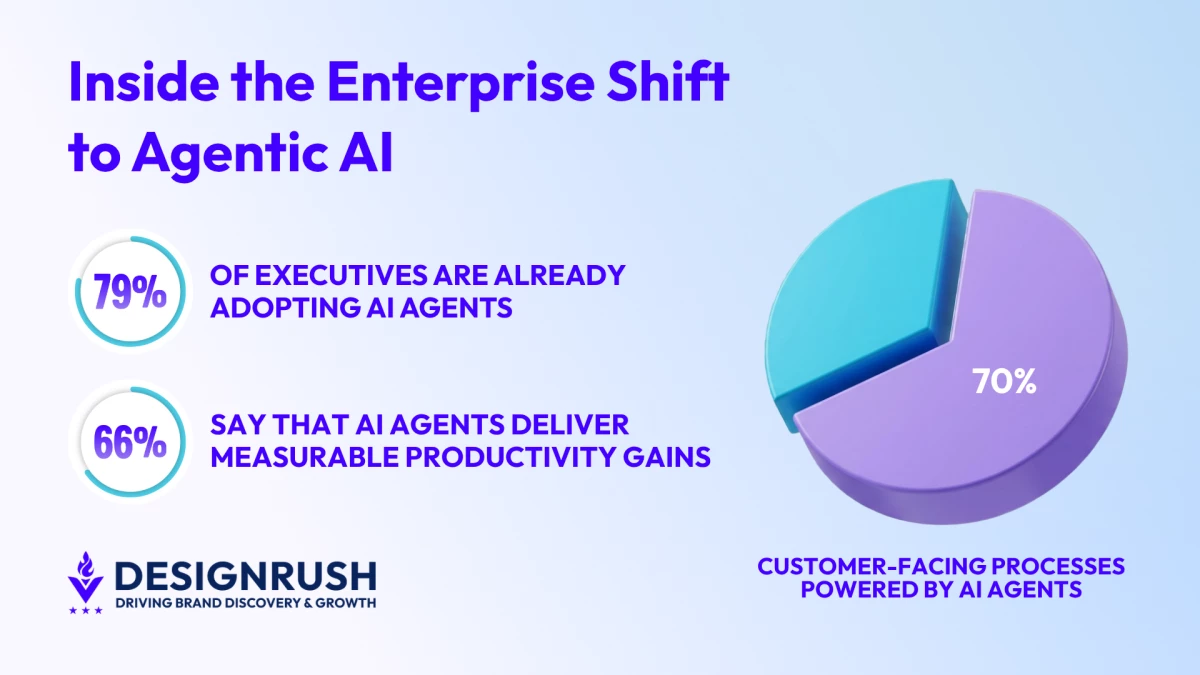

Over 70% of all customer-facing processes will likely become fully automated via AI agents by 2027, according to kore.ai.
As such, enterprises will need to incorporate these solutions into enterprise application workflows.
With widespread acceptance and implementation of AI agentic solutions across industries, businesses must shift their focus from adopting AI to incorporating it successfully.
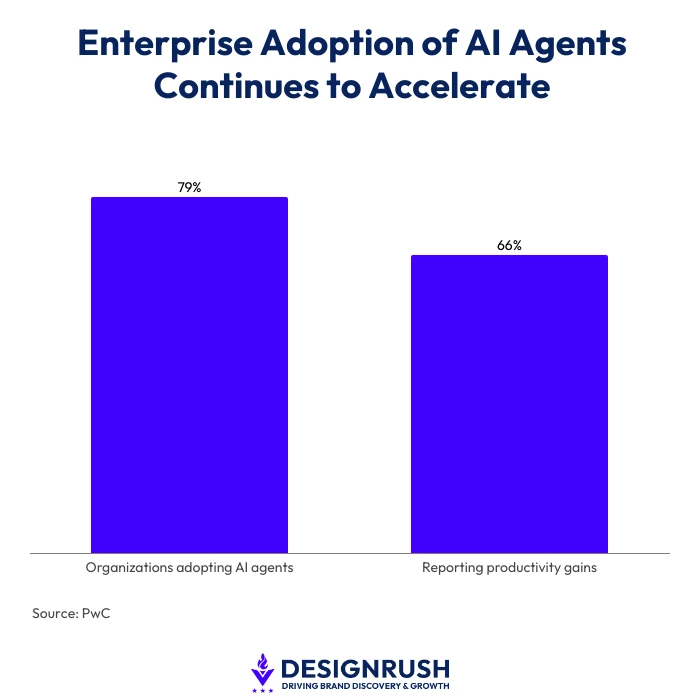
Seventy-nine percent of executives report AI agent adoption within their organizations, while 66% say those initiatives are already delivering measurable productivity gains, according to PwC's 2025 AI Agent Survey.
With more businesses seeing value from these deployments, the conversation is now focused on how AI agents can be integrated into customer-facing workflows in a way that supports both efficiency and customer experience.
To ensure that the resulting processes remain efficient, robust, and customer-friendly, AI vendors should pay particular attention to several important factors while integrating their solutions into enterprise workflows.
AI Agentic Solutions for Enterprise Application Workflows
AI agents have evolved beyond answering simple queries or managing repetitive tasks. Modern technologies allow such solutions to perform more complicated functions in customer-facing contexts.
AI agent development is becoming an essential part of today's digital enterprises when they involve support of queries and guidance during the process of product discovery, as well as onboarding and account management.
Are They Similar to Traditional Chatbots?
While conventional chatbots need to follow established rules of communication, agents possess abilities such as contextual analysis, the ability to gather information from different sources, and responding based on the user's intention.
In doing so, they can automate a range of processes without compromising the quality of customer interactions.
With continuous development of agentic AI technology, there is a tendency for businesses to prefer working with reliable companies specializing in AI agent development to ensure proper functionality of automated software within existing ecosystems.
This is an important factor in achieving successful agentic AI implementation.
Factors to be Considered When Introducing AI Agents to Customer-Focused Processes
The effectiveness of AI agents depends not only on their capabilities but also on how they are implemented.
Before deployment, organizations should assess several factors that can affect performance, reliability, and the overall customer experience.
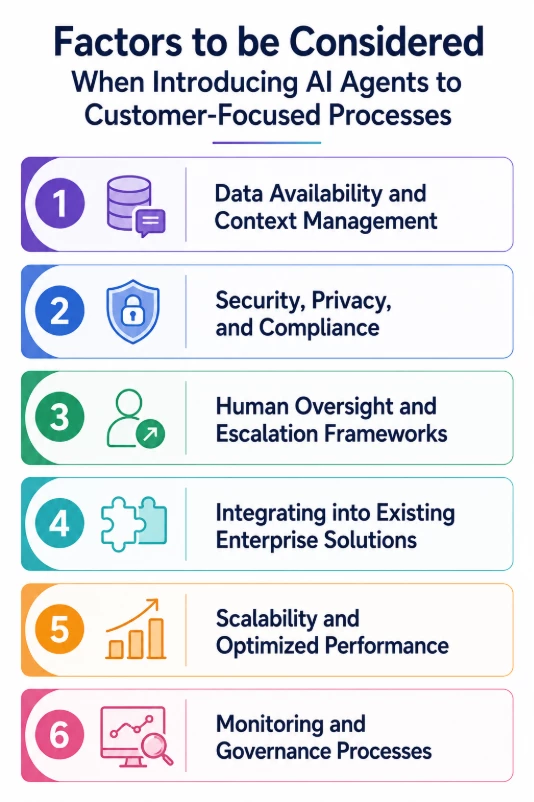
1. Data Availability and Context Management
The efficacy of AI agents depends on the data they can analyze. Seamless data availability is essential in maintaining response accuracy and contextual relevance.
For this reason, it is critical that organizations evaluate how the AI agents would fit into existing enterprise assets such as the database and customer information.
2. Security, Privacy, and Compliance
The integration of customer-oriented AI agents entails the handling of sensitive personal information of users and therefore calls for strong security.
In addition, there needs to be an assessment of the regulatory implications of data protection and privacy concerns in integrating AI agents.
3. Human Oversight and Escalation Frameworks
Although automation can be achieved through AI agents, there are still instances where human judgment is required for some interactions.
With the help of proper procedures in place for escalation, such interactions can be handed over to humans whenever needed. It will also help achieve an ideal balance between efficiency and good service delivery.
4. Integrating into Existing Enterprise Solutions
In most cases, AI agents are expected to interact within various enterprise platforms, which may include CRMs, communication platforms, analytical software, and databases.
Integration makes it possible for the agent to access useful information while performing seamlessly without causing bottlenecks within operations.
5. Scalability and Optimized Performance
For successful use of AI agents, performance is another key issue that has to be considered.
In cases where the volume of customer interactions increases significantly, agents should be capable of scaling up with ease without negatively impacting the overall performance levels.
6. Monitoring and Governance Processes
Integration of AI agents does not stop at installation and deployment.
Monitoring and governance can provide vital feedback on any areas that require improvement as well as changes in customer needs and processes within the organization.
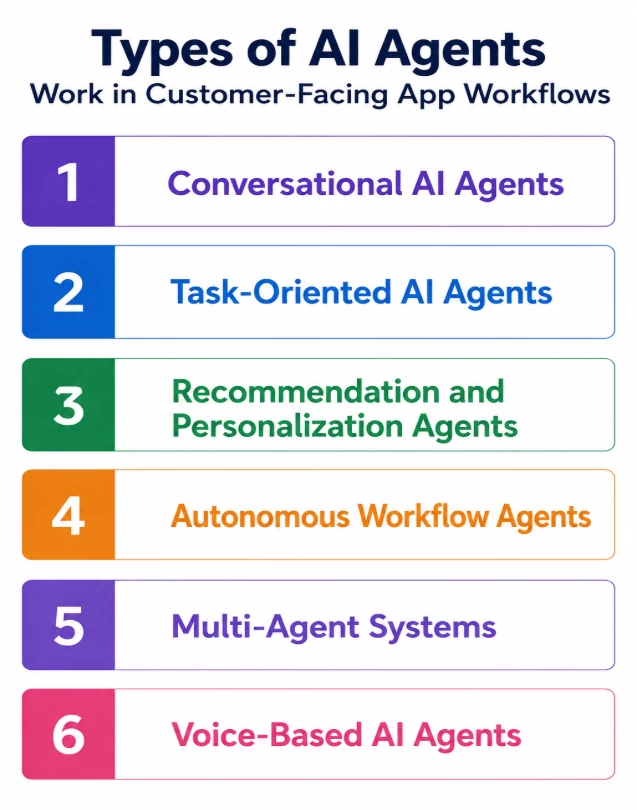
Types of AI Agents Work in Customer-Facing App Workflows
An AI agent may perform a number of tasks based on the complexity of the workflow and degree of autonomy in the customer-oriented application.
Awareness of the various types of AI agents will allow for selecting the best type to meet organizational needs.
1. Conversational AI Agents
Conversational agents are one of the most popular kinds of customer-oriented AI technologies.
Such agents communicate directly with customers via instant messenger, websites, applications, and any other type of communication interface used by a company.
Their primary task is to provide information or resolve a customer's query.
2. Task-Oriented AI Agents
A task-oriented agent performs a predetermined task based on user request or an internal objective set by the company.
Task-oriented agents in customer-oriented workflows usually handle tasks such as making an appointment, tracking orders or account changes, making payments, etc.
3. Recommendation and Personalization Agents
These agents are based on data analysis of customers' behavior and interactions.
This technology is mostly used in e-commerce, media, and other digital products to provide recommendations tailored to specific customers' needs.
4. Autonomous Workflow Agents
Autonomous workflow AI agents can automate multi-stage workflows with minimum human involvement.
Autonomous workflow agents can extract data from different systems, perform actions in various applications, and organize tasks needed to complete customer requests.
With companies continuing to invest in artificial intelligence agents' developments, these agents have become widely used in improving customer-related workflow efficiencies.
5. Multi-Agent Systems
In more complicated systems, several artificial intelligence agents act together to accomplish the same objective.
For example, one agent would collect customer data, another would gather the needed information, and yet another would perform the required action.
The use of multi-agents makes it possible to deal with difficult situations in a more flexible manner.
6. Voice-Based AI Agents
The voice-based artificial intelligence agents make it possible for customers to engage or make sales via voice commands and voice interactions.
The most common applications of the voice-based artificial intelligence agents include virtual assistants, contact centers, and smart devices.
Voice agents' increasing abilities are associated with improvements in speech recognition technology.
What's Next for Customer-Facing AI Agents?
With advances in AI technology, customers are being provided with more advanced interactions than just mere support and automation processes.
By 2026, 40% of enterprise applications will incorporate specific AI agents for their tasks, per Gartner. These include:
- Autonomous decision-making across workflows
- Multi-agent collaboration for complex tasks
- Real-time personalized customer interactions
- Enhanced governance and regulatory oversight
- Broader enterprise-wide adoption
Preparing Enterprise Workflows for an Agent-Driven Future
Organizations are moving beyond experimenting with AI agents and beginning to embed them into customer-facing operations. As these systems take on more responsibility, success will depend on more than technical capabilities alone.
Data accessibility, security, governance, scalability, and human oversight all play a role in determining how effectively AI agents perform in real-world environments.
Organizations that address these considerations early will be better positioned to deliver reliable customer experiences while supporting long-term business objectives.