
AI-Powered UX Research: Key Findings
- AI is becoming core to enterprise infrastructure as UX research shifts from episodic projects to continuous, embedded operations.
- UX research is moving from reactive testing to predictive insight, with AI enabling teams to anticipate usability gaps and behavioral friction before live testing begins.
- Human interpretation increases in value as AI scales because automation accelerates evidence gathering, but strategic judgment and empathy determine competitive advantage.
It has become clear that AI is no longer a side experiment in product design, but the very foundation of how teams operate, particularly in research.
Not that long ago, UX research simply took more time and hands-on effort.
Teams had to line up interviews, type up conversations themselves, and sift through pages of notes before they could confidently share what they were learning.
UX Team, a leading evidence-based UX and UI design agency, knows this all too well, with Co-founder, Chris Gieger, saying that this rhythm has changed.
“AI is not just speeding up research but reshaping how insights are gathered, interpreted, and applied. And as the tools grow more capable, the role of the human researcher has become more important, not less.”
Editor's Note: This is a sponsored article created in partnership with UX Team.
AI Becomes Core Business Infrastructure
To understand what is happening inside UX research, it helps to zoom out.
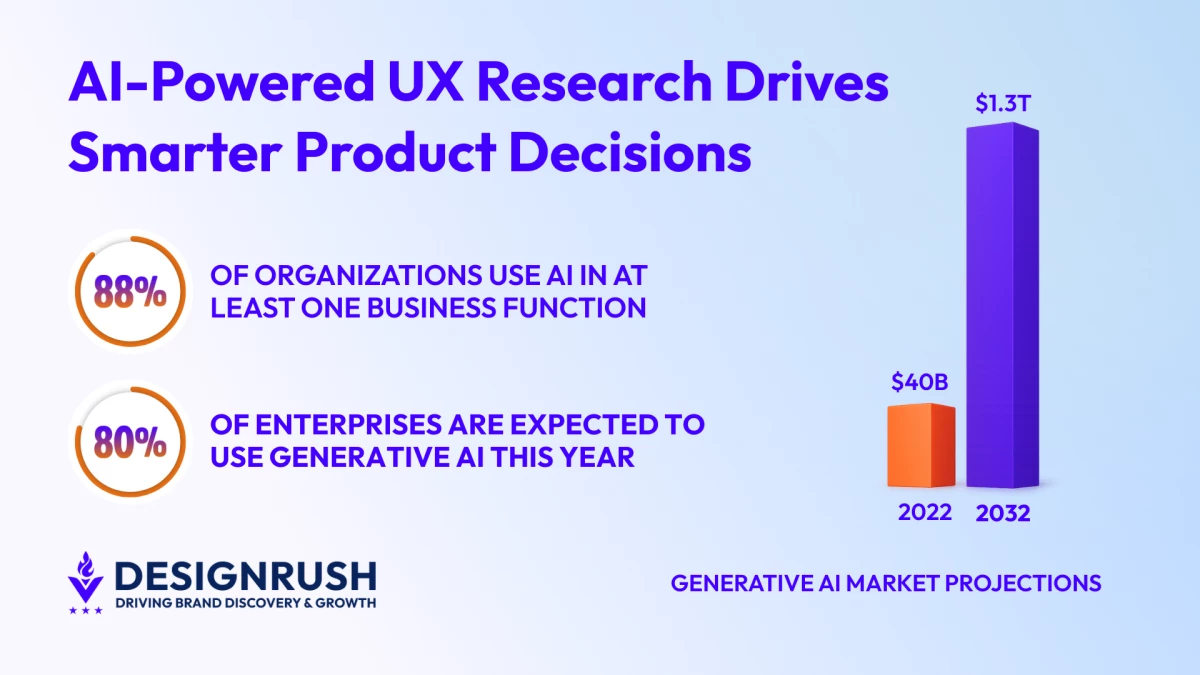
Artificial intelligence is no longer limited to innovation teams, with McKinsey’s State of AI report, claiming that 88% of organizations now use AI in at least one business function, a jump from 78% in 2024.
At the same time, Gartner reports that more than 80% of enterprises are expected to use generative AI this year, up from less than 5% in 2023.
That level of adoption reflects how AI is becoming part of daily business operations.
Market projections reinforce that momentum, with historical insights by Bloomberg Intelligence projecting that the generative AI market will grow from $40 billion in 2022 to $1.3 trillion by 2032.
“Few technology categories have scaled at that pace, and these numbers signal that as AI becomes embedded across organizations, research workflows are evolving alongside it,” Gieger says.
How AI Has Reshaped UX Research
1. Accelerated Data Synthesis
AI’s most immediate impact on UX research shows up in analysis.
Making sense of qualitative research has always taken time, as listening back to interviews, spotting patterns, and comparing responses could easily stretch into days of focused work.
AI tools can now process transcripts and recordings in minutes. They surface recurring themes, identify sentiment patterns, and highlight friction points quickly.
“AI’s advantage isn’t just speed, with researchers spending less time organizing information and more time interpreting it,” Gieger says. “That change moves UX research closer to strategic decision making.”
2. Predictive User Modeling
UX research has historically been reactive. Teams build, test, learn, then refine.
AI, on the other hand, introduces an anticipatory layer.
By analyzing behavioral data, AI systems can generate predictive heatmaps, identify user clusters, and surface potential drop-off points before formal usability testing begins.
Some tools even simulate early interactions to identify obvious usability gaps ahead of time.
“This does not replace live testing but strengthens it,” Gieger says. “Teams enter research sessions with sharper hypotheses and more refined prototypes, leading to deeper insight rather than surface-level corrections.”
3. The End of 'Researcher Bias'
Every researcher carries assumptions into a project. That is part of being human.
AI can serve as a counterbalance. It can highlight unexpected patterns and surface responses that may otherwise be overlooked in large datasets.
“It’s important to remember that this does not eliminate bias but creates friction against it,” Gieger says. “And that friction often leads to more balanced conclusions and stronger product decisions.”
Why AI Can’t Replace Human Empathy
For all its efficiency, AI cannot replicate empathy.
Sure, it can cluster responses, summarize transcripts, and detect patterns.
But it cannot fully understand the emotional context behind behavior.
“AI is the engine, but human-centered UX design is still the steering wheel,” Gieger says
“At UX Team, we recently launched our new proprietary methodology called Evident™, which we use to supercharge the gathering of evidence needed to drive design decisions.”
It's critical to distinguish that while AI accelerates information, human researchers are instrumental in interpreting meaning.
The Future of AI-Powered UX Research
AI is not replacing UX researchers. But it’s definitely reshaping how they work.
By automating transcription, tagging, and early pattern detection, research becomes more continuous and less episodic.
Insights surface faster. Iteration cycles shorten. Research shifts from a checkpoint to an ongoing capability.
There was a time when UX research was one of the first items cut from a budget.
But as AI lowers the operational cost of gathering insight, research is increasingly viewed as essential rather than optional.
“For teams willing to approach it thoughtfully, this shift is not about automation for its own sake. It's about building better products through stronger evidence and sharper interpretation,” Gieger says.