
Our analysts track AI developments that change how brands advertise, measure, and operate. Brands building AI programs can partner with vetted AI companies for strategic implementation.
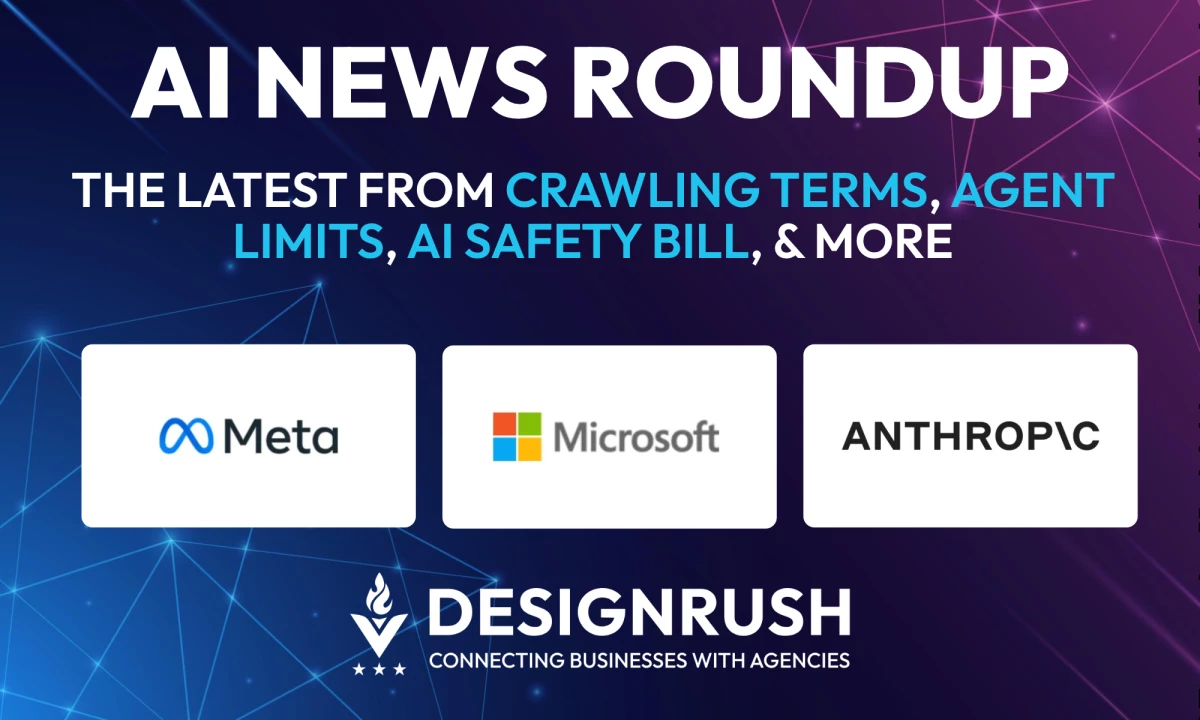
This week's AI updates add new defaults, new platform terms, and tighter limits on what automated agents can do.
- Meta sets two October deadlines, switching on product browsing in existing ads on October 28 and authorizing website crawling on October 30.
- Microsoft now detects 60 types of local AI agents, cutting an agent's permissions as its assessed risk rises.
- Anthropic pitched Congress a draft for an AI safety bill, proposing a $1 billion damage threshold before the government can halt a frontier model.
This week, the strings attached to each new permission decide who controls a business' data.
Our Take: Who Keeps Control Once a Business Grants Access?
Businesses often connect apps to an ad platform or let a crawler onto their site without checking whether that data gets reused for something else.
Terms change faster than internal policies, so businesses adapt after the fact.
In our view, the platform keeps control by default, since Meta showed it can rewrite a clause within a day of a news report.
Companies can't leave it to platform terms or regulation to decide what happens to their data once an AI tool has access to it.
Canadian publishers learned this in 2023, when Meta decided for them by blocking news on Facebook and Instagram.
Microsoft's new controls can restrict or shut down an agent, but they only help a business that knows what the agent can do.
Meanwhile, Anthropic's draft bill sets its bar far above the everyday risks businesses face, so a company's own paper trail is its best protection.
A 3% Lift Claim Leaves Conversions Undefined
Media buyer David Herrmann posted a Meta notice on LinkedIn that gives advertisers until October 28 to opt out of product browsing in existing ads.
Meta says that people who tap such an ad "may see an experience on Facebook or Instagram with product info and personalized suggestions."
Product browsing can put a Meta page between the ad and the advertiser's own site, where many brands run their analytics.
Meta backs the switch with a 3% average lift in conversions from its own August test across about 117,700 advertisers.
The notice leaves out which conversions Meta counted, so the lift could sit on the advertiser's site or inside Meta's apps.
Herrmann asked Meta to hold off until January, since the switch arrives 30 days before Black Friday.
When a platform changes where a click goes, it also changes what a brand's social media marketing reports can measure.
Meta's Revised Terms Still Allow Broad Scraping
Two days after product browsing switches on, Meta's new commercial terms take effect for business accounts, including those that run ads.
Nieman Lab reported on October 15 that the terms let Meta crawl websites "associated with" those accounts and use the content to "train" its products.
Law professor Benjamin Sobel compared the setup to "tying" in antitrust law, since businesses must accept the crawling to keep using Meta's tools.
"Virtually every news organization has at least one Meta business account." https://t.co/9XawysPvRt
— Nieman Lab (@NiemanLab) October 15, 2026
A day after the report, Meta revised the clause, removing the word "train" and limiting the uses to "advertising and business products."
Attorney Matt Topic said that Meta can still use the content to "develop" any business product, a word he reads as broad enough to cover AI training.
Meta says that sites can still block its crawler through robots.txt, but the revised terms never mention the file.
International News Media Association CEO Earl Wilkinson argued that publishers may leave Meta's platforms unless the company formally reissues the terms.
The crawling permission has no opt-out, so any business still using Meta's tools after October 30 automatically accepts it.
Brands should treat a platform's terms of service as part of their content marketing strategy, since one clause can decide who reuses their site.
Admins Get Risk-Based Limits on Claude Code and Codex
Microsoft said on October 19 that its security tools now detect 60 types of local AI agents, including Claude Code, OpenAI Codex, and GitHub Copilot.
Microsoft then scores each agent's risk continuously, using signals from identity, data, endpoints, cloud, and network.
As the score rises, administrators can limit an agent to read-only access, require human sign-off for key steps, or shut it down.
Guardian Agents, new to Microsoft's Project Perception security system, investigate why the risk changed and apply containment within the rules people set.
The design follows an October 10 essay in which Microsoft CEO Satya Nadella argued for separating "the supply of intelligence from the authority over it."
Anthropic and OpenAI make Claude Code and Codex, yet Microsoft builds the controls on what those tools can reach.
Microsoft has yet to set pricing or a release date, so a company relying on these controls waits on a third vendor's roadmap.
An AI adoption plan should name which vendor controls each agent's permissions before that agent touches company data.
Frontier Labs Could Face Mandatory Outside Testing
Anthropic has pitched lawmakers a draft of a frontier AI safety bill, Politico reported, citing three people familiar with the effort.
The government could block a model only for a foreseeable, imminent risk of over $1 billion in damage or more than 50 deaths or serious injuries.
And this risk would have to come from a bioweapon, a cyberattack, or a model slipping out of human control.
Anthropic quietly pitches its own AI safety bill to lawmakers, Politico reports https://t.co/8ZqqjyurrN https://t.co/8ZqqjyurrN
— Reuters (@Reuters) October 16, 2026
Even then, the U.S. Department of Commerce would need a federal judge in the District of Columbia to order a halt.
The bill would also require developers to test frontier models and get them independently evaluated, an Anthropic spokesperson told Reuters.
At an IMF-World Bank panel in Bangkok, co-founder Jack Clark said Anthropic tests its systems and shares the results, but this work shouldn't stay voluntary.
"And it's remarkable to me that the toys I buy for my children are regulated more than the literal superintelligence I work on at my day job," he added.
Everyday errors fall outside the draft entirely, so brands shipping chatbots and agents still need their own AI governance.
Advertisers Have Three Checks to Run This Week
Three moves can help teams prepare before Meta's October deadlines:
- Log a performance baseline. Record each ad account's current results before a platform default changes, so any claimed lift can be checked against your own numbers.
- Send the terms to counsel. Ask a lawyer which of your domains a platform's crawling clause reaches before the new terms take effect.
- Date-stamp robots.txt. Save a dated copy of the file so you can show which crawler rules were in place before the terms changed.
Brands that own their customer relationships and spread customer acquisition across channels keep more say when a platform rewrites its terms.
Last week's AI roundup covered Claude's false police tip and the push to hold AI agents accountable.
Which of your Meta accounts will still be in use after October 30?
These leading AI companies help brands set agent permissions and review platform terms before they apply.