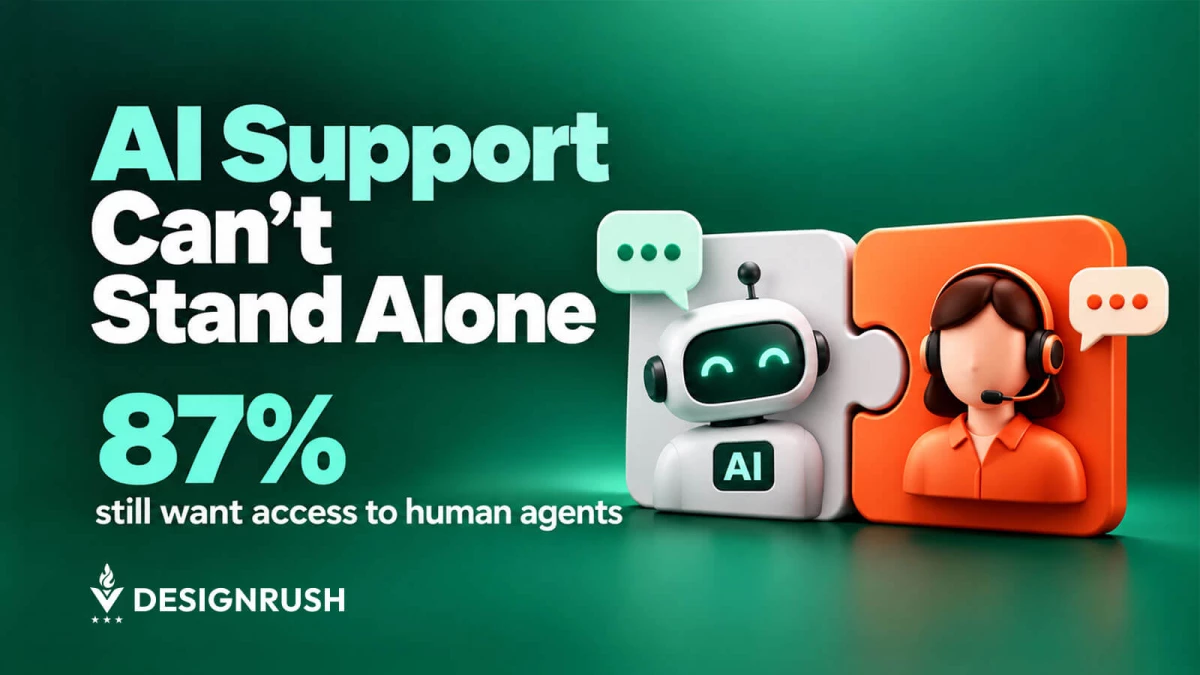

For 87% of customers, there's a condition attached to AI-powered customer service: they still need a way to speak to a person.
That's according to a Gartner survey of 3,566 B2B and B2C customers.
At the same time, 50% said GenAI makes their interactions with companies easier.
Customers are also moving beyond using AI simply to find information.
And customers aren't just turning to AI for answers. Gartner found that 58% of GenAI users had used it to carry out tasks for them, from booking appointments to placing orders.
That figure was even higher for B2B customers, at 74%.
That creates a different customer service challenge for brands.
As AI takes on more of the interaction, human access cannot become harder to find, according to Alex Holmes, Head of Growth at Influx.
"A visible human path means the customer knows from the beginning that they can get to a person if the AI reaches its limit," Holmes says.
"It shouldn’t take three failed answers, repeated prompts, or searching through menus to discover that option."
It's worth asking AI automation agencies and customer service outsourcing companies a simple question.
What happens when the bot can't solve a customer's problem?
Human Access Builds Trust in AI Support
Gartner says companies should avoid making GenAI a mandatory first step for every customer service issue.
Gartner analyst Eric Keller says companies risk putting customers off AI support when they make them repeatedly try a chatbot before allowing them to speak to an agent.
If the bot can't resolve the issue, customers should have the option to move straight to human support.
Gartner revisited the issue in September, looking at whether customers would give a chatbot another chance after a bad experience.
Just 27% said they would try a chatbot again after a bad experience.
Keller calls this a "leaky bucket" problem, as customers may not return even after the chatbot improves.
Holmes says the failed AI answer itself is only part of the problem.
"Customers can forgive an AI system for not knowing something," he says.
"What damages trust much faster is when the system clearly isn’t solving the issue but still makes the customer work to reach somebody who can."
This distinction changes how brands should evaluate AI support.
A chatbot can reduce the number of conversations reaching human agents while still creating a poor experience if customers are being contained rather than resolved.
Gartner specifically recommends that chatbots act as connectors to human support rather than “containment traps.”
Customers shouldn't have to repeat what's gone wrong, and go through the same questions again just because they've been transferred from a chatbot to an agent.
That frustration is part of a wider trust issue.
In a 2026 Scientific Reports study, 28 people in Pakistan and China were interviewed about AI customer service.
Participants responded positively to chatbots that admitted when they couldn't help and passed their requests to a person.
For Holmes, the biggest design mistake is treating human escalation as evidence that the AI has failed.
"A lot of brands still design around containment rate, so every escalation looks like something the AI should have prevented," he says.
"But if the fastest route to resolution is a human agent, a good AI system should recognize that and make the handoff easy."
Task Completion Raises the Handoff Stakes
A customer asks a chatbot to arrange a refund, but the conversation ends before they know whether it went through.
Now someone has to check what happened before the request can move forward.
Gartner says customer service systems should increasingly be designed around these action-oriented interactions, where GenAI understands the customer’s intent while automation completes transactions in the background.
Holmes says that makes context preservation central to the handoff.
"Once AI is taking action, the handoff can’t just mean opening a chat window with a person."
"The agent needs to know what the customer asked for, what the AI already did, where the process stopped, and what still needs to happen. Otherwise, the customer is effectively starting again."
This model is already reflected in Influx’s AI and human support system.
At Influx, AI agents respond to 20% to 50% of customer messages. But the company doesn't leave everything to automation.
Its 24/7 support guide makes the case for bringing in human agents when customers are upset, need refunds, or have problems that aren't straightforward.
That's something brands should be asking about when comparing call center providers. Who handles the complaints and difficult requests that the chatbot can't resolve?
That's why businesses should not view human availability and AI efficiency as competing goals.
"Cost efficiency comes from giving AI the work it can resolve well and giving people the exceptions that need judgment," Holmes adds.
"Making the human option difficult to reach might reduce escalations on paper, but it doesn’t mean the customer’s problem disappeared."
Gartner’s data suggests customers already understand that distinction.
Customers are happy to have AI handle some tasks, but they still want to know they can speak to someone if something goes wrong.
For brands building AI into customer support, human access is therefore becoming less of a fallback.
It is part of what makes customers comfortable using the AI in the first place.