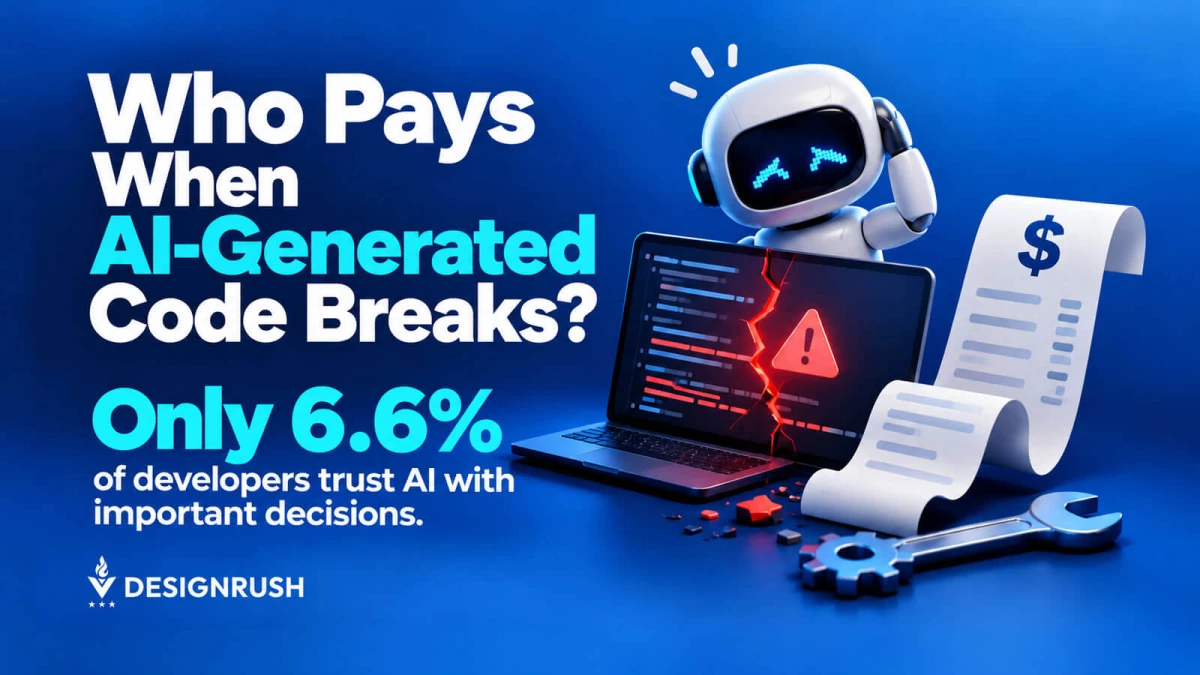

AI tools are common in software development, but their output still needs work.
Stack Overflow’s 2026 Developer Survey, published October 6th and based on more than 30,000 responses from 169 countries, found that 83% of developers use AI tools at work.
Only 6.6% trust the output for important work decisions, and 48% trust it only when they can easily verify it themselves.
Most developers check AI output by running it locally (76%), comparing it against their codebase (64%), or testing it for security (53%), according to the same survey.
That checking is real work, and someone has to do it.
The extra hours can eat into the time saved by AI, and if the problems surface after launch, the bill can get bigger.
Why Does AI Code Still Need Human Review?
Chop Dawg, an app development company that has launched 500+ apps since 2009, uses AI within an engineering process led by senior developers.
Products built by Chop Dawg are used by more than one billion people worldwide.
Founder and CEO Joshua H. Davidson says the numbers match what his team sees: the more an engineer works with AI, the more carefully they check it.
"The developers who trust AI code the most are the ones who have used it the least, because the output almost always looks right. It compiles, it runs, it passes a glance," he says.
Davidson notes that Chop Dawg sets its boundary before coding starts.
"AI accelerates the work; it never decides the work. Architecture is planned by senior engineers before AI writes a single line."
"Every line of AI-assisted code is reviewed by a senior developer, and pull-request review is the gate nothing skips, all running on the same version-control discipline we had years before AI arrived."
The company documents screens and features before development, giving reviewers written requirements to check the software against.
"If a developer cannot walk me through why a function does what it does, it does not ship, no matter who or what wrote it," he says.
"The moment a team ships code it cannot explain, they have stopped being engineers and started being spectators. Our partners are not paying for spectators."
How Do You Evaluate an AI-Assisted Development Partner?
Davidson recommends four questions before buyers treat AI-driven speed from any custom app development company as a discount:
- Who reviews the AI-generated code, and how senior are they?
Ask what review is required before code can move forward. - Is the team pitching the work the team delivering it? Ask who handles architecture, coding, testing, and project decisions.
Chop Dawg’s team is full-time salaried across the United States, Brazil, Pakistan, and India, never gig freelancers, all working 9 AM to 7 PM Eastern.
Ask each vendor to identify who will handle the project after the sales call. - What happens if problems surface months later? Understand how the contract treats rework, missed deadlines, and additional costs.
- Can another team maintain this code in two years? Davidson recommends requesting an explanation of documentation, code ownership, security practices, and handoff plans.
A low initial quote offers little comfort if the software becomes difficult or expensive to maintain.
These questions separate governed AI use from “vibe coding,” where a tool produces software without enough architectural planning or review.
Chop Dawg increasingly sees AI-generated projects arrive as rescue work, sometimes with security and architecture problems that make replacing the codebase more cost-effective than patching it.
"A faster quote is not a discount if it is a loan. The founders paying it back are already in our inbox," Davidson says.
Teams should explain their technical choices, testing practices, and response when requirements evolve.
His nine questions to ask an app developer offer a starting point, but buyers should still ask each bidder to demonstrate its review process.
Where Does AI Belong in App Development?
Davidson says his team uses AI to work from approved specifications, generate tests and documentation, and check third-party API documentation before signing a contract.
"My favorite example lives before the contract is even signed: Chop Dawg now runs a partner's third-party API documentation through AI tooling to verify that every endpoint we need actually exists and is supported before we estimate the work," Davidson says.
And while AI could take on more routine tasks, including migrations, code translation, and first drafts of documentation, he believes that decisions about what a product should do, its architecture and security, and accountability when something fails should remain human-led.
"The hard part of software was never the typing. It was the deciding, and the deciding stays human," he says.
Move the conversation past promises of speed:
- The review gate: Who approves AI-assisted code, and what happens when it fails tests?
- The evidence: How are requirements, security checks, and acceptance tests documented?
- The commercial terms: Who bears the cost of rework, and what does the quote include?
- The handoff: Can another qualified team understand and maintain the code?
For a shortlist, DesignRush’s mobile app development company directory lets buyers compare providers before asking each one to explain its process.
AI can speed up coding, but the contract still needs to spell out who pays when the code fails.