
A buyer can see the problem an AI company solves without knowing how its technology works.
That makes the company website's job harder because it needs to explain a complex product, make it tangible, and show why it is different.
The challenge grows when AI websites start using the same design cues such as gradients, glowing interfaces, and abstract data graphics.
These elements can signal "AI," but they do little to show what sets one company apart from another.
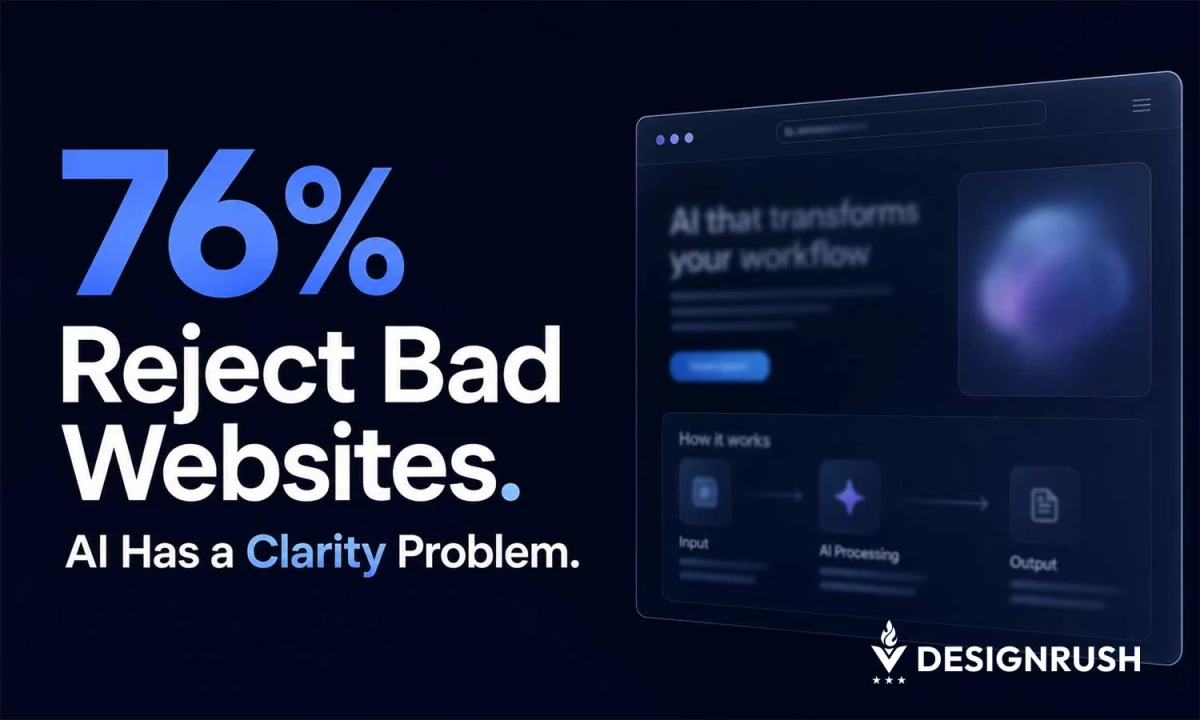
It’s a big problem, considering that 76% of B2B buyers told Gartner that they avoid suppliers with these "bad" websites.
How Should AI Companies Explain Complex Products Online?
A polished interface can attract attention, but attention doesn’t necessarily answer the questions that determine whether a buyer keeps researching.
- What does the product actually do?
- Who is it for?
- Where does it fit into an existing workflow?
- What makes it different from the alternatives?
UPQODE has dealt with this problem across projects for AI and data companies, including Concentric AI and AdPipe.
The agency's website for data security company Concentric AI uses icons, infographics, video, and concise explanations to break down services related to data discovery, security, and compliance.
AdPipe required a different approach.
Since the AI video platform has a visual output, UPQODE used video, animation, and product examples to demonstrate what the platform can do.
The site's structure also gives visitors access to information about the product, resources, and the company itself.
"Neither needs to rely on the same visual formula simply because both companies operate in AI-related categories," says Nicolae Pasecinic, CEO and founder of UPQODE.
"The product determines what needs to be shown, explained, and emphasized."
It also competes with a research process that increasingly starts somewhere else.
About 45% of B2B buyers now use GenAI when purchasing, Gartner found.
They also reported using an average of seven information sources during a purchase, with GenAI primarily used to research vendors and products.
That changes the role of the company website.
A buyer may arrive after asking an AI tool about potential vendors, reading industry material, and comparing several products.
By that point, the website is one piece of a larger information trail and therefore needs to make the company's proposition easy to verify.
Pasecinic outlines three areas to focus on:
- Product explanations should be specific enough to distinguish capabilities from generic AI terminology.
- Demonstrations can show how a platform works. Use cases can connect technical functions to recognizable business situations.
- Supporting content can answer questions that don’t belong on the homepage.
Concentric AI’s website breaks complex security concepts into smaller pieces rather than asking visitors to absorb the entire proposition at once.
AdPipe takes a more demonstration-led route because showing the platform's output gives visitors an immediate way to understand its capabilities.
Pasecinic says the design decision should follow the communication challenge created by the product.
"AI companies often have technology that is difficult to explain in a few words.
"The website has to give that technology a clear visual and verbal structure so visitors can understand what it does and why it matters."
That approach also avoids a common AI branding trap of using flashy visuals to suggest advanced technology without giving visitors enough information to judge the product.
How Should AI Companies Design Websites for B2B Buyers?
The typical B2B buying decision involves 13 internal stakeholders and nine external influencers, according to Forrester's 2026 State of Business Buying research.
The research and advisory firm also found that buying groups become larger for more complex or strategic purchases.
That means that different people need different evidence:
- A technical stakeholder may look for integrations, security information, or product specifications.
- A business leader may want use cases and a clear explanation of the problem being addressed.
- A marketing or operations leader may be more interested in how the product fits into existing processes.
And the website doesn’t need a separate experience for every person involved. But it does need enough depth and structure for different stakeholders to find the information they need.
The website can support a complex B2B buying process in several ways:
- Show the product early with screenshots, demos, workflows, and real outputs that make the technology easier to grasp.
- Product pages should answer real buyer questions, from what the technology does and who uses it to how it works and where it fits.
- Specific product stories and proof points can set a company apart when competitors rely on the same familiar AI visuals.
- Complex information needs room to breathe so serious researchers can find enough detail without turning the homepage into a manual.
- Clear navigation, use cases, and resources can help different stakeholders find the information they need at each stage of the buying process.
The Concentric AI and AdPipe websites show why there is no single visual recipe for an AI company.
One makes a complex security proposition easier to navigate and understand, while the other uses the visual nature of AI-generated video to demonstrate the product.
The most important thing to remember is that design choices have to explain the business and the technology first.