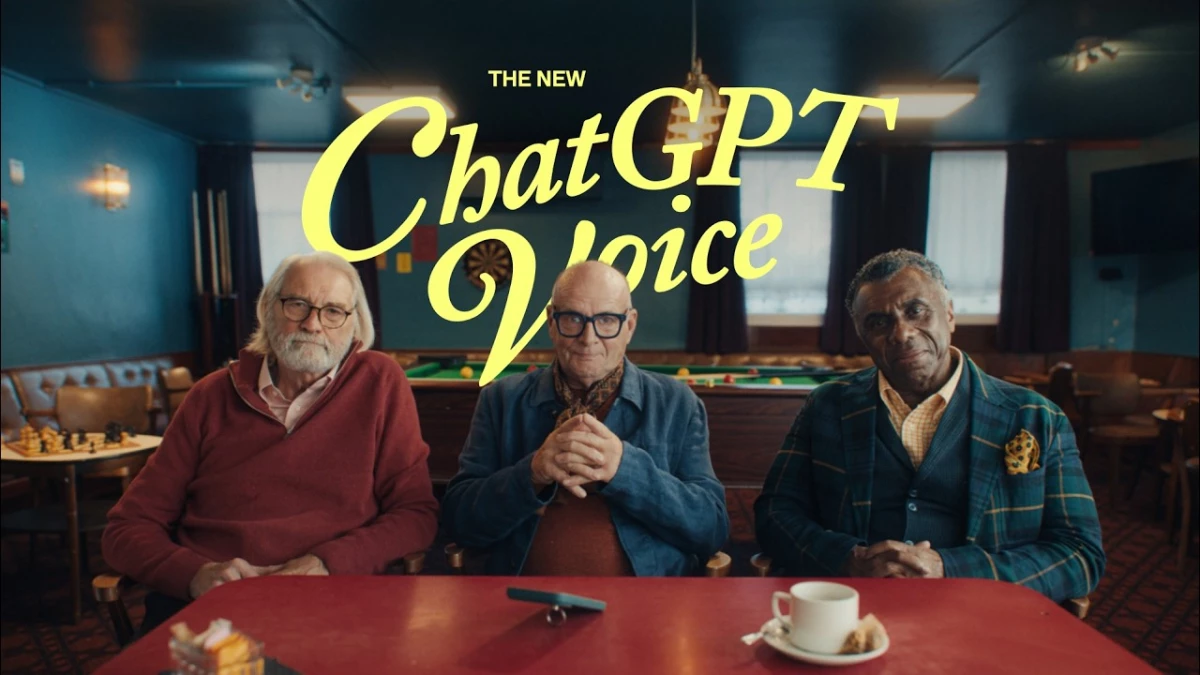

OpenAI handed its newest ChatGPT feature to three busy grandpas, and they have plenty to say.
The AI company has launched "Get Stuff Done with ChatGPT Voice" in the UK, an integrated campaign for the latest Voice updates.
The feature can now translate live and complete tasks across email, calendar, and Slack, as well as create documents or draft emails by voice.
With over 1.2 billion people worldwide now using the tool, the campaign shows how artificial intelligence can help in moments when nobody has a free hand to type.
"A conversation can be the start of getting something done," Elke Karskens, international marketing director at OpenAI, explained.
"With ChatGPT Voice, you can work through an idea, create a document or translate in real time, all while keeping your hands free.
"We hope our grandpas spark a little curiosity about what people can get done with Voice in their own lives."
OpenAI’s in-house creative marketing team developed the films with MindsEye, and Mat LaRoche directed them in London.
Grandpas Go Off Script on Set
The films follow three grandpas as they put ChatGPT Voice to work in daily life.
Jim plans his family’s upcoming trip to Casablanca, Morocco, while Ray polishes up on his Spanish and asks for live translation to chat with a Spanish-speaking friend.
Meanwhile, Terry asks for suggestions to help him solve a crossword puzzle.
The shoots mimic a traditional advertising set, with the crew visible and the grandpas going off script to speak to the director.
The goal is to show viewers they can talk naturally, think aloud, and ask follow-up questions without typing.
OpenAI first introduced grandmas for ChatGPT Voice in July, when the in-house campaign showed how an update let the tool listen and think at the same time, much like a natural conversation.
A two-minute follow-up in September shows grandmas asking Voice to cancel a duplicate magazine subscription it had flagged, as well as to make a website.
The grandpas carry that thread into the UK, moving viewers from asking questions to handing over tasks.
The latest campaign runs from October 19 across video-on-demand services including ITV, Channel 4, Sky, Amazon Prime, Netflix and Disney+.
A two-minute film will run on YouTube, with more activity on Instagram, TikTok, and Facebook.
Talking Tools Need Familiar Faces
The audience for these tools is changing.
IAB UK data from UKOM Ipsos iris shows more than a third of UK adults aged 55 and over used AI tools in July 2026, up from just over a fifth a year earlier.
The IPA’s TouchPoints report adds that 21% of that age group now watch ad-supported streaming weekly, up from 9% in 2024.
Both trends put grandpa-aged viewers within reach.
OpenAI’s earlier Codex campaign titled "Time to Fly" used large gimbal-mounted sets to give developers the physical feeling of flight, which suits a professional audience.
"Get Stuff Done" sells a smaller daily habit to general viewers, so it relies on ordinary errands and a crew that stays in the frame.
Together they suggest OpenAI adjusts its tone for each audience while keeping people at the center.
Marketers selling tech-heavy products can take three lessons from the films:
- Cast an unlikely expert: Three grandpas with no tech reputation make the case that using the product takes no special skill.
- Ground each story to your product's use cases: A trip, a translation, and a crossword give viewers an idea of how they can use ChatGPT in their own lives.
- Buy media where the habit is growing: Streaming placements meet older viewers as their weekly ad-supported viewing climbs.
Voice asks people to change how they use technology, and the change needs proof it is easy.
The brands that earn trust will be the ones that let ordinary people supply that proof.
Our Take: Is a Human-Centered Story the Only Way to Sell AI?
We don't think it's the only way, but it's the approach OpenAI keeps choosing, and the repetition is the strategy.
Its first large brand campaign for ChatGPT in 2025 showed people using it to plan workouts, cook dinner, and map a road trip.
The grandmas followed in July and September, and now three grandpas bring the same everyday setting to the UK.
Each film adds a new errand to the list, which tells viewers that AI belongs in a trip plan, a translation, or a crossword as much as in a work project.
Viewers who keep seeing the product in ordinary moments start to treat it as part of their routine, and routine is what keeps a user coming back.
Tech brands are exploring how to turn data-heavy features into emotionally resonant storytelling moments.
Partner with these top marketing agencies in our directory.