
Our analysts track the weekly developments reshaping AI and how it reaches users. Brands building AI products can partner with vetted AI companies to bring their ideas to life.
Three days after Anthropic launched its two most powerful models, the U.S. government switched them off.
Anthropic spent the same day signing enterprise deals as if nothing had happened.
Over at WWDC26, Apple quietly handed the keys to 2.2 billion devices to Google.
This was the week brands learned how little of their AI strategy they actually control. Here's where things stood, in more detail.
Anthropic's Top Models Go Offline
On June 12, the U.S. government ordered Anthropic to disable Fable 5 and Mythos 5, its two most powerful models, just three days after launch.
The directive arrived at 5:21 p.m. ET with no specific national security detail.
It also applied to non-U.S. users worldwide, including Anthropic's own foreign-born employees.
The US government, citing national security authorities, has issued an export control directive to suspend all access to Fable 5 and Mythos 5 by any foreign national, whether inside or outside the United States, including foreign national Anthropic employees.
— Anthropic (@AnthropicAI) June 13, 2026
The net effect of…
The government cited a reported jailbreak.
Anthropic complied within hours but disputed the severity, noting that rival models like GPT-5.5 can do the same task.
Applying this standard across the industry would "essentially halt all new model deployments for all frontier model providers," Anthropic wrote.
Last week, Anthropic's researchers called for a coordinated pause if AI risks escalate.
This week, the U.S. government made the call on its own for two models, all in an afternoon.
Canadian Prime Minister Mark Carney said the situation showed the risks of overreliance on American AI providers, as reported by AP.
European politicians called it a turning point for AI sovereignty, per Euronews, with British MP Tom Tugendhat writing that "sovereignty is more about code than cannons."
Two Enterprise Deals for Claude
On the same day, Anthropic signed a partnership with Tata Consultancy Services (TCS), one of the world's largest tech services firms.
The deal puts Claude in front of 50,000 employees across 56 countries.
Hours later, it announced a multi-year alliance with DXC Technology.
This collaboration embeds Claude into the systems DXC runs for global banks, airlines, and government agencies.
Both signed the deals knowing exactly what the U.S. government had just done to Anthropic.
For firms already working inside enterprise clients, losing model access is a manageable risk, but losing implementation depth is not.
These integrators are becoming the channel that enterprises use to adopt AI.
The company with the deepest client relationships may outlast the company with the strongest model.
Apple Rebuilds Siri on Gemini
Apple confirmed at WWDC26 on June 8 that Siri runs on a custom Google Gemini model, chosen over ChatGPT and Claude.
Bloomberg reported that the deal is worth about $1 billion a year, though neither company confirmed terms.
Apple processes queries on its own servers, so user data is not shared with Google. The feature skips the EU and China at launch over regulatory concerns.
Siri can now recommend products and answer purchase questions right as a user decides what to buy.
This makes Siri a distribution channel, and the brands that surface in its answers get there through content quality.
The same week Anthropic's models went offline, Apple quietly switched the assistant on 2.2 billion devices to a new provider.
Brands downstream had no warning.
AI Takes Over Ad Production
Major brands are pulling ad production in-house with AI, compressing timelines enough to change what agencies compete on.
Kimberly-Clark, the company behind Huggies and Kleenex, built an AI platform that cut content creation from 24 days to two hours, per Reuters.
Catalyst Brands, parent of J.C. Penney, is replacing global product shoots with AI-generated imagery and video.
Similarly, Target's ad unit, Roundel, now uses AI to write copy and react to trends in real time.
Gartner analyst Jay Wilson told Reuters that agencies can no longer compete on size and scale.
Strategic and creative thinking are what's left. But speed also creates a quality control problem.
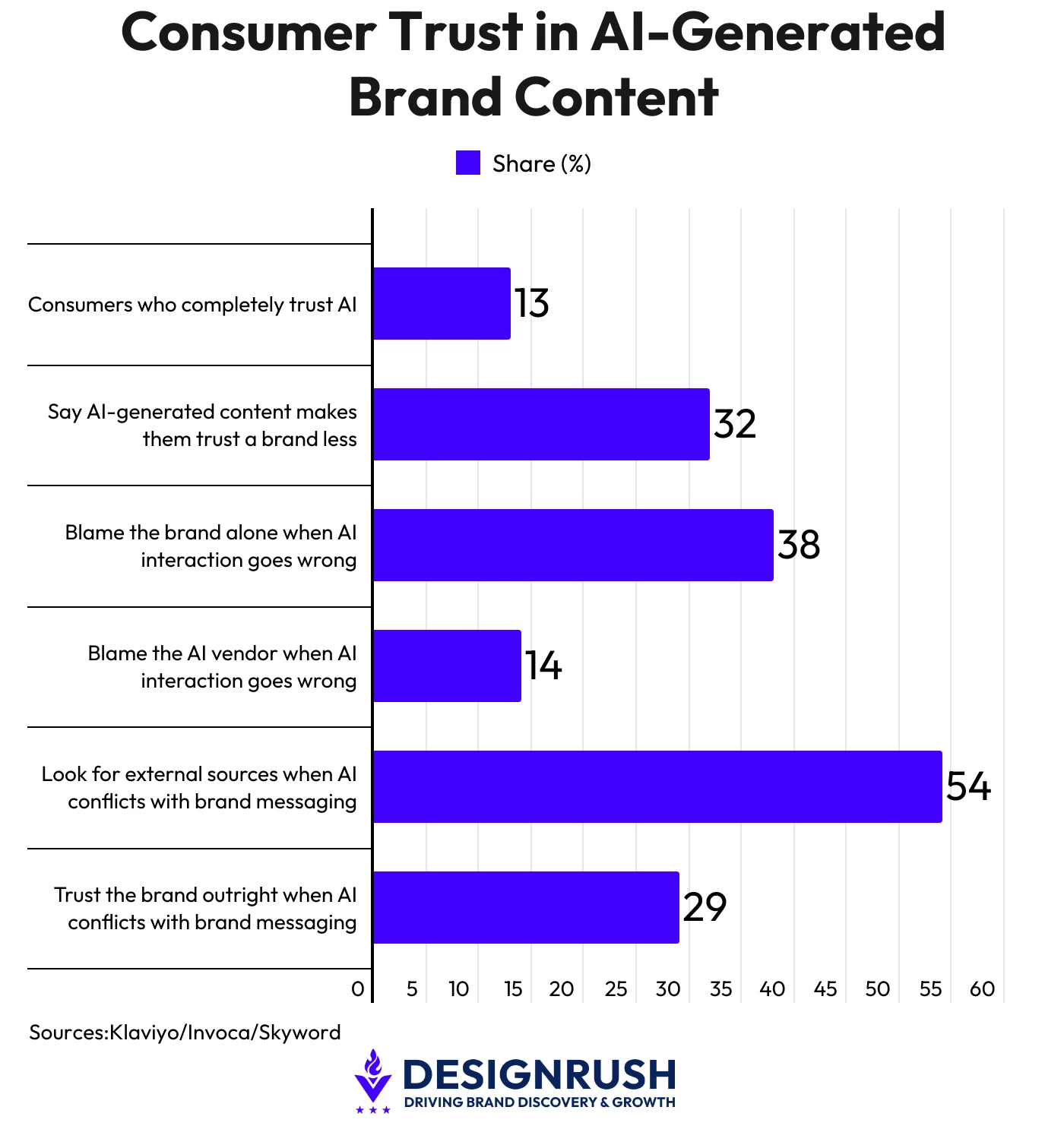
Consumer trust in AI-generated content is thin, and when something goes wrong, the brand takes the hit, not the AI vendor.
In fact, only 13% of consumers completely trust AI, and 32% say AI-generated content makes them trust a brand less, according to Klaviyo.
The pattern holds across every measure. Consumers blame the brand, trust it less, and look for outside sources when its AI gets something wrong.
AI gives brands speed, but no model signs its name to the work.
The brands that keep a human on every output gain the speed without putting their reputation on the line.
What Brands Should Do Next
AI access, distribution, and content quality are now operational concerns that brands and agencies have to manage.
- Vendor dependency threatens continuity. Document which workflows stop if AI access is revoked and find alternatives before you need them.
- The AI default reaching consumers just changed. Audit whether your content is structured to be cited by AI assistants, not only indexed by search engines.
- Production speed without review creates brand liability. Agencies that add human approval where in-house teams skip it have a direct service to sell.
The brands that build these checks in now will absorb the next change instead of scrambling through it.
Our Take: Do Brands Control Their AI Strategy?
The biggest AI decisions affecting brands this week came from governments and platform owners.
When Anthropic complied with the export control directive, it protected its own legal standing.
When Apple moved Siri to Gemini, it protected its own hardware business.
We'd argue the workflow audit and the content authority push are correct, but not enough.
The brands that get this treat AI the way seasoned advertisers treat any platform. They use the channel without depending on it.
In practice, this means spreading content across more than one AI assistant, sourcing from more than one model, and running operations that can switch providers.
The brands treating this week as a preview of the new normal are the ones who will be ready when the ground moves again.
For analysis on the MAI-Thinking-1 launch, the Nvidia Kumo acquisition, and the pause call, check out last week's AI roundup.
When the AI powering your distribution channel changes overnight, does your content still get found?
These leading AI companies help brands move from generic AI tools to specialized models trained on their own data.