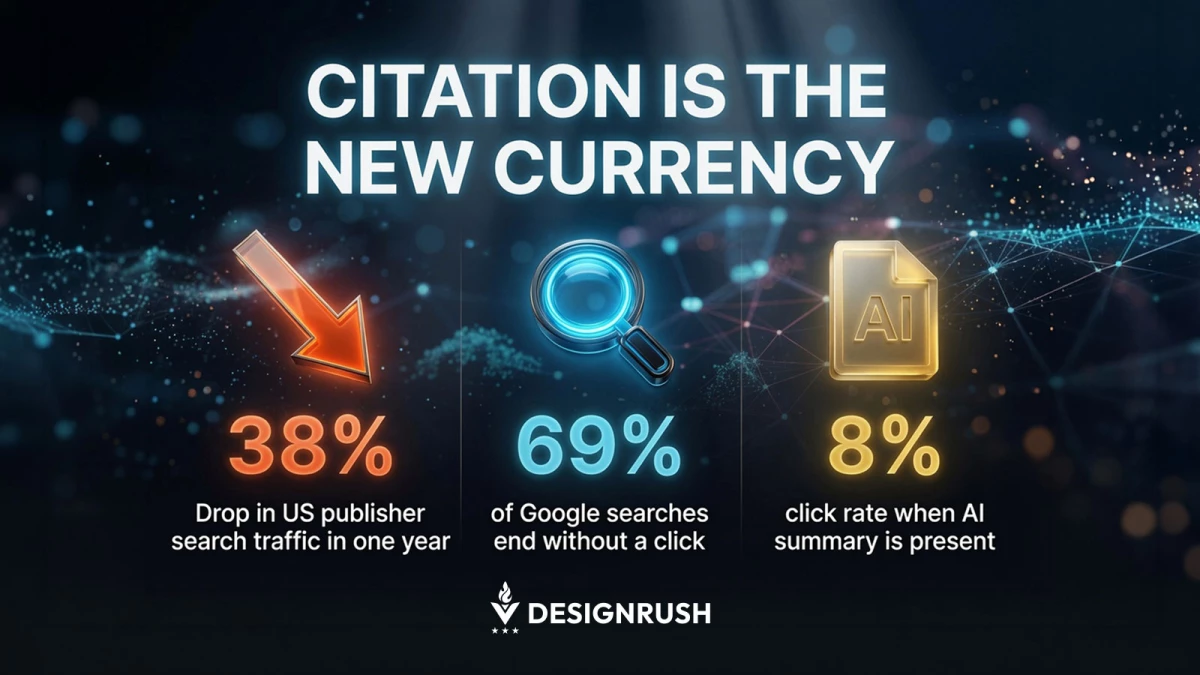

Organic search traffic across 2,500 publisher sites fell 38% in the US from November 2024 to November 2025, per Chartbeat data cited by the Reuters Institute.
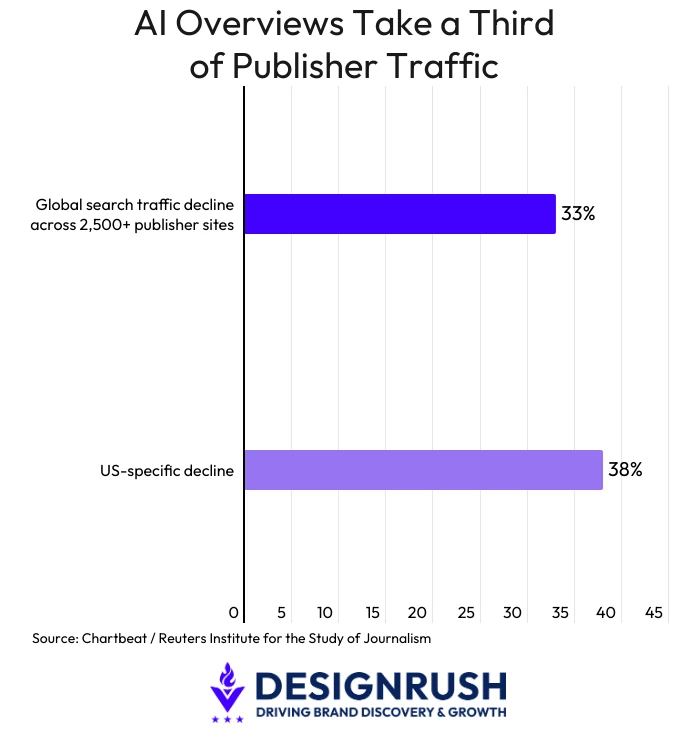 At the category level, informational queries such as definitions, product summaries, and how-to content were the most affected.
This is mostly because AI-generated responses increasingly resolve intent inside the search interface before a click happens.
Furthermore, the biggest names took the hardest hits. For example, Business Insider lost more than half its search traffic and cut 21% of staff.
Meanwhile, education platform Chegg sued Google on antitrust grounds, citing a 49% collapse in non-subscriber traffic due to AI Overviews.
Even HubSpot reported steep declines in informational search traffic as AI Overviews absorbed queries the blog had ranked for over a decade.
Structural Shift in Discovery
Smaller publishers are absorbing the sharpest losses as AI-mediated search restructures how visibility flows across the web.
Scale determines how much of that compression a publisher can absorb. Chartbeat's data breaks the decline by publisher size:
- Small publishers (1,000–10,000 daily page views): search referral traffic down 60%.
- Mid-sized publishers: down 47%.
- Large publishers: down 22%.
AI chatbots increased referral volume by more than 200% in the same period, but still represent less than 1% of total publisher referrals, per Chartbeat.
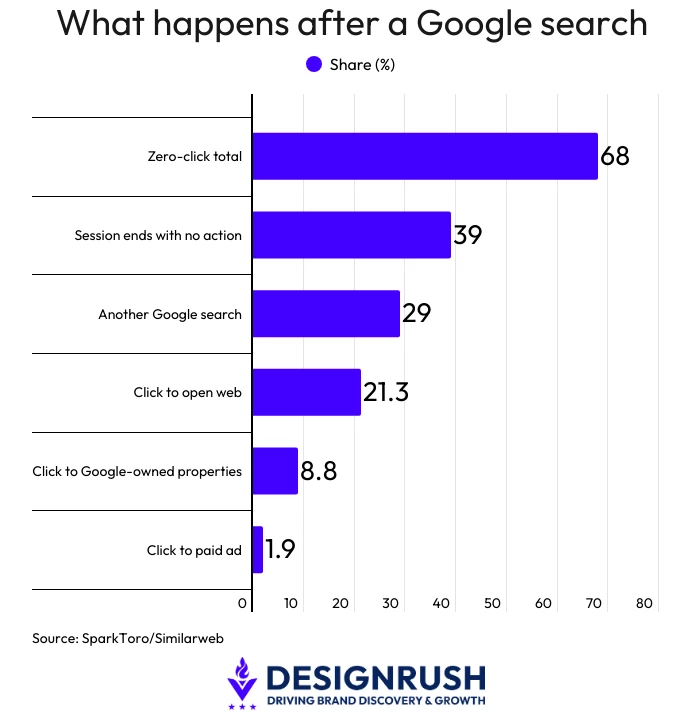
Zero-click searches reached 68% in early 2026, up from 60% in 2024, per SparkToro research based on Similarweb data.
 When an AI Overview appears, click-through at the top organic position drops 58%, per Ahrefs.
Design In DC, a Washington, D.C.-based web design and generative engine optimization agency, says the shift demands an entirely different brief.
"We stopped designing sites to win a click and started designing them to be worth citing," said Ziad Foty, CEO and co-founder of Design In DC.
"A site built for the click is optimized to be found. A site built for the citation is optimized to be the answer."
What Survives the Summary
AI Overviews absorb the shallow layer first. Definitions, summaries, and how-to content that any model can replicate are the most exposed.
The counterexample is Reddit, which grew while the rest of the web shrank. It now ranks among the most-cited sources inside AI answers, alongside Wikipedia and YouTube.
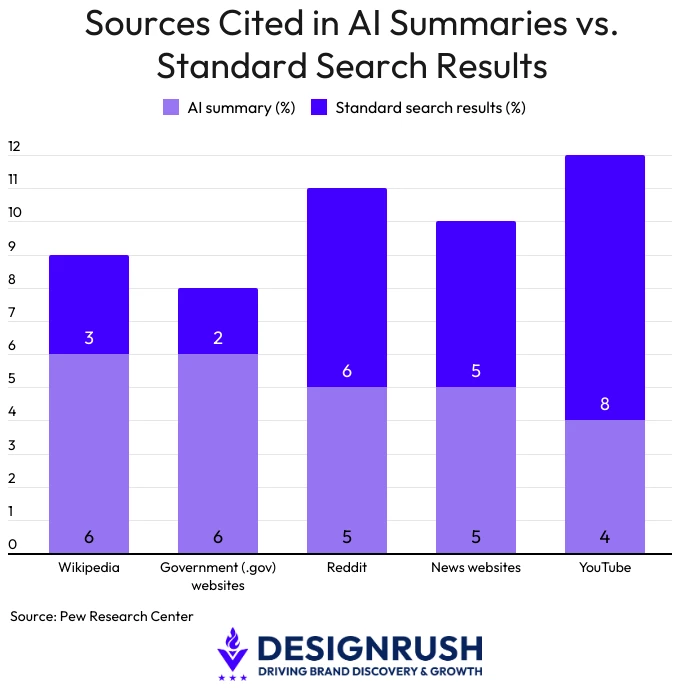 Foty says the sites gaining traction in AI search share a common denominator.
"Reddit and Wikipedia win because millions of people contributed something real. AI systems are very good at averaging, but they cannot average a perspective that only one person or one community could produce," he adds.
Getting cited brings the visitor in. What they find when they land decides whether the visit becomes a relationship.
Build for the Reader Who Already Has the Answer
A visitor arriving from an AI answer already has the facts. They came for the depth, the perspective, or the action the summary could not provide.
Design In DC redesigns site architecture specifically for that visitor.
"If users no longer arrive through links, the value of content is increasingly determined before the click ever exists," Foty says.
The publishers adapting fastest are making three structural changes.
- Redesigning pages for extraction. Clear definitions, modular sections, and explicit statements of insight increase the likelihood of being referenced inside AI outputs.
- Shifting from keyword coverage to topic ownership. Build repeated authority signals within narrow domains instead of publishing around search demand alone.
- Treating AI systems as distribution endpoints. Optimize to be cited inside answers, not just listed below them.
Google Closes the Hallway
Search, Gemini, and agent tools are converging into a single interface, per Google's own confirmation, with AI completing tasks before returning results to the person searching.
Major publishers are already planning for zero search traffic.
Some teams responding to that shift are investing in schema, structured data, and GEO optimization.
Those tools matter, but they are infrastructure around a problem that is fundamentally editorial.
Teams that optimize the container without changing what is inside it will find that the infrastructure works and the citations still don't come.
The difference now is that good editorial strategy and good technical strategy have become the same thing.