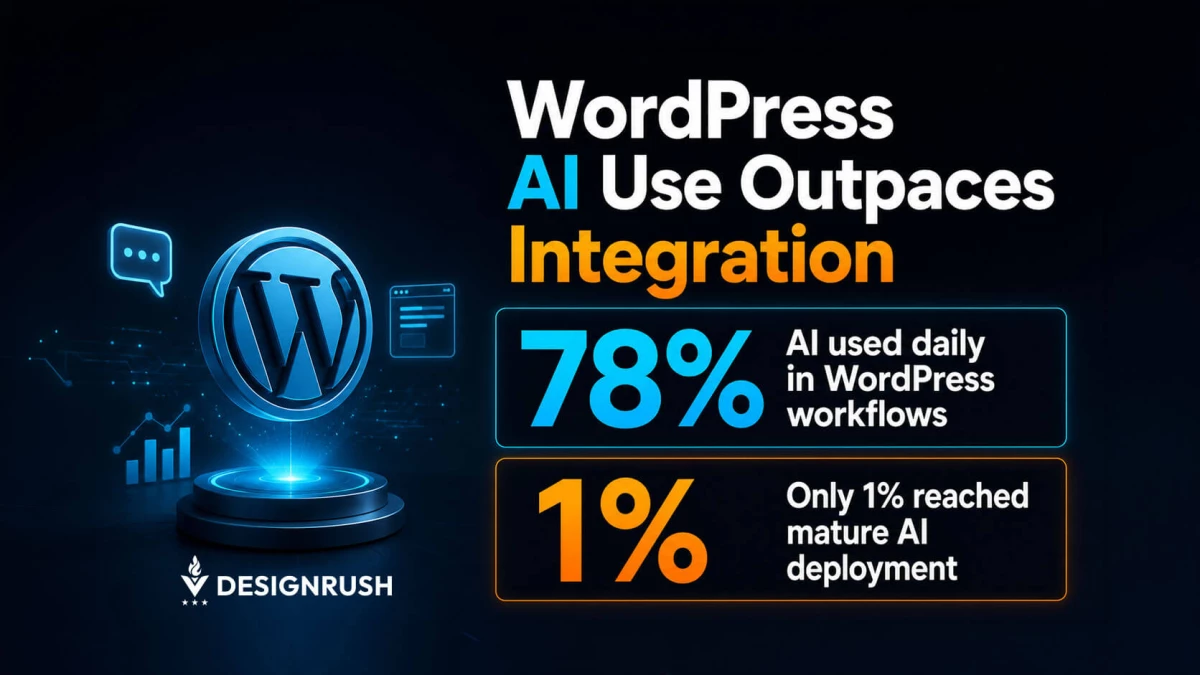

Around 78% of small businesses using WordPress rely on AI daily, and yet many still use it for one-off tasks rather than integrating it into their everyday business workflows, according to SiteGround's 2026 research on small-business AI adoption.
SiteGround’s report, AI in WordPress: The 2026 Landscape for Small Businesses, says AI use is now common across small firms, but it is not yet part of daily work.
About 88% of respondents already use AI in at least one business function, according to McKinsey’s research.
Only 1% of business leaders say they have reached mature deployment.
WordPress 7.0 introduces a built-in AI foundation for handling these functions inside the platform rather than as separate tools.
But here’s the kicker…value remains inconsistent across workflows.
“Many small businesses using WordPress now rely on AI for daily tasks like content drafting, website updates, and customer support, yet these tasks often still sit on their own instead of linking into wider workflows.” says Ivan Stefanov, technical project manager of SiteGround’s AI Agent for WordPress.
That disconnect between usage and integration is what keeps AI from delivering consistent business-wide impact.
Why Small Businesses Struggle To Scale AI Adoption
Twenty-nine percent of companies under $100 million in revenue have reached the scaling phase of AI deployment, according to McKinsey’s 2025 research.
That compares with 47% of firms above $5 billion.
“The difference signals that larger organisations are better positioned to convert experimentation into repeatable systems, while smaller businesses remain stuck in early-adoption loops,” Stefanov adds.
SiteGround’s report suggests that many small businesses already have access to AI tools but lack the workflow design needed to turn those tools into consistent output.
AI high performers are nearly three times more likely than others to say they have redesigned individual workflows around AI, according to McKinsey.
“Those companies go beyond using AI and adjust how work is organised around it,” Stefanov says.
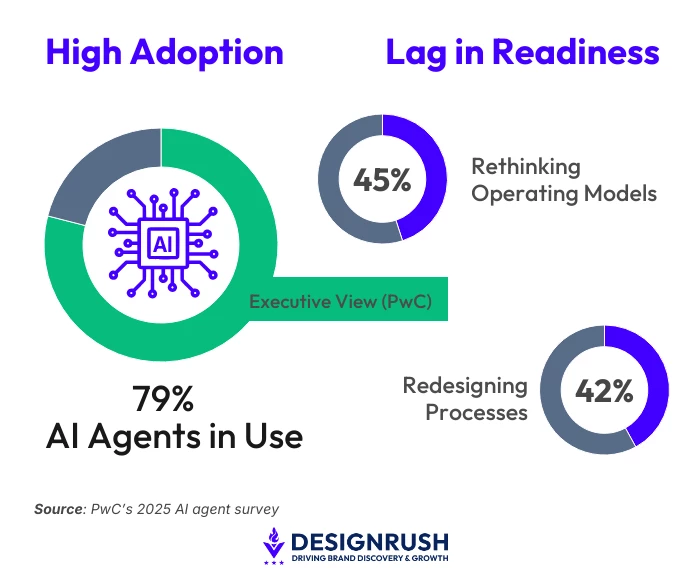
Conversely, about 79% of executives say AI agents are already in use across their companies, yet fewer than half are rethinking operating models (45%) or redesigning processes around those agents (42%), according to PwC’s 2025 AI agent survey.
SiteGround’s findings align with this pattern among small businesses using WordPress, particularly those that adopt AI through plugins, writing assistants, or automation tools without embedding them into end-to-end processes.
“Efficiency improves in isolated tasks, but it doesn’t translate into wider business performance,” Stefanov says.
Why AI ROI Stalls After Adoption
Nearly 60% of executives believe responsible AI improves ROI and efficiency, while half say operationalisation remains their biggest hurdle, according to PwC.
In agency work, AI use is already widespread, but commercial returns haven’t caught up, according to Forrester:
- 75% of decision-makers say most AI tools focus too heavily on individual productivity rather than team-level performance
- 69% say switching between AI tools and core work systems interrupts workflows and reduces practical usage over time
- Nine in 10 US marketing agencies now use generative AI, and half have already introduced agentic AI into execution processes
- 61% still describe AI as a cost of doing business, and only 31% expect to monetise agentic AI within the next 24 months
The pattern mirrors what SiteGround sees among small business respondents, where usage is heavy but commercial conversion remains limited.
Only 28% of AI use cases in infrastructure and operations meet ROI expectations, while 20% fail outright, according to Gartner’s 2026 analysis.
“This means success depends less on the tool itself and more on how it fits into existing workflows, along with executive alignment,” Stefanov says.
“Across these findings, AI value comes down to structure rather than access.”
Tools are widely available. Usage is high.
But the systems that connect these tools into repeatable workflows are still missing in many organisations.
For agencies and developers working in WordPress, the situation is already visible in client expectations. Many clients use AI daily and expect it to sit inside existing services, not alongside them.
What matters now is turning AI use into something steady in daily work without piling on more tools.