
Imagine a lead books a demo with your company, and when you ask how they found out about you, they say something along these lines: “Honestly, I’m not sure. I just kept seeing your name pop up everywhere.”
There’s no UTM code or clear referral, just a deal in your pipeline with no way to trace it.
This is the attribution crisis that generative AI is creating in your sales funnel.
AI answer engines gather information from many sources and give people a combined answer, so no clicks are needed.
This is a problem because marketers have relied on tracking clicks for years.
For leaders focused on revenue, this isn’t just another search trend to ignore until next quarter.
About 70% of CMOs say becoming an AI leader is a critical goal for 2026, while only 30% report mature AI readiness capabilities, according to Gartner.
This suggests that many organizations recognize AI's strategic importance but are still adapting their marketing operations.
It’s happening now, and it’s disrupting the data models your budgets depend on.
Why Traditional Attribution No Longer Works
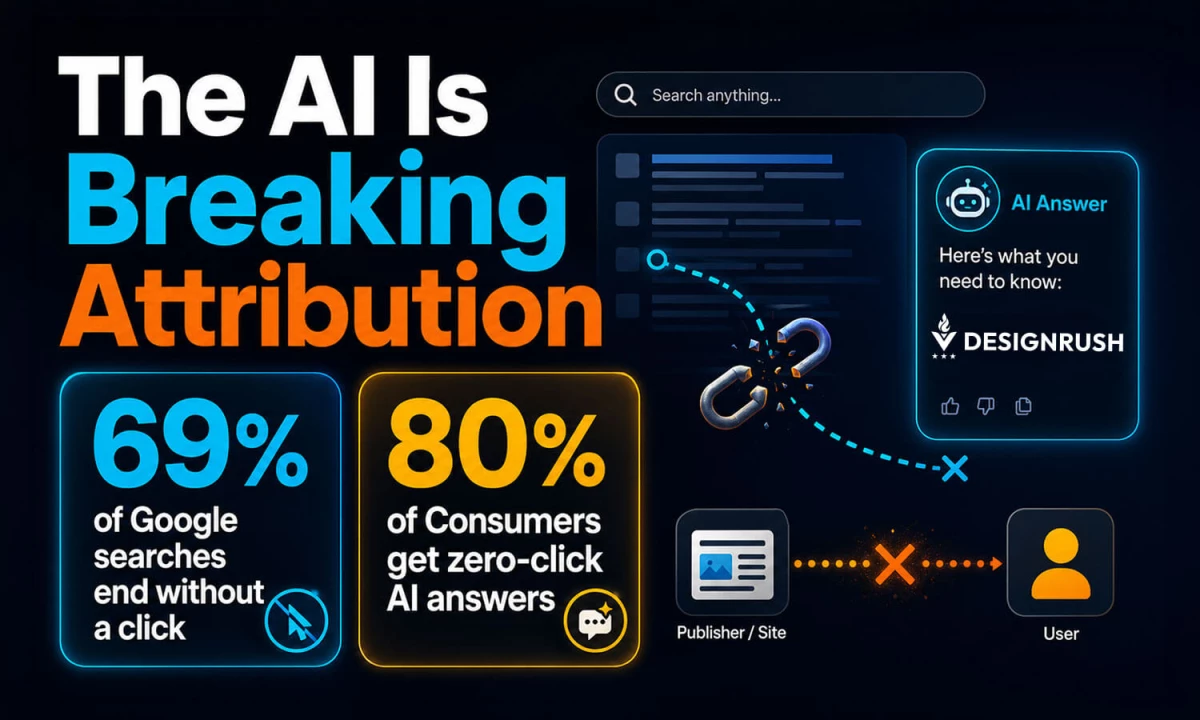
After Google AI Overviews launched in May 2024, zero-click searches rose from 56% to 69% in a year.
Now, just shy of 7 out of 10 Google searches end before anyone visits a brand’s website.
This issue isn’t limited to Google.
Around 80% of consumers now get zero-click answers for at least 40% of their searches, which has caused organic traffic to drop by about 15% to 25%.
Referral traffic to the top 1,000 websites also fell from 12 billion visits in June 2024 to 11.2 billion in June 2025, a 6.7% decrease year over year.
Platforms such as ChatGPT and Perplexity do send some referral traffic, but it’s not nearly enough to replace what’s being lost.
Traditional web analytics are based on a simple idea: Someone clicks a link, and the conversion is credited to that source.
Last-click attribution has its critics, but at least it provided a clear number.
Generative engine optimization (GEO) changes this completely.
When an AI search tool like Google AI Overviews, Perplexity, or ChatGPT creates an answer, it might use your brand’s expertise yet never send visitors to your site.
In one study of 68,000 real search queries, people clicked through only 8% of the time when an AI summary appeared, compared to 15% when it didn’t.
That’s almost half the clicks lost.
The brand that provided the content gets nothing: no referral signal and no session. GA4 can’t record a visit that never happened.
Similarweb found that 35% of U.S. consumers now use AI for product discovery, while only 13.6% use traditional search.
More people are deciding what they want before they even visit a website.
Their shortlist is created in the AI’s answer, not on your homepage.
Why Attribution Is Becoming Probabilistic
When a lead finally gets on a call with your sales team and says, “I kept seeing your name pop up,” there’s a good chance that’s the influence of generative engines working outside any channel you can track.
Your brand informed their decision without creating a session, a form fill, or a UTM parameter.
This is how probabilistic attribution works. There’s no clear referral path.
Instead, your brand keeps appearing in AI-generated answers until a buyer enters your funnel already interested in you.
Here’s the main problem most companies face: Performance teams are measured by click-based metrics, while brand influence is often overlooked.
But this approach no longer matches how buyers make decisions.
What Executives Need to Rethink
The biggest risk right now is misallocating your budget.
If last-click attribution remains the main way you measure success, the channels that build your AI-driven brand authority will seem less effective than paid channels that seize bottom-of-funnel demand.
As a result, budgets shift away from these channels, which hurts the strong, authoritative content that gets you featured in AI answers.
Here are three things worth fixing now:
1. Start treating ‘AI share of voice’ like an actual metric.
GEO experts are already tracking how often a brand:
- Appears in AI-generated answers
- Which URLs are cited
- How brands compare to competitors using tools like BrightEdge, Semrush, and Google Analytics.
Start building a baseline now. This will help you prove your influence later.
2. Pay closer attention to what information leads share during the sales process.
Every lead form should include an open-ended "How did you hear about us?" field. Avoid dropdowns, as they push people toward expected answers.
Open-ended fields let someone write, "I asked ChatGPT which tool was best, and it pointed me to you." No dashboard can capture that level of detail by itself.
3. Build content the way generative engines actually judge credibility.
Content featuring statistics and named sources saw 30% to 40% higher AI visibility than content without them, according to Analyzify.
Clear sourcing and authorship signals can help content gain visibility in AI-generated answers
The Revenue Connection
Accurate attribution is important because it guides your budget.
If you can’t connect AI’s influence to the bottom line, GEO won’t get the investment it needs.
Brands that don’t update their attribution measurement will keep diverting resources away from the content that’s shaping buyers’ decisions.
The companies that succeed won’t always be the ones with the most content.
They’ll be the ones that understand that zero-click doesn’t mean zero impact and that unseen influence still needs to be measured.
One example of this approach comes from brands measuring how often they appear in AI-generated answers and tracking the impact of GEO efforts:
The sooner you build ways to track this, the smaller the gap will be between what’s influencing buyers and what you can prove to the boardroom.