
Marketing reports keep showing lower lead costs. Meanwhile, sales close almost nothing.
The problem is what those dashboards are optimizing for.
The triopoly of Meta, Google, and Amazon will control 62.3% of global digital ad spend this year, per Emarketer.
Within that dominance, Meta is projected to overtake Google in total ad revenue for the first time.
As budgets concentrate on these platforms, ad spending is moving rapidly toward total AI automation.
Systems like Meta’s Advantage+ are gaining widespread adoption because they streamline campaigns and find efficiencies human media buyers miss.
But these black-box AI algorithms introduce a massive strategic trap for lead-generation businesses.
Because AI optimizes strictly for the primary signal it is given, a marketing strategy focused on cheap CPL forces the algorithm to prioritize low-intent volume over actual business revenue.
Here is the technical reality of why the old lead-generation playbook is dead, and why market forces are shifting spend toward high-intent data.
AI Ad Platforms Take Conversion Prompts Literally
Historically, B2C marketing was a numbers game. You drove the highest volume of cheap leads possible and let your internal sales team or call center sort out the mess.
If you run that playbook today, automated ad networks will destroy your margins. Automated systems eliminate manual targeting and bid controls.
Instead, they scan the entire network to find the cheapest possible way to complete your chosen conversion objective.
If you tell Meta or Google that your primary goal is a cheap form fill, the algorithm executes that task perfectly. It will hunt down the users most likely to fill out a form for a nominal cost.
The platform does not know if that lead is a fraudulent form fill, a bot, or a person who misread the ad.
It treats a low-intent click identically to a qualified buyer. Your dashboard shows an incredibly efficient CPL, while your sales team is buried in noise.
The Front-End Cost Per Lead Is a Mathematical Illusion
Agencies and internal media buyers celebrate low CPL because it is the metric they can control most easily.
Broadening targeting or simplifying forms lets anyone make a front-end report look spectacular.
But evaluating a campaign strictly on CPL ignores the only metric that dictates profitability, and that is your cost per acquired customer.
When you look at the actual unit economics, the math consistently favors high-intent, expensive leads over raw volume.
Consider a typical $3,000 monthly ad spend comparison:
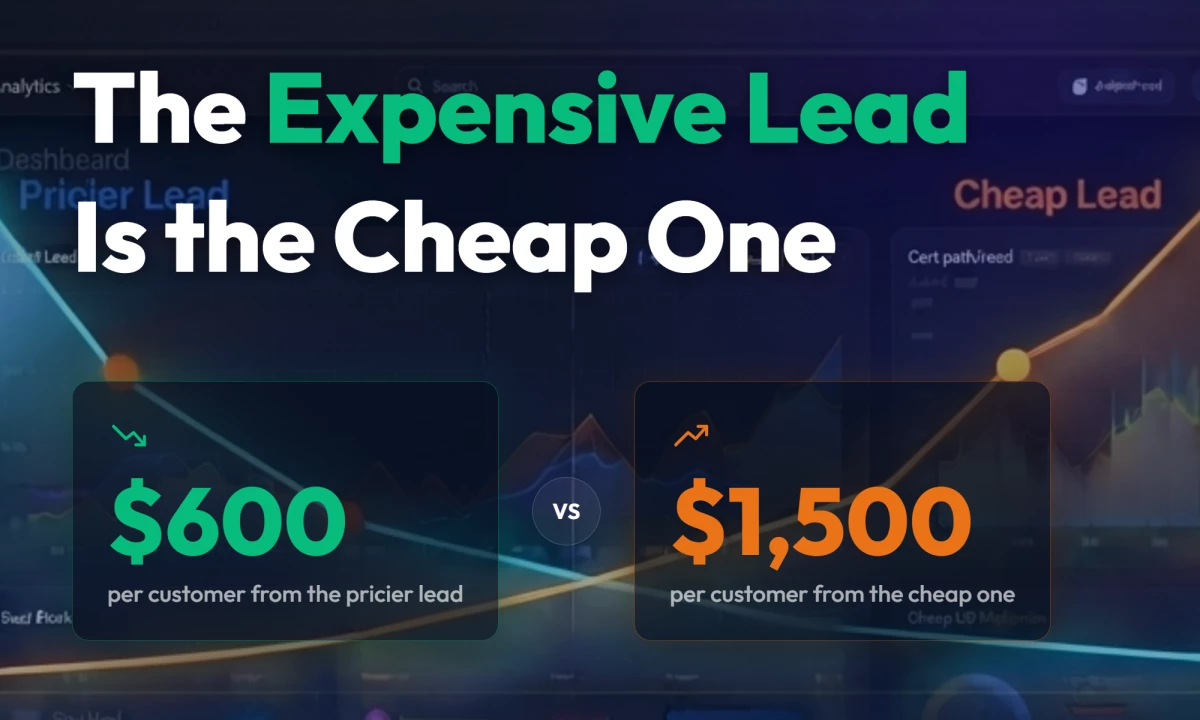
- The volume approach. Broad targeting generates 100 leads at $30 CPL. Low intent means a 2% close rate, or two customers, at $1,500 each.
- The quality approach. Precise targeting drops volume to 20 leads at $150 CPL. High intent means a 25% close rate, or five customers, at $600 each.
The $150 CPL looks alarming in a vacuum, while the $30 CPL looks efficient. Yet the "expensive" approach yields 2.5 times more customers at a 60% lower cost per sale.
Cheap Lead Volume Carries Massive Hidden Operational Costs
The financial penalty of a low-quality lead shows up clearly on a cost-per-customer calculation.
But there is an even more damaging cost that never appears on a marketing report: the operational tax on your sales development team.
Based on what we've seen at Disruptive Advertising, volume-optimized campaigns come at a cost.
Sales reps spend billable hours on data entry and calls to people who were never going to buy. That time represents direct salary waste and a significant opportunity cost.
Worse, bad data fundamentally breaks sales culture. When professionals spend 98% of their day facing immediate rejection from low-intent leads, their confidence deteriorates.
They start expecting failure, and their energy on the few high-value calls becomes defensive.
Furthermore, a pipeline packed with unqualified data makes it impossible for leadership to read meaningful business trends or predict revenue accurately.
Machine Learning Requires Deep Funnel Data Feedback Loop
Artificial intelligence is pushing ad spending toward greater efficiency, but that efficiency requires clean data.
To achieve this, growth leaders are decoupling their marketing success from the initial form fill.
By integrating customer relationship management, or CRM, systems with platform APIs, brands can pass downstream milestones back to ad networks in real time.
That includes signals like "qualified lead," "scheduled meeting," or "closed deal.
When you feed deep-funnel data back into Meta or Google, you change the parameters of the machine learning model.
The automated engine stops chasing cheap clicks and begins targeting users whose online profiles and behaviors mirror those of your actual paying clients.
Front-end CPL numbers will rise, but your cost per sale will drop because the algorithm is no longer wasting your budget on audience segments that do not convert.
Where Growth Leaders Go From Here
As three technology giants command nearly two-thirds of all digital ad spend, surviving the shift to full automation requires immediate structural changes to your measurement playbook:
- Realign team incentives. Move KPIs away from lead volume and front-end CPL. Tie evaluations to sales velocity and qualified pipeline value.
- Build direct CRM feedback loops. Use server-side tracking and platform API integrations to pass sales milestones back to ad networks within standard look-back windows.
- Audit downstream lead quality weekly. If call quality drops, media buyers adjust the algorithm's signals immediately.
The concentration of digital ad spend within automated networks means that data quality, rather than tactical campaign settings, is now the primary driver of digital marketing efficiency.
Brand leaders who continue to judge campaign health by a cheap CPL will watch their budgets get consumed by algorithms optimizing for low-value metrics.
Long-term market profitability belongs to the organizations that feed their deep-funnel sales data directly back to the platforms, turning automated scale into actual revenue.