
Our analysts are now tracking the weekly developments reshaping AI and how it reaches users. Brands building AI products can partner with vetted AI companies to bring their ideas to life.
Microsoft released MAI-Thinking-1, its first reasoning model, almost matching Anthropic's Opus 4.6 on coding benchmarks.
NVIDIA bought Kumo AI, a startup that builds prediction models from a company's own internal data.
Meanwhile, Anthropic called on rival labs to coordinate a verifiable pause, warning that autonomous AI capability is doubling every four months.
Ninety-seven percent of enterprises deployed AI agents in the past year, yet only 23% report meaningful returns.
OpenAI added conversion tracking to ChatGPT Ads Manager earlier this week, opening performance advertising to any U.S. business.
Here is where AI stood this week, in more detail.
Microsoft Builds First Model From Scratch
MAI-Thinking-1 is the first reasoning model Microsoft built from scratch, trained on clean, commercially licensed data with no shortcuts borrowed from other systems.
Running on 35 billion active parameters, it scored 52.8 on SWE Bench Pro, a test of real-world coding ability.
This score nearly matches Opus 4.6's 53.4.
MAI-Thinking-1 is our first in-house reasoning model developed from scratch that is competitive with models of similar size on STEM reasoning and coding tasks.
— Microsoft AI (@MicrosoftAI) June 3, 2026
35B active/1T total MOE.
💻Coding: 52.8% on SWE Bench Pro competitive with Opus 4.6
🧐 Reasoning: 97% on AIME 25… pic.twitter.com/jHPWplLFu5
A smaller model hitting this level changes the economics of running AI.
Companies can now fine-tune it on their own data and host it in-house, replacing recurring API fees with a one-time training cost.
This change puts the advantage in the hands of whoever owns the richest data, since the model itself is no longer the hard part to get.
NVIDIA Grabs Kumo AI for $400 Million
NVIDIA made the same bet on proprietary data with its $400 million acquisition of Kumo AI.
The four-year-old startup builds prediction models from data that companies already hold, like purchase records, supply chain history, and customer behavior.
Its models plug straight into enterprise data warehouses like Snowflake and Databricks, with past clients including Reddit and DoorDash.
A model trained on a company's own behavioral history learns patterns unique to that business, and no competitor can license access to them.
NVIDIA built its empire selling the hardware on which AI runs, so this acquisition shows it sees the next phase of value sitting with the data that companies already own.
Anthropic Warns AI Labs to Slow Down
Anthropic Co-Founder Jack Clark and Anthropic Institute Head Marina Favaro published a June 4 report with a direct ask.
Major AI labs should coordinate a verifiable slowdown in frontier development, and their concern is the pace of innovation.
AI's capacity to handle tasks on its own is now doubling every four months. Just a year ago, the rate was every seven months.
This speed pushes the industry toward systems that can design their own successors without human oversight.
A real pause needs several labs stopping under the same terms, since one lab pausing alone just hands the lead to the others.
OpenAI also made a parallel case two days earlier in a governance blueprint, proposing a permanent federal body to vet frontier models before release.
When two of the biggest AI labs call for government oversight, regulation tends to follow.
Brands should start tracking which AI agents they run and what data these agents touch, since any future law will require exactly this kind of record.
Enterprise AI Hits 54% Adoption
Writer's 2026 enterprise AI adoption survey polled 2,400 executives and employees worldwide.
It found 79% of organizations facing serious adoption challenges, a double-digit jump from 2025.
More than half of C-suite executives say AI adoption is "tearing their company apart."
Almost every company deployed AI agents in the past year, yet only 23% report significant returns.
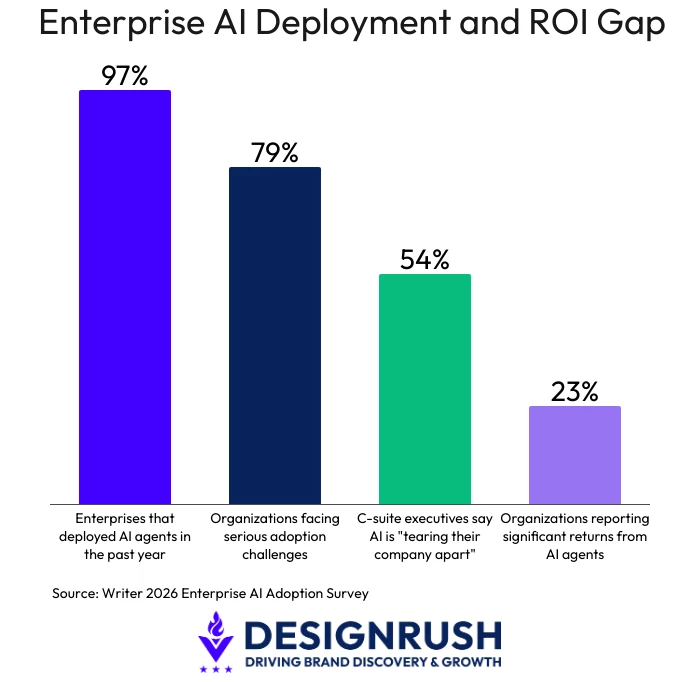
The gap exists because companies rolled out agents before building any system to manage them, and the exposure is measurable:
- No oversight. 36% have no formal supervision plan, so deployed agents make decisions with no defined accountability.
- No kill switch. 35% could not immediately stop a rogue agent that acts on its own or reaches data outside its scope.
- Breaches are already happening. 67% suspect their company suffered a data breach from unapproved AI tools, pointing to internal use as the bigger risk.
AI super-users already deliver five times the output of their peers, so companies should find one workflow where agents act unsupervised and build a review protocol there first.
OpenAI Launches a Deployment Arm
The OpenAI Deployment Company launched in May to solve the oversight gap that's stalling enterprise AI.
The venture is backed by more than $4 billion from 19 investment firms, consultancies, and system integrators.
Through its acquisition of enterprise deployment firm Tomoro, roughly 150 engineers now work directly inside organizations to build on OpenAI's models.
This is a direct revenue opening for agencies.
Deciding which calls an AI agent can make, which need human sign-off, and which stay off-limits is strategic work that comes before any tool gets selected.
The agencies that master this groundwork early claim a service every enterprise will soon need.
ChatGPT Ads Can Now Measure Conversions
OpenAI's self-serve ChatGPT Ads Manager opened to any U.S. business on May 5 with no minimum spend.
The ads run as labeled placements at the bottom of AI responses, targeted by conversation topic and chat history.
This week, OpenAI added conversion-optimized campaigns, which let advertisers track real business outcomes for the first time.
The tracking works through a pixel on the advertiser's own website.
When someone clicks a ChatGPT ad and then buys or signs up, the pixel reports that action back to OpenAI, closing the loop.
The early numbers suggest the channel is worth testing. The pilot already crossed $100 million in annualized revenue within six weeks.
The catch is timing. Many conversions happen well after the click, because a shopper might see an ad in ChatGPT today and buy days later through a different path.
Brands testing now should pair the pixel with survey-based attribution, like a "How did you hear about us?" field, to catch the conversions that fall outside the click path.
Three Moves Worth Making Now
Reading the news is easy, but acting on it is what sets the leading brands apart. So, here's where you can start:
- Treat your data like an asset. Audit what you own before committing to any AI vendor, because your data is the part that competitors can't copy.
- Write the rules before you scale the tools. Define who is accountable for every agent's output now, while the stakes are still low.
- Test new channels while they're cheap to learn. Run small experiments, so you build the instincts that latecomers will pay far more to acquire.
Each move comes down to timing, and the advantage goes to whoever starts before the rest of the market catches on.
Our Take: Is Enterprise AI Moving Fast in the Wrong Direction?
Enterprise AI has a speed problem, and it starts with fear.
Companies are deploying fast because falling behind feels riskier than moving carelessly, so 97% rolled out AI in a year while only 23% saw returns.
We think that the direction isn't wrong, but the order is.
Brands are buying tools before deciding what these tools should touch and who's responsible for their output.
The quiet winners are the ones who slowed down first, mapping their data and accountability before scaling.
Always keep in mind that speed only helps once you know where you're going.
Does your company have an AI strategy, or just an AI budget?
These leading AI companies help brands move from generic AI tools to specialized models trained on their own data.