
US private AI investment reached $285.9 billion in 2025, alongside 1,953 newly funded AI companies, more than 10 times the next closest country, according to Stanford HAI.
Enterprise buyers are betting the same way.
Generative AI spending grew from $11.5 billion in 2024 to $37 billion in 2025, with $19 billion going to AI applications, according to Menlo Ventures.
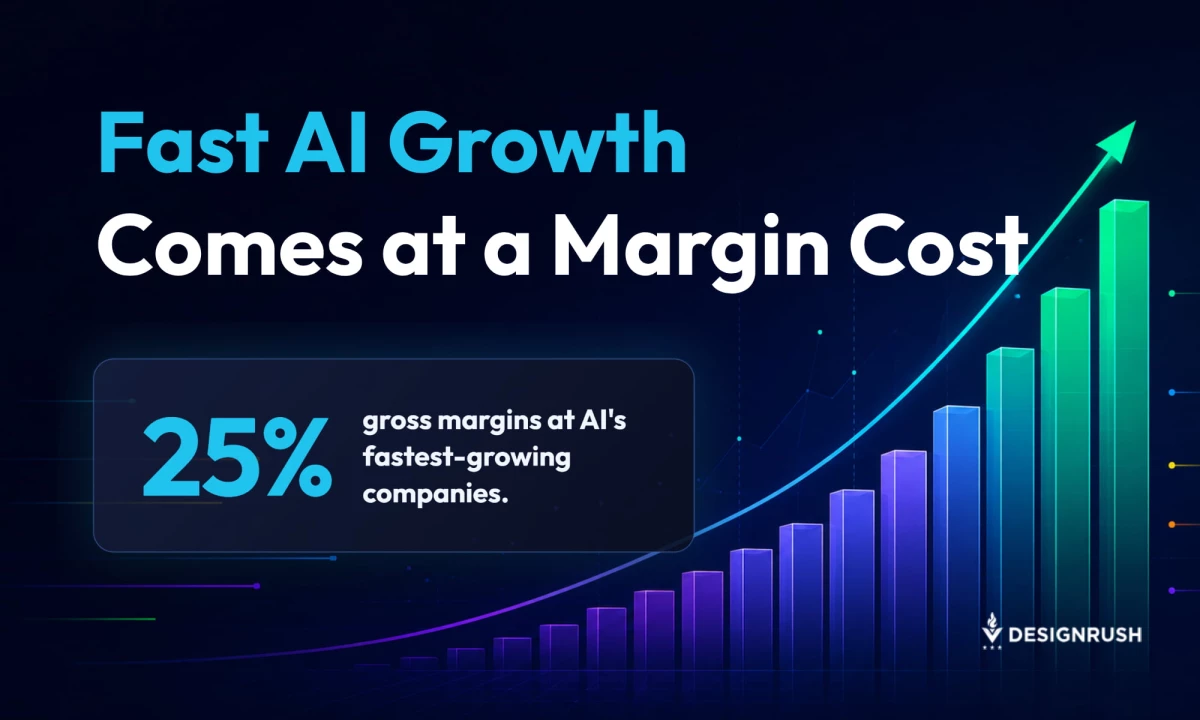
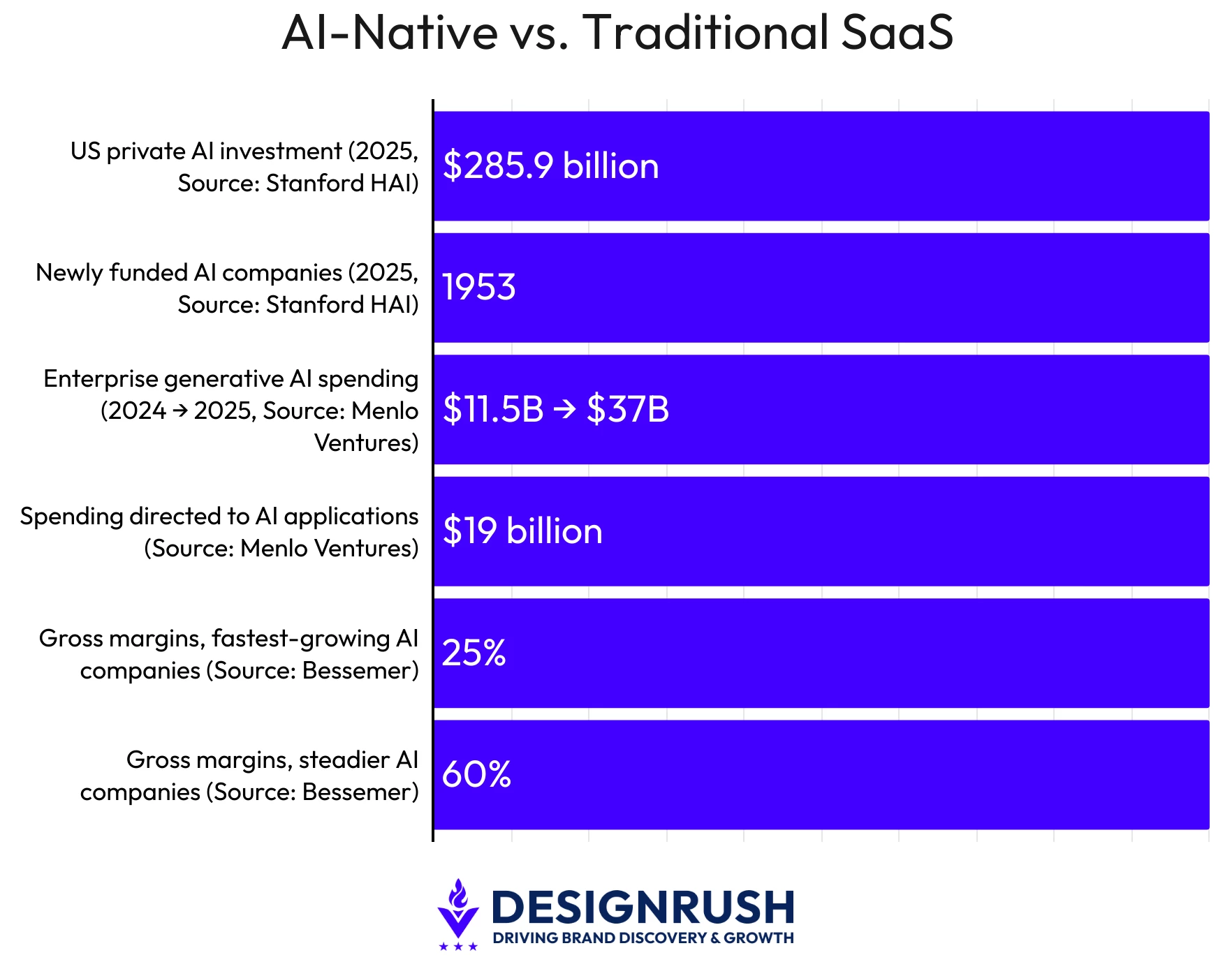 That growth has a cost. Bessemer found that its fastest-growing AI companies reported 25% gross margins, well below the 60% a steadier group reported.
Traditional SaaS helps users manage work, while AI-native products are being built to complete more of it.
That decision carries real risk. The product still has to solve a real problem. It has to keep costs under control. And it has to earn enough trust to stay part of daily work.
Why Traditional SaaS Is Losing Its Edge in Some Workflows
Traditional SaaS made software easier to access and update.
It also helped businesses move important data out of spreadsheets, inboxes, and disconnected systems. But most platforms still leave the difficult work to the user.
A sales tool can show which leads are active, but someone must still decide who to contact and what to say.
A support platform stores past conversations. Reviewing them and preparing a response is still someone's job.
The software organizes information, but it rarely completes the task.
Why Buyers Want Work Completed
Most businesses run separate platforms for sales, support, and finance already.
A new tool has to remove work to earn its place, not just add another interface.
An AI-native finance product can explain why a transaction looks unusual, while a legal product can identify clauses that need closer review.
A sales product can research an account and suggest the next action.
In each case, the product isn't surfacing information for a person to act on. It's taking the next step itself, which is the shift buyers are increasingly willing to pay for.
Why AI-Enabled Is Not AI-Native
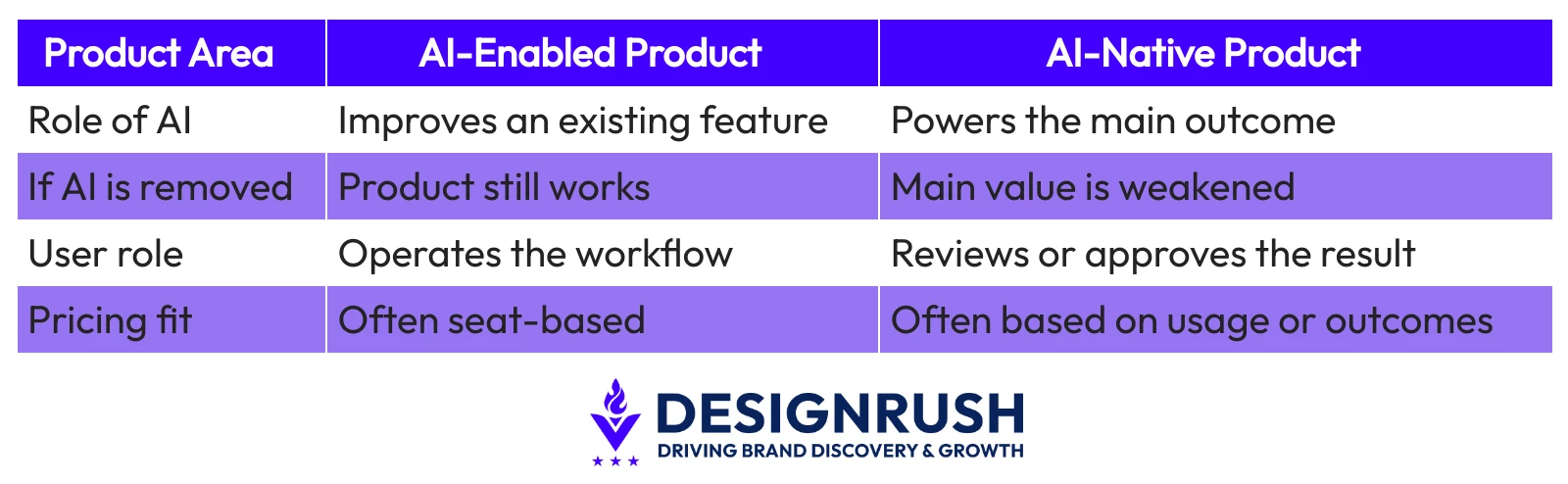
A chatbot added to an existing dashboard does not make a product AI-native. It may be useful, but it remains an added feature.
An AI-powered SaaS development service can still deliver its main value without AI. In an AI-native product, AI is central to the result the customer is buying.
Why US Founders Are Making the Shift
Investment is only part of the story. The stronger signal is that enterprise spending is moving toward AI applications used in real workflows.
That capital isn't sitting in infrastructure.
The Menlo Ventures finding that more than half of spending is going to applications rather than infrastructure is the actual point this section makes.
Why Faster Prototypes Matter
Prototyping moves faster with AI now. Code generation and early workflow testing speed up too.
This lets founders test whether users trust the result before investing in a complete platform.
The real advantage is faster learning, not simply faster development.
A prototype can still fail when it meets poor data, security requirements, unusual requests, or real workloads.
DesignRush reported that 66.7% of surveyed founders prioritized speed to market when testing AI features.
Why AI Can Target Larger Business Costs
Traditional SaaS mainly competes for software budgets.
AI-native products can also reduce costs linked to manual processing, outsourced services, and added operational capacity.
A product that reviews documents or handles routine support requests can connect its value to measurable savings.
Why Context Can Become the Moat
Most founders can access the same foundation models. Far fewer have the same customer data, workflow history, industry knowledge, or integrations.
The model provides capability, but context determines whether it becomes useful and difficult to replace.
Bessemer identifies context, memory, deep workflow integration, and accumulated user knowledge as possible sources of defensibility.
Why AI-Native Growth Changes SaaS Economics
AI-native products can scale quickly, but every model call, data retrieval, or automated task can create a direct cost.
That margin gap is the risk hiding inside fast growth.
A product can sign customers quickly while every new user adds real inference cost, the opposite of how traditional SaaS scales.
Founders need to know how many model calls each workflow requires, whether every request needs an expensive model, and how much review remains necessary.
Why Pricing Must Follow Usage and Value
Seat-based pricing assumes predictable delivery costs.
That assumption weakens when one customer uses AI occasionally, and another runs thousands of tasks each day.
Founders may need pricing based on usage, completed tasks, or outcomes. The right model should reflect both the value delivered and the cost of producing it.
Why the Risks Cannot Wait Until Launch
AI-native products introduce risks that normal software testing does not fully address. A feature can work technically and still deliver a misleading or unsafe result.
Why Confident Answers Can Still Be Wrong
AI models can sound right and still be wrong. That's why products need testing that continues well past launch.
Teams should define an acceptable result and test the product against unclear requests, edge cases, and real conditions.
Why Weak Data Weakens the Product
An AI product depends entirely on the data it can reach.
Missing or outdated information leads to poor results, and unpermissioned data can create legal exposure on top of that.
Founders need to know where the data comes from and whether it's legal to use. They also need a plan for what the product does when information simply isn't there.
Why High-Stakes Work Needs Human Control
The highest stakes are in the legal, financial, and healthcare sectors. A wrong output there needs a person to catch it before it triggers a decision.
Founders also need a fallback for when a model fails or returns a low-confidence result.
Why Not Every SaaS Product Should Become AI-Native
AI-native architecture makes sense when AI directly improves the result the customer is paying for.
It is less useful when AI adds convenience but does not remove meaningful work.
Founders should ask whether reliable data is available, output quality can be measured, and pricing can support the operating cost.
If those answers remain unclear, a focused AI feature may be the more practical choice.
Why Founders Should Validate the Workflow First
Founders should begin with one narrow workflow where the problem, cost, and expected result can be measured.
The first prototype should test the biggest risk, such as data quality, accuracy, user trust, or delivery cost.
Good AI product development starts with the customer workflow, not with a list of model capabilities.
Teams using AI-powered SaaS development services should expect quality and cost to be measured together before the product scales.
For founders comparing SaaS Development Services in US markets, the right team should offer more than engineering capacity.
An AI SaaS development company should question the use case, assess data readiness, and explain how costs may change with usage.
At Bytes Technolab, we work as a Digital Product development partner. That spans product validation, AI opportunity mapping, and solution architecture. It also covers proof of concept development, MVP engineering, and long-term support.
Why Useful Work Will Define the Winners
Traditional SaaS is not disappearing. Businesses still need reliable systems for records, contracts, and finances.
Customer expectations are what's shifting. Specifically, how much of the task they expect the product to handle on its own.
AI-native products can understand a request, use the right information, and move the work toward completion.
US founders are prioritizing this model because buyers place more value on useful outcomes than visible AI.
The strongest products will prove that value without losing control of cost, quality, or trust.