
Your SEO rankings can hold while website traffic keeps falling. For CMOs, the urgent question is what to change when AI gives buyers the answer before they ever reach your site.
In fact, Pew Research Center found that 60% of U.S. adults say they read AI summaries at the top of search results, making AI-generated answers part of the search experience for a majority of Americans.
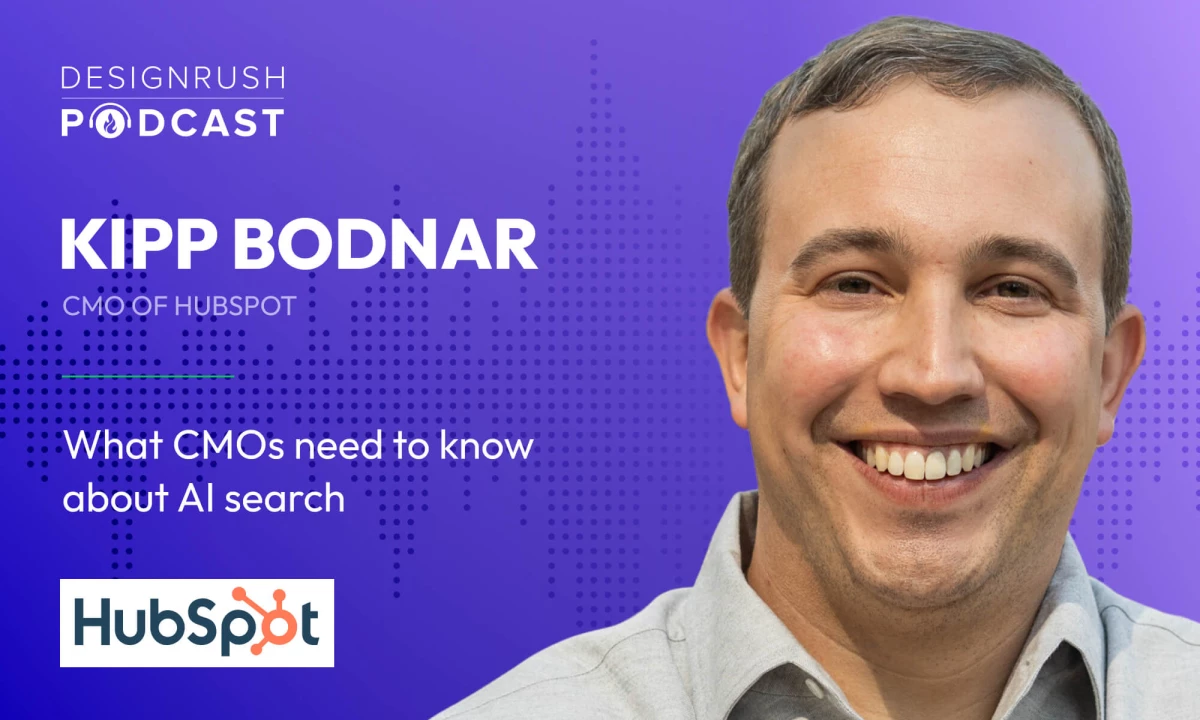
I spoke with HubSpot Chief Marketing Officer Kipp Bodnar in the latest DesignRush Podcast about what companies should change when established marketing channels stop producing the same results.
HubSpot experienced that pressure directly. Bodnar says the company built a search operation generating tens of millions of website visits before traffic began declining rapidly.
“Over the course of a year we lost 140 million visits,” Bodnar tells DesignRush.
The loss forced HubSpot to reconsider how its marketing team tested ideas, distributed content, used AI, and decided what deserved continued investment.
Bodnar says the Loop framework first appeared in an internal memo that brought together the experiments HubSpot had run and what the team had learned about how AI was changing marketing.
Those ideas became part of Loop: Outlearn. Outmarket. Outgrow., his book with Kieran Flanagan.
That means giving new ideas a clear test, a defined window, and a reason to keep or drop them.
Watch the full episode now on YouTube or listen on Spotify.

Who Is Kipp Bodnar?
Kipp Bodnar is HubSpot’s Chief Marketing Officer, leading global strategy for awareness and demand.
He previously served as VP of Marketing, overseeing worldwide demand generation and establishing HubSpot’s EMEA and APAC marketing teams. He also advises SaaS companies and holds a BA in Journalism from Marshall University.
Run AI Tests in Six-Week Sprints
AI gives marketing teams an enormous number of possible tactics. Bodnar says the danger is spreading attention across all of them.
“You need focus bets. You need a lot of them, but you don't need (to say), 'I'm just gonna do everything under the sun',” Bodnar says.
HubSpot moved much of its work into six-week sprints. Teams start with a thesis, test it within a defined period, and look for early evidence that the idea deserves another round.
“You want to have a clear thesis and you want to test it in a very short period of time to see if there's any sparks,” Bodnar adds.
If the evidence appears, the team keeps testing. If it does not, Bodnar says the company should stop quickly.
“If it is, then you do it again and you keep learning and compounding. If it isn't, you kill it really quickly so you can go try something else.”
Every AI test needs a thesis, a deadline, and a decision attached to the result.
DesignRush recently examined AI search measurement, including citations, user experience, agent readiness, and downstream business outcomes.
Use AI to Improve the Work
Bodnar does not see AI’s value only in finishing the same task in less time.
A piece of writing that once took two days may still take him roughly a day and a half. AI gives him the ability to review far more possible versions during that time.
“But the end thing is ten times better.”
“I have gone through a hundred versions instead of five.”
He also uses specialized AI agents as editors, including a cold-read agent that checks whether an argument makes sense without the context that produced it.
His point is useful for executives evaluating AI investment.
The better question is whether AI improves the finished work and the decisions around it, not only whether it removes hours from a task.
DesignRush reported a related problem in AI content production, where faster output can create extra review work when teams lack clear brand rules and human oversight.
Keep Taste and Judgment Human
Bodnar says AI has made acceptable content easy to produce.
“AI can make 'okay' stuff infinitely.”
That raises the standard for work that earns attention.
“You have to create more than you've ever created at a higher quality.”
AI can absorb customer information, brand guidelines, campaign history, and previous creative work. Bodnar still sees several decisions as distinctly human.
“Taste, judgment, point of view, perspective, those are the things.”
“AI can give you some insights to help guide you in that, but it can't do that for you.”
A company needs a clear point of view before software can reproduce it consistently.
That also matters for discoverability. DesignRush recently examined source eligibility in AI search and why established SEO alone does not guarantee that a brand becomes a source inside AI-generated answers.
Ask Agencies for Judgment and Systems
Bodnar believes AI also changes what companies should expect from agency partners.
“They used to hire agencies for their taste, their judgment, their unique insights in the market; the pulse that they have in seeing how marketing works across all these clients, right?” Bodnar says.
He expects agencies to pair that judgment with specialized AI systems and processes that internal teams may not want to operate alone.
Creative volume is one example.
“What I'm seeing from all the best advertisers I'm talking to is...'I need a thousand ads now'.”
Advertisers he speaks with are asking for large numbers of creative variations because AI targeting increases demand for creative diversity.
For CEOs and CMOs, the agency relationship comes down to three questions:
- What insight does the partner bring?
- What system can it run repeatedly?
- How does information from one campaign improve the next?
Agency value increasingly sits in judgment, market insight, and the operating system behind the work.
The question also gets at a larger issue Bodnar sees across marketing organizations.
When asked what CMOs are too scared to admit, his answer was immediate.
“That their old way of doing marketing isn't working.”
In the full conversation, Bodnar goes deeper on:
- The Express, Tailor, Amplify, and Evolve stages of Loop
- Why HubSpot invested in answer engine optimization
- Using AI to simulate buyer reactions before spending
- How HubSpot uses AI agents inside its marketing team
- Why video became essential to HubSpot’s creator strategy
- Which agency services may become harder to justify
- How CIO and CTO involvement is changing agency relationships
He also discusses the experiments that failed and how HubSpot chose its first AI priorities.