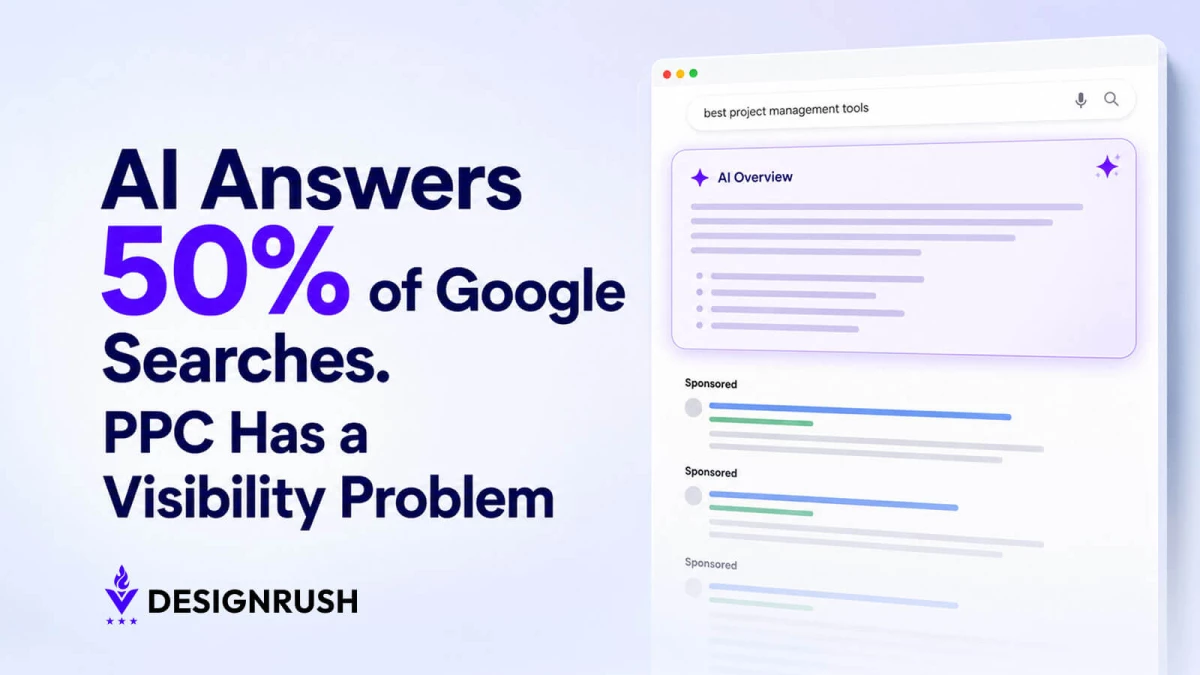

A buyer searches for a product, Google answers the question in an AI Overview, and the paid listings never get the chance to win the click.
So if the search happens inside ChatGPT instead, where does a PPC strategy fit?
AI-generated answers are already appearing across a large share of Google searches.
About 50% of Google searches already return an AI-generated summary above traditional results, according to McKinsey's October 2025 research. The firm expects that figure to reach 75% by 2028.
McKinsey also warns that unprepared brands could lose 20% to 50% of traffic from traditional search as AI-powered platforms take on more of the decision process.
The traditional PPC model relies on capturing search intent, placing an ad in front of it, earning the click and moving the prospect into the funnel.
"Paid search was built around a simple exchange: someone expresses intent through a query, and a brand pays for the opportunity to answer it," says Chad de Lisle, Head of Marketing at Disruptive Advertising.
"When an AI system answers the query first, the valuable real estate isn't necessarily the ad slot anymore. It's the answer itself and the sources the system chooses to reference."
Is AI Replacing Google Search?
Forty-five percent of B2B buyers used generative AI during a recent purchase to gather information about vendors and products, according to Gartner's 2025 B2B Buyer Survey of 645 buyers.
That puts AI inside the buying process, not just on the sidelines as a research tool.
A traditional search sends a buyer through a series of pages, ads and reviews before a decision is made.
Instead of moving between search results, ads, and review sites, a buyer can ask an AI assistant for a recommendation, compare options and get an answer in the same exchange.
As such, many buyers don’t feel particularly compelled to look at the more traditional search results or the PPC ads within the SERPs.
This means committing more to ad spend won’t restore the traffic that never reached the traditional search page in the first place.
For de Lisle, that changes what needs to sit alongside it.
"AI isn't a reason to throw out PPC. It’s a reason to stop treating paid search as the entire visibility strategy," he says.
"The strongest approach still needs disciplined execution inside the ad platforms, while also making sure the brand has useful, authoritative information for AI systems to find and use."
Disruptive Advertising's research and guidance on AI says information from outside a company's website can also be scraped by AI platforms.
The agency points to sources like LinkedIn, YouTube, Reddit and podcasts as examples.
That gives brands more places to be found. The content still needs to be clear and easy to follow wherever it appears.
Disruptive Advertising recommends answering questions directly, using clear headings, keeping things concise and linking related pages so the information is easier to understand and connect.
“That doesn't mean the basics of SEO no longer matter. Brands still need relevant keywords, credible backlinks and content that actually answers what people are looking for," de Lisle says.
The agency also argues that AI systems tend to favor content that answers the question quickly and gives people something useful to work with.
In other words, the content fighting for visibility in AI answers can't rely on traditional search tactics alone.
It has to be useful enough to support the answer itself.
What ChatGPT Advertising Means for PPC
ChatGPT Ads reached a $1 billion annualized revenue run rate in less than 200 days, with tens of thousands of advertisers now using the platform, according to OpenAI.
ChatGPT Ads are now available in more than 40 countries, while self-service access through Ads Manager has expanded across India, Europe, the Middle East, and North Africa. OpenAI also says small and midsize businesses now represent a material share of the advertising business.
That growth gives advertisers another place to reach buyers while they are researching and comparing products.
A buyer could research a product, compare options and see paid placements without leaving the conversation. OpenAI describes this as bringing discovery, consideration and decision-making into a single experience.
There’s no need to move from an AI answer to a Google results page before seeing an ad.
Google isn't disappearing, and neither is the ad auction.
But advertisers can no longer assume that every buying journey starts with a traditional search and ends with a click on a paid listing.
AI can handle parts of PPC management, from bidding and creative testing to forecasting and keyword expansion.
But Disruptive Advertising argues that those tools still need human oversight and a clear marketing strategy.
“The same goes for getting a brand mentioned in AI-generated answers,” de Lisle says.
“Tools can help execute the work, but they can't decide what a brand should be known for, which questions it can answer credibly or what information buyers need before they are ready to act.”
Traditional search still has plenty of life left in it.
The bigger change is that it no longer controls the entire journey from a buyer's first question to the point of purchase.
For advertisers, PPC remains part of the strategy, but it can’t be the whole strategy.
Some buyers will still click an ad.
Others may encounter a brand through the answer that comes before the click.
Want to assess how your current campaigns are performing? Request a free audit to identify opportunities to improve lead quality and connect marketing activity more closely to revenue.