
Our analysts track the ranking and AI search changes that move agency traffic reports. Brands building search programs can partner with vetted SEO agencies for strategic implementation.
This week's changes give agencies more to explain in client search reports.
- Google began rolling out its November 2026 core update, which it says may take up to two weeks.
- The Search Console Generative AI report undercounted impressions from Nov. 9 to 11 because of a logging error.
- Gemini 4 Hydrogen became AI Mode's default model on Nov. 12, with the "hardest" AI Overviews questions running on it too.
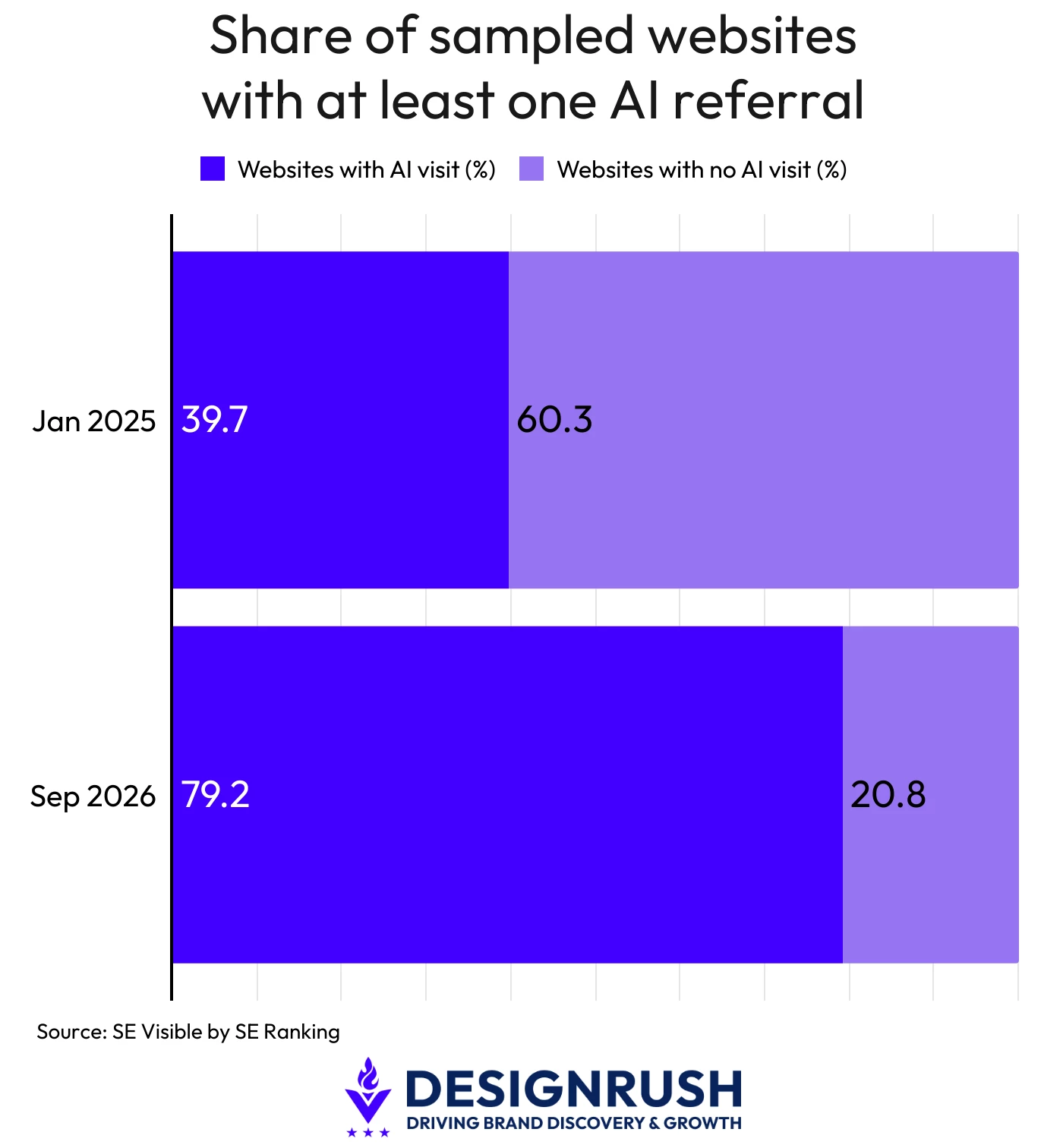
- SE Visible found that 79.2% of 28,500 sampled websites received at least one AI referral in September 2026, up from 39.7% in January 2025.
Which of these causes a genuine visibility loss, and which only imitates one?
Our Take: Can Agencies Explain the Core Update Yet?
Brands should treat any agency explanation of the November core update as a hypothesis until December.
Google's method measures against the week of Nov. 3 to 9, which holds two data problems.
Ahrefs said on Nov. 6, midway through that week, that its page-one ranking data had largely recovered from October's poisoned results.
Search Console's Generative AI report then undercounted impressions on Nov. 9, the baseline's last day.
We don't think any agency can explain the core update yet, since both problems sit inside the baseline week that agencies compare against.
Brands that move holiday budget on a premature diagnosis are acting on bad data.
We'd trust the SEO or GEO agency that names its baseline source and says "not yet."
Google's Ranking Rollout Could Run Into Black Friday
Google began rolling out the November 2026 core update on Nov. 10 at 10:06 a.m. PST, with a rollout window of up to two weeks.
The core updates documentation advises waiting at least a full week after the rollout ends before analyzing Search Console data.
Agencies following that guidance wouldn't have a post-update comparison until around Dec. 1.
The two-week estimate may prove optimistic, since two of Google's last five core updates ran longer, according to its ranking history.
The June and December 2025 updates took about 17 and 18 days, while this year's March and May updates each took about 12.
If this rollout follows the longer 2025 pattern, it could finish on Black Friday or the following day.
Retailers could enter the busiest shopping weekend without a clear explanation for swings in organic traffic.
In-house teams know which holiday promotions launched when, so they should hand that calendar to their agency before any comparison runs.
Logging Error Clips AI Impressions as Rollout Begins
Google's data anomalies page confirms a logging error that lowered impressions in the Search Console Generative AI report for Nov. 9 to 11.
It adds that the error affects data logging only, so any dip in AI visibility numbers on those days reflects missing figures.
The core update began inside this window on Nov. 10.
Google Search Console Generative AI performance report in Search data bug resulted in a decrease in impressions https://t.co/iLukb9B3nq
— Barry Schwartz (@rustybrick) November 12, 2026
Google restored the missing data on Aug. 21 after the same report undercounted Aug. 13 to 17.
If it does the same for November, reported AI impressions will jump, giving brands that pay for AI visibility a gain that no agency work produced.
A longer Search Console bug skewed impressions, CTR, and average position from May 13, 2025, to April 27, 2026, while leaving clicks untouched.
Any year-over-year holiday report sits on both sides of this fix, so clicks give agencies the cleaner comparison.
In-house analysts can run this click comparison themselves before an agency's holiday recap arrives.
Gemini 4 Hydrogen Becomes the Default Answer Model
Google made Gemini 4 Hydrogen the default model in AI Mode on Nov. 12, VP of Product for Search Robby Stein wrote on X.
Stein added that the model also answers the hardest AI Overviews questions.
(1/6) The biggest model upgrade to Search yet has landed. Gemini 4 Hydrogen is here, and brings cutting-edge intelligence to all Search users. It’s now the new default model in AI Mode & being used for your hardest questions in AI Overviews. > Breaks down complicated, multi-part Qs & precisely follows your prompts > Reasoning advancements improve query fan-out to show more links to the web > Much more visual, scannable & highly tailored responses (with comparison tables, charts & more) > Rich understanding of all supported languages I’ve been testing the model behind the scenes and it’s really incredible. It’s one of my favorite models I’ve ever used, and can’t wait for you all to try it! Here are a bunch of examples I found helpful 👇
— Robby Stein (@rmstein) November 12, 2026
Google's announcement says that Hydrogen improves query fan-out, the related searches that run behind each answer, so users reach a wider mix of links.
Neither the post nor Stein's thread gives a link count or defines "hardest."
Without this definition, no brand can tell which of its queries now run on the new model.
Brands tracking AI Mode citations through search engine marketing agencies can test the wider-links claim only against their own numbers.
A Typical Site Gets 2 to 5 AI Visits per 100 From Organic Search
SE Visible, SE Ranking's AI visibility tracker, drew its 79.2% figure from 28,500 websites with organic traffic every month since January 2025.
One AI visit qualifies a site for that share, so the figure shows reach.
Contribution looks smaller, since the typical site with 1,000-plus organic visits a month got two to five AI visits per 100 organic ones.
One in five reached at least five, up from 1.2% in May
SE Visible notes that this ratio also rises when organic traffic falls.
An agency can therefore report a higher AI share in a month when the site lost organic visits.
The study also comes from a vendor that sells AI visibility tracking.
Marketers comparing small business SEO companies should ask whether AI traffic grew or organic traffic shrank.
SEO Industry Insights
Google Search Advocate John Mueller answered a question on Bluesky on Nov. 10 about pages stuck at "currently not indexed."
In a follow-up, he called crawl budget a separate problem connected to severe technical issues.
This distinction tells brands whether an indexing problem calls for a technical SEO specialist or stronger content.
Usually this is a sign that Google's quality systems are unconvinced about your site (or convinced in the way that you don't want). Just making the site smaller doesn't significantly raise the overall quality of the site.
— John Mueller (@johnmu.com) November 10, 2026 at 9:51 PM
Brand sites feed ChatGPT, too.
OpenAI opened its Business Hub in beta on Nov. 10, letting verified businesses see how often ChatGPT mentions them and how many users click through.
Two days later, SEO expert Lily Ray took a first look at the companion agent builder on X.
She said that it pulls "a lot of recommendations out of your website," so setup is "pretty low-effort."
Whatever a brand publishes on its site now becomes the starting script for its ChatGPT agent.
In-house teams can handle the setup, which frees agency hours for auditing the site copy that the agent draws from.
Meanwhile, Anthropic's rule against "deceptive campaigns or artificial activity" took effect Nov. 12.
SEO and AI search consultant Glenn Gabe said on X that he'll watch whether sites using risky tactics to show up in Claude's answers take a hit.
Anthropic's policy against 'deceptive campaigns or artificial activity' is supposed to go into effect today, 11/12/26. Will be interesting to follow to see if sites engaging in risky tactics to game Claude visibility get impacted. Stay tuned. https://t.co/nKPFTNCxC3
— Glenn Gabe (@glenngabe) November 12, 2026
The usage policy bars using Claude to seed the sources that search engines and AI systems draw answers from.
The ban covers content that misrepresents its "origin, authorship, or independence."
AI tools can publish pages in minutes, but credibility with search engines and AI answers takes far longer to build.
A content marketing agency selling AI visibility should show which of the two its plan delivers.
Agency Reports Need 3 Fixes Before December
Brands that outsource digital marketing can take three lessons from the four days between Nov. 9 and 12:
Hold Edits to Pages That Still Rank
A small dip is no reason to rewrite content that keeps delivering.
Google’s core updates page says a drop from position two to four needs no drastic action and advises against changing material that already performs well.
Annotate Platform Changes Beside the Chart
Every graph a client receives should flag outside events and faulty data.
Google's anomalies page ties the May 7 removal of FAQ rich results to lower impression counts, alongside its logging errors.
Report AI Referrals as Their Own Line
Clients should see answer-engine traffic as a separate row in every summary.
In SE Visible's 1,000-plus group, 75.5% of sites got at least one AI visit per 100 organic ones in September, up from 5.1% in January 2025.
Agencies that set up these reports now give a brand's SEO strategy a clean read when December's comparison arrives.
The shared AI training token in the last SEO roundup is another change that agencies will want dated in their reports.
Which November traffic change at your company has a date and a report behind it?
These leading SEO agencies in our directory help brands date platform changes and separate their effect in Search Console.