
SEO Roundup: Key Findings
- Google’s March 2026 core update finished after a 12-day rollout, showing a milder overall impact despite volatility across some sites.
- A Search Console logging error inflated impressions for nearly 11 months, affecting CTR calculations while clicks remained accurate.
- Sundar Pichai outlined search evolving into an AI agent manager, confirming a shift toward task-based, multi-agent workflows.
Each week, our SEO analysts compile essential search updates for brands tracking performance across traditional rankings and AI answer engines. Companies can connect with vetted SEO agencies for strategic guidance.
Search platforms are rewriting their fundamental architecture this month.
Google completed its first core update of the year, fixed a year-long impression tracking error, and its CEO outlined how search will function as an AI task manager.
Meanwhile, platforms are adjusting how they surface citations, and new research quantifies the ranking gap between human and AI content.
Here's what search teams need to follow this week.
March Core Update Finishes With Moderate Impact
Google's March 2026 broad core update completed rolling out on April 8 after 12 days, affecting sites globally across all languages.
SEO expert Glenn Gabe tracked volatility across previously impacted sites and found the update caused fewer ranking swings than in December 2025.
Google described it as a regular update to surface more relevant content and didn't release new guidance.
Today we released the March 2026 core update. We'll update our ranking release history page when the rollout is complete: https://t.co/tBENzbTqB2
— Google Search Central (@googlesearchc) March 27, 2026
Search Console Bug Inflated Impressions for 11 Months
Google reported a Search Console logging error that overcounted impressions starting May 13, 2025, affecting nearly a year of data.
Clicks and other metrics remained accurate, but the issue skewed all CTR calculations since impressions serve as the denominator.
Site owners should export current data before the fix completes and treat May 13 as a break point when analyzing trends.
Pichai Signals Agentic Future for Google Search
Google CEO Sundar Pichai outlined a future where Search functions as an agent manager during a recent podcast with Stripe.
He described scenarios where information-seeking queries become agentic, with users completing tasks while managing many threads simultaneously.
Shortly after ChatGPT launched in 2023, Gabe also discussed a Jarvis-like future for Search.
Pichai's comments confirm that Search is moving toward this vision where AI assistants handle appointments, research products, and complete complex workflows.
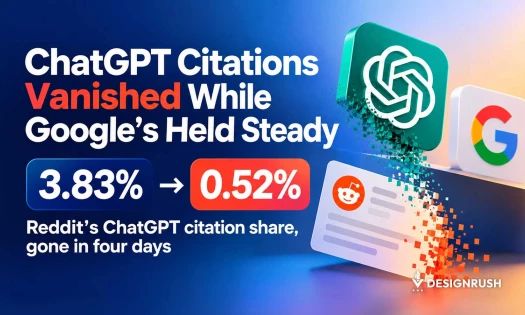
ChatGPT Search Cites Fewer Sites After Model Switch
According to SEO consultancy Resoneo, ChatGPT Search references about 20% fewer websites per response after GPT-5.3 Instant became the default model.
After tracking 400 prompts daily over 14 weeks, the study found that the average unique domains per response is dropping from 19 to 15.
Jérôme Salomon's server log analysis at Oncrawl also confirmed the pattern, showing reduced crawl volumes, with some pages no longer being visited at all.
Google Tests AI Mode Jump From Desktop Overviews
Google is testing direct transitions from AI Overviews to AI Mode on desktop, where clicking “Show more” opens the AI interface instead of expanding results.
The change mirrors a mobile update introduced earlier this year, with SEO expert Brodie Clark documenting the test.
Users can still scroll to traditional results, signaling a deeper push to integrate conversational AI into the core search experience.
Whoa, this is a big change. Google is now integrating the AI Mode experience within the 'All' tab, with the test making the chat function more accessible.
— Brodie Clark (@brodieseo) April 1, 2026
This is as close as we've now come to the "AI Mode as the default", with instead of showing the standard "Dive deeper with… pic.twitter.com/KxKOOOcGQB
Human Content 8x More Likely to Rank First on Google
Human-written content ranks in Google's top position eight times more frequently than AI-generated content, according to new Semrush data analyzing 20,000 keywords.
Human-written pages outperformed AI and mixed content across all top 10 positions. AI-generated content, on the other hand, appeared more often in lower Page 1 positions.
The findings contrast with SEO practitioner perceptions, as 72% of those surveyed reported that AI content performs as well as or better than human content.
SEO Industry Insights
Lily Ray observed that Google's March core update boosted YouTube visibility in AI Overviews, similar to the February Discover core update pattern.
She shared a screenshot showing a rise in YouTube citations in AI Overview results, highlighting Google’s continued prioritization of the platform in AI answers.
DejanSEO also released a free tool allowing brands to check how they rank in Google's AI memory.
It examines brand perception within Google's knowledge systems before content surfaces in AI answers, helping companies establish a baseline for answer engine optimization (AEO).
Gemini's Brand Authority Maphttps://t.co/pCPSrSyFJ8
— DEJAN (@dejanseo) April 1, 2026
These 2,883,072 brands live rent-free in Gemini's parametric memory, ranked by frequency and personalised pagerank. Basic interface for now with plans to develop it further. For brands not known to Gemini we show common crawl…
This week's developments raise three key action items:
- Protect historical performance data. Export and preserve reports before fixes or updates change baselines.
- Track brand presence beyond owned channels. Mentions across forums, video platforms, and reviews now influence visibility in AI systems.
- Prepare for shifting traffic patterns. Changes in AI interfaces and citation behavior can influence how users find and interact with content.
The priority now moves from earning links to securing mentions that AI systems can find and cite, changing how visibility builds across platforms and how it's measured.
Our Take: Are We Optimizing for Machines That Optimize for Us?
We think Google publishing its internal crawler mechanics means the company is acknowledging that technical infrastructure directly impacts discoverability.
The Search Console impression inflation also reveals how fragile our measurement systems remain, even as we build strategies on top of them.
Pichai's agentic search vision suggests that we're moving toward systems that fundamentally change what ranking means.
Still, the human content advantage indicates that Google's algorithms still reward originality and expertise that AI systems can't replicate at scale.
Last week, we covered Googlebot crawling mechanics and Reddit Pro tools.
Check out our previous SEO roundup for analysis on page size growth and Gemini referral traffic.
How are you adapting measurement frameworks for AI-integrated search?
These leading SEO agencies help companies build visibility strategies that work across traditional rankings and emerging AI discovery systems.